Short run metal stamping is a manufacturing process used for low-to-medium production volumes, typically between 500 and 5,000 parts. It utilizes modular, lower-cost tooling to blank, pierce, and form sheet metal components, offering faster setup times and lower upfront engineering costs than progressive die stamping.
For engineers and procurement managers, choosing the right sheet metal manufacturing method is a constant battle between unit price and tooling investment. Laser cutting and press brake forming become too slow and expensive at 2,000 parts, but building a $20,000 progressive die is impossible to justify for mid-volume runs.
Short run stamping fills this exact void. However, to maximize its cost benefits, you must understand the limitations of the tooling. This guide breaks down exactly how to evaluate the process. Below, we cover how to calculate break-even volumes, adjust your CAD designs (DFM) for modular tooling, and structure your RFQ to avoid hidden manufacturing fees.
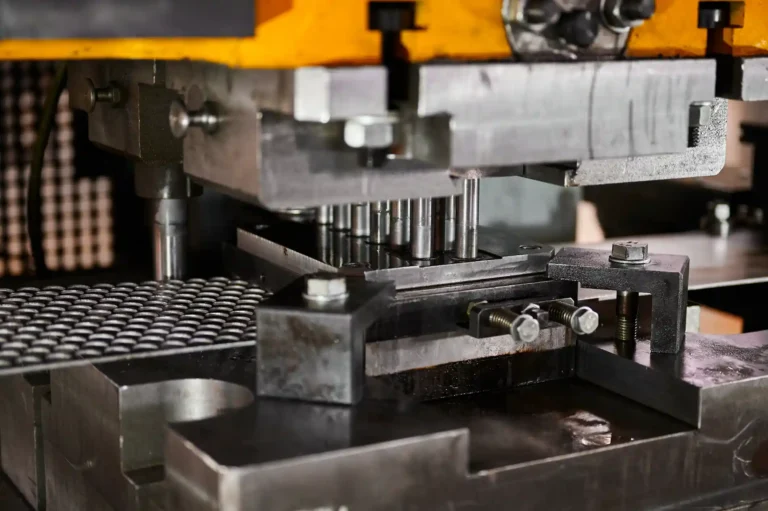
When to Choose Short Run Metal Stamping?
Selecting the right manufacturing method requires evaluating the physical characteristics of your part against your production schedule and cost targets.
Parts and Operations
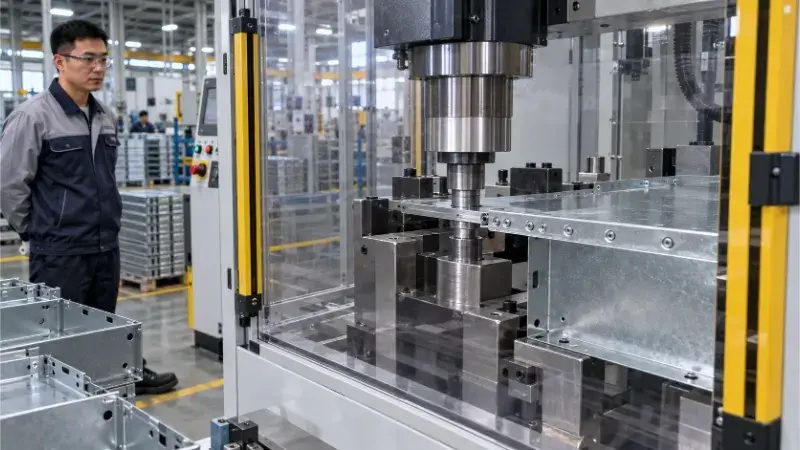
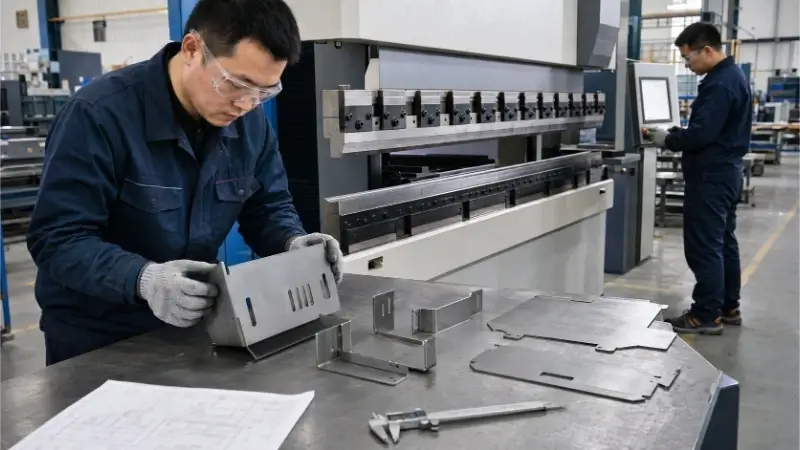
Consider a standard sheet metal mounting bracket. Producing this component usually involves blanking the flat profile, piercing mounting holes, and forming the flanges. While a press brake might take 45 seconds and multiple operator handlings to form the bracket, a stamping press completes the same forms in a 2-second stroke.
Beyond basic speed, stamping becomes the most viable option when the part geometry includes complex features. Extruded holes, embossments, coining, or tight-tolerance hole patterns are difficult to control across multiple manual setups but are easily maintained with dedicated tooling.
Volume and Design Stability
Volume alone does not dictate the process. You must separate your initial run quantity from expected repeat orders and the total life cycle volume. If a design is still undergoing functional testing or frequent revisions, hard tooling presents a financial risk because every engineering change requires modifying the physical tool.
Short run stamping works well for designs that are stable enough to lock in the flat pattern and critical hole locations. This applies even if the total lifetime volume does not justify the cost of progressive dies.
Process Comparison
Selecting a process requires balancing tooling costs against the per-part piece price, design flexibility, and material yield.
Often, a hybrid approach offers the best balance of initial cost and production repeatability. For example, you can laser cut the flat blank for maximum material yield and use a dedicated hard tool for forming.
| Manufacturing Process[cite: 20] | Best Used For[cite: 20] | Tooling & Setup Cost[cite: 20] | Unit Cycle Time[cite: 20] | Material Yield[cite: 20] | Design Flexibility[cite: 20] |
|---|---|---|---|---|---|
| Laser Cutting & Press Brake[cite: 20] | Prototypes, highly variable designs, volumes under 500[cite: 20] | None / Very Low[cite: 20] | Slow (Minutes)[cite: 20] | High (Tight nesting)[cite: 20] | Excellent (Easy CAD updates)[cite: 20] |
| CNC Punching[cite: 20] | Panels with standard hole patterns, low-to-mid volume[cite: 20] | Low (Standard tooling)[cite: 20] | Moderate[cite: 20] | Medium[cite: 20] | Good (Tool changes for new features)[cite: 20] |
| Short Run Stamping[cite: 20] | Mid-volume runs (500–5,000), stable designs, repeat orders[cite: 20] | Moderate[cite: 20] | Fast (Seconds)[cite: 20] | Medium (Requires web/carrier)[cite: 20] | Limited (Requires tool modification)[cite: 20] |
| Progressive Die Stamping[cite: 20] | Mass production (50,000+), locked designs[cite: 20] | High[cite: 20] | Very Fast[cite: 20] | Low/Medium (Strip layout dependent)[cite: 20] | Poor (Costly die rework required)[cite: 20] |
How to Calculate Short Run Stamping Costs?
Comparing total costs requires evaluating both the initial engineering investment and the recurring production expenses across the life of the project.
Tooling and Setup
A short run quote separates non-recurring engineering (NRE) costs from the recurring setup fees applied each time a new batch is ordered. Short run tooling costs significantly less than progressive dies because facilities use master die sets (universal shoes). Instead of building a complete custom die block from scratch, engineers only machine the specific punch and die inserts required for your part.
However, you must still account for production handling. Because short run tools often rely on manual loading or multi-stage transfers rather than continuous coil feeding, recurring setup and operator handling time remain visible cost factors in smaller production runs.
Complete Part Costs
The per-piece price extends beyond the press stroke. A complete cost analysis must account for material yield, inter-operational handling, and secondary processes like hardware insertion, tapping, or surface finishing.
When evaluating quotes, confirm exactly what the piece price covers. Check whether it includes all necessary post-processing, deburring, and final inspection steps required to yield an assembly-ready component.
Break-Even Volume
To evaluate cost efficiency, calculate the total cost (Tooling Cost + [Unit Price × Volume]) across different manufacturing methods. For a standard formed bracket, laser cutting offers zero tooling cost but a higher piece price due to slower machine and operator time.
Short run stamping introduces a moderate tooling fee but sharply reduces the unit price. Depending on the complexity of the part, the break-even point where stamping becomes cheaper than fabrication usually falls between 1,000 and 5,000 parts.
Hypothetical Cost Comparison for a Formed Steel Bracket
| Order Quantity[cite: 21] | Laser Cutting (Total Cost)[cite: 21] | Short Run Stamping (Total Cost)[cite: 21] | Progressive Stamping (Total Cost)[cite: 21] | Most Cost-Effective[cite: 21] |
|---|---|---|---|---|
| 500 Parts[cite: 21] | $1,250[cite: 21] | $2,200[cite: 21] | $12,075[cite: 21] | Laser Cutting[cite: 21] |
| 2,000 Parts[cite: 21] | $5,000[cite: 21] | $3,400[cite: 21] | $12,300[cite: 21] | Short Run Stamping[cite: 21] |
| 10,000 Parts[cite: 21] | $25,000[cite: 21] | $9,800[cite: 21] | $13,500[cite: 21] | Short Run Stamping[cite: 21] |
| 50,000 Parts[cite: 21] | $125,000[cite: 21] | $41,800[cite: 21] | $19,500[cite: 21] | Progressive Stamping[cite: 21] |
> Note: Actual break-even points shift based on material gauge, tolerance requirements, and whether standard or custom tooling inserts are used. This model assumes a laser cost of 2.50/unit; Short Run Tooling at 1,800 + 0.80/unit; and Progressive Tooling at 12,000 + $0.15/unit.
How Tooling Affects Accuracy and Repeatability?
Short run stamping should not be confused with temporary “soft tooling.” The tooling strategy directly determines the physical accuracy of the part and how consistently that accuracy is held across the entire batch.
Tooling Options
Facilities use different tooling configurations based on the part’s geometric tolerance requirements. Single-hit dies perform one operation per stroke, which is cost-effective but requires more handling. Compound dies can blank and pierce a part simultaneously, ensuring perfect concentricity between the outer profile and internal holes.
To keep costs down without sacrificing rigidity, engineers mount custom hardened steel punches and die blocks into standard master die sets (universal shoes). This approach separates the cutting tools from the base structure, providing the alignment and stability of a permanent die at a fraction of the cost.
Location and Transfer
Moving a part between multiple single-hit operations introduces positioning errors. Every time an operator unloads and reloads a blank, tolerance stack-up occurs.
Toolmakers control this movement using locating pins (pilots), nesting blocks, and physical stops. To ensure consistency, ensure your CAD datums match the actual physical locating points used on the shop floor. To minimize transfer errors entirely, always try to design critical features—like a mounting hole pattern and its corresponding alignment tab—so they can be pierced or formed in the same press stroke.
Wear and Maintenance
As production scales, tooling wear directly impacts part quality. The first signs of dulling punches are usually increased burr height, dimensional drift, or surface scoring (galling) on the metal.
Maintenance frequency depends heavily on material type, tool clearance, and lubrication. Stamping abrasive materials like high-tensile stainless steel might require punch sharpening every 3,000 strokes, while soft aluminum with proper lubrication can easily run 15,000 strokes. For buyers, understanding tool life is critical because sharpening punches mid-run adds unquoted downtime to your delivery schedule.
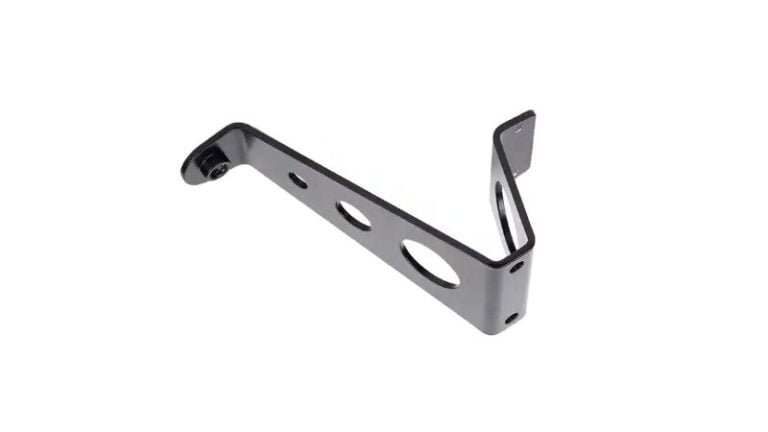
How to Design Parts for Reliable Stamping?
Applying Design for Manufacturability (DFM) rules early prevents cracking, distortion, and the need for expensive secondary operations.
Materials and Bends
Material selection dictates how sheet metal behaves in the press. You must account for alloy grade, temper, thickness, and the rolling grain direction.
Bending metal across the grain prevents cracking, especially in harder tempers. Additionally, springback varies widely between material batches. The final flat pattern and bend deductions must always be verified against the physical tooling on the shop floor, not just assumed from CAD software calculations.
Holes and Reliefs
There is a strict golden rule in metal stamping: never design a pierced hole with a diameter smaller than the material thickness (a 1:1 ratio). Attempting to punch a 0.040″ hole in 0.060″ steel will simply snap the punch. If a smaller hole is functionally required, it must be drilled or laser-cut as a secondary operation.
Proximity matters just as much. Punching holes too close to a bend line causes the hole to pull and distort during forming. Keep the edge of any hole at least 1.5 times the material thickness plus the bend radius away from the bend line. Likewise, always design bend reliefs that are at least twice the material thickness in width to prevent the metal from tearing at the flange corners.
Tolerances and Secondary Operations
Clearly define your critical-to-function datums on the drawing. While short run stamping holds consistent standard tolerances (often ±0.005″), demanding tighter variances will trigger secondary operations.
A pierced hole meant for a precision bearing fit, for example, will likely need secondary reaming. If the part has strict cosmetic requirements, explicitly call out the cosmetic faces on the drawing. This allows the manufacturer to apply protective films and adjust die clearances to avoid tool marks.
How to Inspect Short Run Stamped Parts?
Translating engineering tolerances into a physical inspection plan ensures both the manufacturer and the buyer agree on what constitutes an acceptable part.
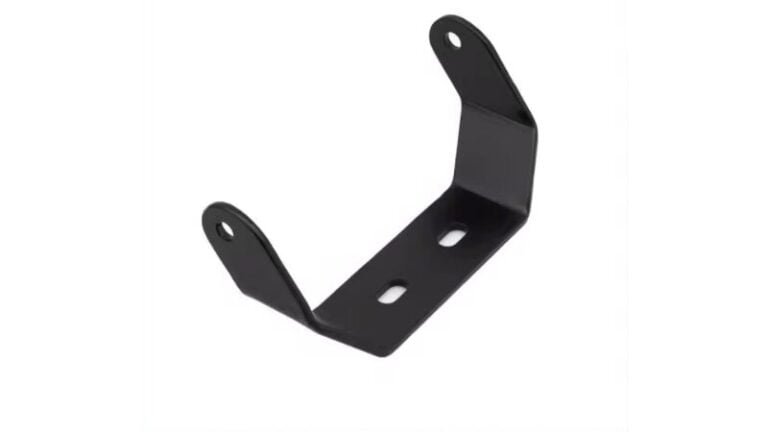
First Article Approval
Before running a batch of 5,000 parts, the manufacturer must prove the process. A First Article Inspection (FAI) report locks in the baseline by verifying the raw material, critical dimensions, bend angles, and physical assembly fit.
Approval must tie directly to a specific drawing revision. If the drawing updates, the FAI process must reset for the affected features to ensure the physical tooling matches the new geometry.
In-Process Checks
Operators do not measure every single part in a multi-thousand-piece run. Instead, quality control establishes an in-process sampling plan—such as checking critical features every 100 strokes or at the start of a new shift.
For complex hole patterns, custom Go/No-Go check fixtures are often built. If the part drops onto the fixture pins smoothly, it passes. This provides 100% functional verification in seconds without taking up expensive CMM time. If a dimension drifts out of tolerance due to a dull punch, the operator halts the press, sharpens the tool, and documents the corrective action before resuming production.
Edges and Surfaces
Burrs are an inevitable physical result of shearing metal. Instead of requesting “no burrs,” define the maximum allowable burr height (typically 10% of the material thickness) and specify which side of the part the burr should face to avoid interference in assembly.
For cosmetic requirements, clearly identify the primary visual A-surfaces. Establishing physical boundary samples—actual stamped parts that show the maximum acceptable limit for scratches, tool marks, or edge rollover—helps both sides understand acceptable conditions far better than text descriptions.
Standard Short Run Stamping Acceptance Checklist
| Inspection Category[cite: 22] | Verification Method[cite: 22] | Acceptance Criteria[cite: 22] |
|---|---|---|
| Material Base[cite: 22] | Mill Certificate Review[cite: 22] | Matches specified alloy and temper[cite: 22] |
| Critical Dimensions[cite: 22] | Calipers / CMM[cite: 22] | Within stated 2D drawing tolerances[cite: 22] |
| Hole Positions[cite: 22] | Go/No-Go Check Fixture[cite: 22] | Pins pass through datums without force[cite: 22] |
| Edge Condition[cite: 22] | Visual / Micrometer[cite: 22] | Burr height < 10% of material thickness[cite: 22] |
| Cosmetic Surface[cite: 22] | Visual (Boundary Sample)[cite: 22] | No deep tool marks on specified A-surfaces[cite: 22] |
How to Request and Compare Stamping Quotes?
A comprehensive RFQ prevents hidden costs and allows procurement managers to compare bids accurately. Missing information always translates to assumed risk, which manufacturers price into your quote.
Drawings and Requirements
A 3D CAD model shows the shape, but the 2D PDF drawing dictates the cost. Provide both. The 2D print must explicitly state the drawing revision, material grade and temper, thickness, and any required surface treatments.
Highlight the critical-to-function features. By identifying which three or four dimensions actually affect assembly, you allow the toolmaker to focus their engineering effort where it matters most.
Expert Pro-Tip: Keep in mind that secondary finishes like anodizing or zinc plating often carry minimum lot charges. Processing 500 parts might cost the exact same overall as processing 1,500 parts at the plater.
Quantities and Delivery
Always separate your immediate run quantity from your expected annual demand. If you need 5,000 total parts but want them delivered in batches of 1,000, state this clearly. Ordering smaller batches increases the frequency of press setups, which will raise the unit price compared to running all 5,000 parts at once.
Specify your packaging needs upfront. Bulk-dumping heavy metal parts into a gaylord box is cheap but risks cosmetic scratching and bent flanges. Layer-packing with dividers protects the parts but increases shipping volume and handling costs.
Tooling Terms
Tooling ownership is a major procurement blind spot. Clarify upfront whether you are paying for the physical master die set, or just the custom punch and die inserts.
You must also confirm terms for tool maintenance, storage, and revision modifications. If your product volume eventually scales to require a progressive die, ask if the manufacturer can reverse-engineer the short-run data to accelerate the new tooling design.
Expert Pro-Tip: Ensure your contract states that upon payment, you own the custom tooling inserts and have the right to transfer them to another facility if necessary. Clear ownership prevents vendor lock-in.
Ready to bridge the gap between prototype and mass production?
Send us your 3D models, 2D prints, and expected volumes. Within 24 hours, our engineering team will provide a comprehensive DFM review, highlight potential cost-saving opportunities, and deliver a transparent quote detailing exactly what you pay for tooling versus the unit price.
Hey, I'm Kevin Lee

For the past 10 years, I’ve been immersed in various forms of sheet metal fabrication, sharing cool insights here from my experiences across diverse workshops.
Get in touch
Kevin Lee
I have over ten years of professional experience in sheet metal fabrication, specializing in laser cutting, bending, welding, and surface treatment techniques. As the Technical Director at Shengen, I am committed to solving complex manufacturing challenges and driving innovation and quality in each project.