When a sheet metal part transitions from a few prototypes to a run of 50,000 units, the manufacturing strategy has to change. Relying on laser cutting and CNC bending at that volume usually means overpaying for machine time.
Progressive die stamping is often the standard next step. It drives down the cost per part significantly, but it requires a heavy upfront investment in custom tooling. If the design is stable and the volume justifies the cost, it makes sense. If the part geometry is still changing or the total run is small, building a die is usually a mistake.
This guide walks through the mechanics of the process and how to evaluate whether your current project is a good fit.
What Is Progressive Die Stamping?
Progressive die stamping is an automated metalworking process. It uses a single, custom-built die to turn a flat coil of metal into a finished part. Instead of using separate machines for cutting, punching, and bending, the metal moves continuously through one tool, with the finished component dropping out at the end.
How Progressive Die Stamping Works?
The efficiency of the process relies on precise timing and simultaneous operations inside the press.
Feeding the material
The process begins with a coil of sheet metal. An automated feeder pushes the flat metal strip into the stamping press. With every stroke of the machine, the feeder advances the strip by a specific, calculated distance called the progression pitch.
To keep the metal aligned, the tool punches pilot holes early in the process. Locating pins drop into these pilot holes on subsequent strokes, holding the strip securely in place.
Moving through the stations
Inside the progressive die, there are multiple workstations. The metal strip pauses at each station to undergo a specific operation. A typical sequence involves:
- Piercing or Punching: Removing material to create internal holes or cutouts.
- Forming or Bending: Shaping the metal to specified angles.
- Coining: Applying pressure to form tight tolerances or specific surface features.
Throughout this sequence, the partially formed part remains attached to the main carrier strip (also called the web). Keeping the part anchored to the strip allows the material to advance from station to station without losing its orientation.
Completing the cycle
Every station in the die operates simultaneously. When the press cycles down, the first station cuts raw metal while the middle stations form the shape. At the final station, the tool shears the completed part away from the carrier strip.
Because all these actions happen during a single press stroke, the equipment can output parts continuously, making it efficient for large production runs.
When Progressive Die Stamping Makes Sense?
Deciding to build a progressive die is largely a financial decision. It usually comes down to balancing upfront tooling costs against long-term piece price savings.
High-volume production
The primary advantage of a progressive die is cycle speed. Once the press is running, the piece price is usually a fraction of what CNC machining or stage stamping would cost. But designing and machining the custom tool requires a heavy upfront investment.
Your production volume needs to be large enough to absorb that tooling cost. Often, annual runs of 50,000 units or more are where the numbers start to make sense.
Stable part geometry
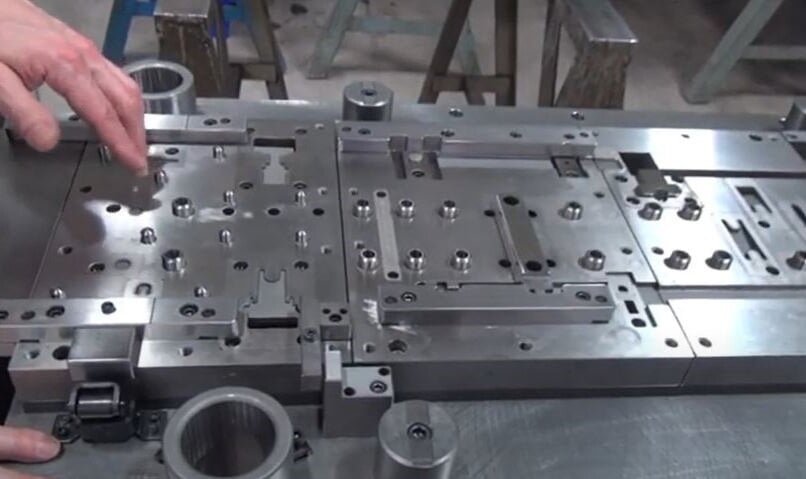
Progressive dies are built from hardened tool steel. They are highly durable, but modifying them later means grinding or wire-cutting hardened blocks, which is expensive and slow.
Building a die makes sense when your design is fully proven and finalized. A stable design allows the hard tooling to do what it does best: stamp consistent parts over a long lifespan, holding tolerances without the variations you get from manual handling.
Long-running repeat orders
Setting up a die in a press takes time. You have to load the coil, thread the feeder, and align the heavy tooling. That setup cost eats into your margin if you only run a few parts.
When you have steady, repeating orders over several years, you can spread that setup cost across thousands of components. Consistent demand helps recover the initial tooling investment and locks in a predictable unit price for the life of the project.
When Progressive Die Stamping Is the Wrong Choice?
Progressive stamping is highly efficient at scale, but it is not very flexible. Pushing a project into hard tooling too early can lead to wasted capital.
Prototypes and small runs
If you only need a few hundred parts, paying for a custom die will artificially inflate your project costs. For smaller batches, laser cutting, turret punching, or CNC bending are usually more practical. Because they require minimal custom tooling, you pay only for the material and machine time you actually use.
Drawings that still change
If your product is still in the testing phase, hole placements, bend angles, and dimensions might shift. Adjusting a progressive die to match those changes is costly and adds lead time. It is usually safer to rely on more flexible manufacturing methods until the engineering drawing is completely frozen.
Deep draws and complex forms
Progressive stamping relies on a continuous carrier strip to move the part between stations. If a part requires a deep draw—like a cylinder where the depth exceeds the diameter—the metal has to stretch. That stretching pulls material from the surrounding strip, which can distort the web and cause alignment issues inside the tool.
What Really Changes the Cost?
A stamping quote breaks down into two main parts: the upfront tooling investment and the ongoing piece price. Knowing what drives both numbers helps you evaluate quotes and spot areas where a slight design tweak can save serious money.
Tooling cost
Building the die is your largest upfront expense, and it scales directly with part complexity. More bends, tighter tolerances, and complex cutouts mean more stations inside the die. Every additional station requires a larger die block, more tool steel, and hours of extra machining and assembly time on the bench.
Material yield
Over a multi-year production run, raw material is usually your biggest overall expense. The strip layout—how the part sits on the metal coil—dictates how much metal ships out as product and how much goes into the scrap bin. A clever layout that nests parts tightly and narrows the carrier strip directly lowers your long-term unit price.
Output rate
Press speed, measured in strokes per minute, directly impacts your piece price. A die engineered to run smoothly at 120 strokes per minute uses half the machine time of one struggling at 60. Hitting those higher speeds requires robust tool design and flawless material feeding, but it drastically reduces final production costs.
Tool maintenance
Progressive dies take a beating and require regular upkeep. Punches dull, springs fatigue, and forming blocks wear down from friction. While using premium tool steel helps extend the time between sharpenings, maintenance frequency is also driven by part design, cut clearances, and material thickness.
Whenever a tool is pulled from the press for repair, production stops. Building the tool for easy servicing and factoring in routine maintenance keeps downtime to a minimum.
Where Production Problems Usually Start?
Even with solid tooling, running thousands of metal parts puts heavy stress on the equipment. When quality issues hit the stamping floor, they usually trace back to a few common culprits.
Burr growth
Cutting edges inside the die slowly wear down over time. As punches and die blocks lose their sharpness, the tool begins to tear the metal slightly rather than shearing it cleanly. This leaves rough, sharp burrs on the part edges.
Operators monitor burr height as a standard quality check. When it exceeds the allowable limit, the die must be pulled and sharpened.
Feeding errors
The automated feeder has to advance the metal strip by an exact distance on every single stroke. If the timing drifts or the strip slips, the locating pins will not align cleanly with the pilot holes. A minor misfeed produces out-of-tolerance parts.
A severe misfeed can cause the press to smash the strip in the wrong position, which can shatter punches and seriously damage the die.
Inconsistent bend angles
Holding a consistent bend requires stable conditions. If the forming blocks inside the die wear down, the bend angles will gradually open up or close.
Beyond tool wear, minor variations in the hardness or thickness of the raw material coil change how the metal springs back after a strike. Operators must constantly monitor these angles to ensure the forming process stays within spec.
Surface damage
When the tool punches holes, the small scrap pieces—called slugs—should fall cleanly through the bottom of the die. Sometimes, suction from the punch pulls a slug back up onto the metal strip.
When the press comes down on the next stroke, it drives that hardened scrap into the surface of the part, leaving noticeable dents and scratches. Designing proper scrap clearance is critical to protecting surface quality.
How Part Design Affects the Result?
A successful stamping project starts at the engineering drawing. A minor design change can sometimes eliminate an entire station from the die, saving thousands of dollars and making production much more reliable.
Strip layout
Before a tool is built, engineers map out how the flattened parts will sit on the metal coil. A tighter strip layout reduces scrap, which lowers your piece price. However, nesting parts too closely leaves very little material for the carrier strip.
If that connecting web becomes too thin, it will stretch or snap as the feeder pushes it through the press, causing immediate shutdowns. The layout has to balance material yield with feeding stability.
Tolerance levels
Applying a blanket tight tolerance across an entire drawing is a common habit that drives up stamping costs. In a progressive die, tight tolerances require highly precise tool construction and frequent maintenance.
This is not only a matter of tight punch-to-die clearances. It also means that forming blocks wear out faster, and operators need to inspect parts more carefully. A practical design keeps tight tolerances only on critical mating surfaces and allows wider tolerances on non-functional edges.
Springback
Bending metal is rarely exact on the first strike. The material naturally wants to open back up after the press releases it, an issue known on the floor as springback. Toolmakers have to over-bend the metal inside the die so it relaxes into the correct angle.
Because springback fluctuates with minor variations in coil thickness and yield strength, specifying a consistent, high-quality material grade helps keep the bending process predictable from batch to batch.
Designing for tool life
Certain part features are notoriously hard on stamping tools. For example, punching a hole with a diameter smaller than the thickness of the sheet metal is a quick way to snap punches. Sharp inside corners create stress points that can crack both the part and the tool steel.
Opening up those corners with radii and keeping hole sizes proportional to the material thickness keeps the press running efficiently and extends the life of the die.
Progressive Die vs Other Options
Progressive stamping is a specialized process. Depending on your part geometry and production volume, another manufacturing method may be a better fit.
Progressive die vs transfer die
Both processes use multi-station dies, but they move the metal differently. A progressive die keeps the part anchored to the carrier strip until the very end. A transfer die cuts the blank free at the first station, using mechanical fingers to move the loose part from station to station.
Because the metal is free to stretch and flow without pulling on a strip, transfer dies are usually a better option for deep-drawn shells, cups, or parts requiring complex forming from multiple sides.
Progressive die vs laser cutting and bending
This decision is primarily driven by volume. Laser cutting and press brake bending require almost no custom tooling. You pay for machine time, which makes them ideal for prototypes, small batches, and parts still undergoing design iterations.
A progressive die requires a heavy upfront tooling investment, but its output speed often makes it highly cost-effective for stable, high-volume production runs.
Progressive die vs CNC machining
These processes handle entirely different types of raw material. CNC machining cuts parts from a solid billet, which is necessary for components requiring varying wall thicknesses, heavy cross-sections, or highly complex internal features.
Progressive stamping is used for sheet metal parts with a uniform thickness. In some cases, a machined block can be changed into a folded sheet metal bracket. This can greatly reduce the part cost in large volumes. However, this change only works if the new sheet metal design can still meet the project’s needs for stiffness, tolerance, and final assembly.
Conclusion
Progressive die stamping can be a very efficient process, but it only works well when the part, volume, and design stage are right for it.
If the geometry is stable, the yearly demand is high, and the goal is to reduce unit cost over long production runs, a progressive die can be a strong choice. But if the design is still changing, the order volume is low, or the part needs deeper or more difficult forming, another process may be the better fit.
If you are planning a sheet metal part and are not sure whether progressive die stamping is the right choice, send us your drawing. Our engineering team can review your part design, yearly volume, material, and tolerance needs. We will then give you clear feedback on whether progressive die stamping is a good fit for your project.
Hey, I'm Kevin Lee

For the past 10 years, I’ve been immersed in various forms of sheet metal fabrication, sharing cool insights here from my experiences across diverse workshops.
Get in touch
Kevin Lee
I have over ten years of professional experience in sheet metal fabrication, specializing in laser cutting, bending, welding, and surface treatment techniques. As the Technical Director at Shengen, I am committed to solving complex manufacturing challenges and driving innovation and quality in each project.