For complex metal components operating in high-pressure or corrosive environments, pure CNC machining from solid billet quickly becomes cost-prohibitive, while forging lacks the flexibility for intricate internal cavities. This is exactly where brass casting dominates the manufacturing floor.
Brass casting is a manufacturing process where molten brass is poured into a mold to create intricate shapes. Renowned for its durability, corrosion resistance, and excellent finish, it is widely used in plumbing, electrical components, and decorative hardware. Common methods include sand casting and investment casting.
This guide helps design engineers and buyers make smart choices based on real data. You can use it to pick the best casting method and the right metal grade for your project. It also shows you how to manage costs, from the initial tool design all the way to final CNC machining.
Why Brass Works Well for Cast Parts?
Before diving into specific production methods, it is important to understand why brass is specified over aluminum, steel, or pure copper. Brass casting is chosen when a part demands a specific combination of durability and processability.
Corrosion Resistance
Brass is a copper-zinc alloy that naturally resists rust and environmental degradation. It does not require protective coatings or secondary surface treatments to survive in wet, harsh conditions.
This natural resistance makes it the industry standard material for plumbing fixtures, pressurized water valves, and marine hardware where long-term reliability is non-negotiable.
Machinability
Cast parts almost always require secondary operations—such as tapping threads, milling flat mating surfaces, or boring tight-tolerance holes.
Brass is famous for its exceptional machinability. It chips easily and dissipates heat well, which translates to longer CNC tool life, faster cycle times, and ultimately much lower secondary machining costs.
Dimensional Stability
Once cast and cooled, brass maintains its structural integrity under varying temperatures and mechanical pressures without creeping or warping over time.
This dimensional stability is critical for heavy-duty fittings, pneumatic system components, and electrical connectors that must maintain tight seals and consistent contact over decades of use.
Surface Finish
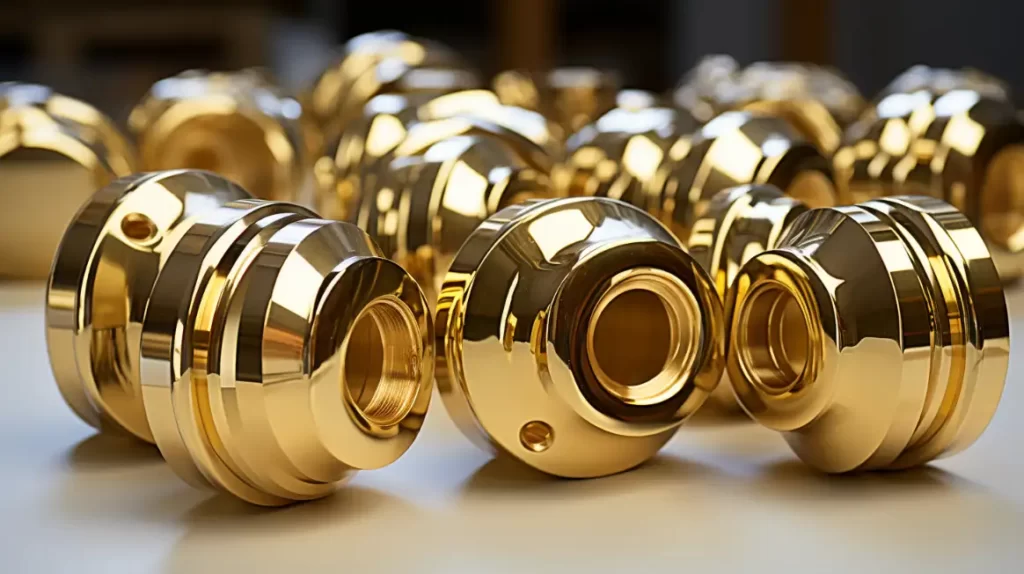
Even in its raw, as-cast state, brass provides a relatively clean surface. With minimal secondary polishing, tumbling, or plating, it achieves a high-end, gold-like aesthetic.
Because it requires fewer finishing steps to look good, it is highly sought after for decorative architectural hardware, lighting fixtures, and consumer goods where appearance drives value.
Choosing a Brass Casting Process
Selecting the right casting method dictates your tooling investment, surface finish, and unit cost. There is no single “best” method; the choice depends entirely on your production volume and the geometrical complexity of your part.
Below is a quick-reference guide for engineers and buyers to compare the core processes:
| Process | Typical Tolerance | Surface Finish (RMS) | Tooling Cost | Ideal Production Volume |
|---|---|---|---|---|
| Sand Casting | ±0.030" | 250 - 500 | Low | Low to Medium |
| Die Casting | ±0.005" | 63 - 125 | High | High (10,000+ units) |
| Investment Casting | ±0.005" | 63 - 125 | Medium | Low to Medium |
| Centrifugal Casting | ±0.010" | 125 - 250 | Medium | Medium (Cylindrical parts) |
Sand Casting
Sand casting is the go-to method for large parts and low-volume production runs. Because it uses expendable sand molds, the initial tooling cost (the pattern) is extremely low, allowing for rapid iterations.
However, the trade-off is a rougher surface finish and wider dimensional tolerances. When designing for sand casting, engineers must include a larger machining allowance to ensure there is enough material to mill down to the final critical dimensions.
Die Casting
Die casting is built for high-volume, standardized manufacturing. Molten brass is forced into reusable H13 tool steel dies under immense pressure, yielding very tight tolerances, excellent surface finishes, and the unique capability to cast thin-walled sections.
While the upfront investment for hardened steel tooling is high, the per-unit cost drops drastically once production scales. It is typically the most economical choice when order volumes exceed 10,000 units.
Investment Casting
Also known as lost-wax casting, this process excels at capturing fine details and complex geometries that would be impossible to machine from scratch. It delivers near-net-shape parts with superior surface finishes.
Because the cast geometry is so close to the final CAD model, it significantly reduces—or entirely eliminates—the need for secondary machining. This makes it ideal for intricate valves and precision aerospace or medical components.
Centrifugal Casting
This process is the superior choice for hollow, symmetrical, cylindrical parts. The mold spins rapidly during pouring, and the centrifugal force pushes the dense molten brass tightly against the outer walls.
This action forces lighter impurities and trapped gases to the inner bore, which is simply machined away later. The result is a casting with a highly dense, fine-grain structure and virtually zero internal porosity, perfect for heavy-duty bearings, gear rings, and industrial pipes.

How to Choosing a Brass Alloy?
Selecting the right brass alloy is just as critical as choosing the casting process itself. The material grade dictates how the part performs under mechanical stress and how easily it can be processed on the shop floor.
C36000 Brass
Also known as Free-Cutting Brass, C36000 is the industry benchmark for machinability. In fact, its machinability is the 100% baseline against which all other copper alloys are measured. It contains a small, controlled percentage of lead, which acts as an internal lubricant to create short, brittle chips during CNC operations.
This chip-breaking capability prevents tool entanglement and significantly extends the life of cutting inserts. If your cast part requires heavy secondary milling, threading, or high-speed turning, C36000 is the most cost-effective choice for threaded fittings, valve bodies, and precision hardware.
High-Strength Brass
Often categorized under manganese bronzes, high-strength brass alloys are modified with elements like aluminum, iron, and manganese. This metallurgical combination pushes the tensile strength far beyond standard commercial brass grades.
These alloys are engineered strictly for heavy-load applications rather than ease of machining. They are the standard specification for high-torque industrial gears, heavy-duty marine valves, and structural bearing components.
Lead-Free Brass
Modern environmental regulations, particularly NSF/ANSI 61 and the Safe Drinking Water Act, strictly limit lead content in plumbing systems. This has forced the manufacturing industry to adopt lead-free brass alternatives, primarily bismuth brass and silicon brass, for potable water fixtures and medical equipment.
While bismuth mimics lead to some extent, silicon brass is notably harder. Engineers and buyers must account for the hidden cost of lead-free compliance: these harder alloys accelerate CNC tool wear, which will inevitably increase your secondary machining costs and cycle times.
Key Stages in Brass Casting
The casting floor is an environment of extreme heat and tight process controls. A failure at any single stage—from mold design to cooling—will result in a scrapped part.
Mold Preparation
Whether packing sand around a pattern or preheating a hardened steel die, mold preparation sets the physical boundaries of the part. The cavity must be scaled up accurately by the tooling engineer to account for the specific shrinkage rate of the chosen brass alloy—typically between 1.5% and 2.0%.
Gating and venting systems are also finalized at this stage. These critical channels dictate how the molten metal flows into the cavity and how trapped gases escape before the metal freezes.
Brass Melting
Brass is melted in a crucible or induction furnace at temperatures typically ranging from 900°C to 1050°C, depending on the specific alloy. Temperature control here is a delicate balancing act that requires constant monitoring.
If the furnace runs too hot, the zinc content begins to boil and vaporize, leading to heavy zinc evaporation. This not only alters the final chemical composition of the alloy but also creates toxic zinc fumes on the shop floor.
Pouring
The transfer of liquid metal from the crucible into the mold must be continuous and controlled. Operators or automated ladles must manage the exact flow rate to maintain a smooth, laminar flow within the gating system.
Excessive turbulence can draw oxygen into the metal stream, creating oxide inclusions and porous defects in the final part. Ultimately, the gating design and pouring execution directly dictate the scrap and yield rates of your entire production run.
Solidification
As the brass cools and transitions from liquid to solid, its cooling behavior dictates the internal grain structure. Sections of the part with different wall thicknesses will naturally cool at different rates.
To prevent internal shrinkage cavities as the material contracts, the mold design must promote “directional solidification.” This ensures that the molten metal freezes progressively toward the risers, which feed additional liquid brass into the thicker sections until the part is fully solid.
Surface Cleaning
Once solidified, the part is ejected or broken out of the mold. The gating system, risers, and any excess flash along the parting line are cut or knocked off the main body.
The raw casting then undergoes shot blasting or tumbling to remove residual sand, scale, and surface oxidation. This final cleaning prepares the part for dimensional inspection and its subsequent CNC machining routing.
Designing Better Brass Cast Parts
The lowest-cost, highest-quality cast parts are optimized long before the metal is melted. Design for Manufacturability (DFM) in brass casting is entirely about managing how the molten liquid flows, cools, and shrinks inside the mold to prevent scrap.
Wall Thickness
Brass alloys experience significant volumetric shrinkage as they cool from a liquid to a solid state. To minimize warping and internal voids, parts must be designed with the most uniform wall thickness possible.
When transitioning between thick and thin sections is unavoidable, use a gradual taper rather than an abrupt step. Sharp transitions create isolated thermal nodes—known in the foundry as “hot spots”—that stay liquid longer than the surrounding areas, virtually guaranteeing internal shrinkage cavities.
Corner Radius
Sharp, 90-degree internal corners are the enemy of any casting process. They create severe stress concentrators as the part cools and shrinks, frequently leading to “hot tears” right at the joint during solidification.
Always design generous fillets (internal radii) and rounded exterior corners. This simple CAD modification allows the molten brass to flow smoothly through the cavity and eliminates stress points, preventing structural failures when the final part is under load.
Draft Angle
A cast part must be physically removed from its mold. Whether you are using a disposable sand mold or a permanent steel die, the vertical walls of your part cannot be perfectly straight (0 degrees).
Engineers must add a draft angle—a slight taper—to all vertical surfaces. A standard draft of 1.5° to 3° is usually sufficient to ensure the part ejects cleanly without tearing the sand pattern or galling against the steel tooling.
Machining Allowance
Castings are rarely the final product; critical mating surfaces and threaded holes must be finished on a CNC machine. However, cast brass develops a tough, abrasive outer skin that often contains microscopic sand or oxide particles.
Your design must include a sufficient machining allowance—typically 0.060″ to 0.120″ (1.5mm to 3mm) depending on the process. The allowance must be deep enough so the CNC cutting tool bites completely under this abrasive skin, rather than rubbing against it and instantly destroying the carbide insert.

Common Brass Casting Defects
Even with perfect DFM, variables on the casting floor can lead to rejected parts. Identifying the root cause of a defect through rigorous Quality Control (QC) is what separates a reliable manufacturing partner from an amateur foundry.
Porosity
Porosity appears as tiny pinholes on the surface or spherical bubbles inside the part. These hidden defects are often only discovered when CNC milling breaks the outer skin, or through X-ray inspection before the parts leave the factory.
This defect is primarily caused by trapped gas. The root cause is usually inadequate mold venting, moisture in the sand, or pouring the brass at too high a temperature, which causes the liquid metal to absorb excessive atmospheric gases.
Shrinkage
Unlike the smooth, round bubbles of gas porosity, shrinkage defects look like jagged, irregular tears or spongy cavities. They almost always occur inside the thickest sections of the part—the thermal hot spots.
Shrinkage happens when a heavy section is starved of liquid metal while it cools and contracts. The solution requires the foundry to redesign the gating system and add larger risers to feed continuous molten brass, ensuring proper directional solidification.
Oxidation
Also known as dross or slag inclusions, oxidation defects appear as dirty, brittle patches embedded in the casting. This severely compromises both the structural integrity and the aesthetic finish of the machined brass.
Oxidation is almost always caused by severe turbulence during the pour. If the molten brass sloshes aggressively through the gating system, it mixes with oxygen. Foundries prevent this by designing gating systems that promote smooth, laminar flow and by using ceramic inline filters.
Misruns
A misrun happens when the molten brass freezes before it can completely fill the mold cavity, leaving the final part with missing features or rounded, incomplete edges.
A closely related defect is a “cold shut,” which occurs when two fronts of cooling metal meet inside the mold but fail to fuse together, leaving a weak, visible seam. Both defects indicate that the pouring temperature was too low, the pouring speed was too slow, or the engineered wall sections were simply too thin.
Zinc Fumes
While not a physical defect on the part itself, zinc vaporization is a critical process failure unique to brass casting. Because the boiling point of zinc is much lower than the melting point of copper, poor furnace temperature control will cause the zinc to violently boil off.
This creates toxic white zinc fumes that pose a severe respiratory hazard (metal fume fever) to shop floor workers. Furthermore, boiling off the zinc alters the exact chemical composition of the alloy, potentially pushing the final casting out of your required material specifications.
Machining After Brass Casting
In modern manufacturing, a brass casting is rarely a finished product; it is essentially a highly optimized, near-net-shape blank. The true precision of the final part is achieved when casting and CNC machining are treated as a single, integrated workflow.
Tolerance Control
Even the most precise die casting processes can only hold tolerances down to about ±0.005 inches. While this is sufficient for raw structural dimensions, it falls short for critical mating surfaces, bearing journals, or valve seats.
Secondary CNC milling and turning are deployed to dial these critical features down to ±0.0005 inches. By casting the bulk geometry and only machining the critical GD&T features, manufacturers drastically reduce CNC cycle times and machine wear.
Thread Machining
Casting internal or external threads is universally avoided because the resulting thread pitch is too rough and prone to binding (galling) during assembly. Instead, holes are cast under-sized and then precisely drilled and tapped on a CNC center.
There is a major commercial advantage here: while secondary drilling removes material, the exceptionally high recycling value of brass swarf (chips) can recover a significant portion of your raw material costs, making this hybrid casting-to-machining route highly economical.
Surface Finishing
An as-cast surface—even from a high-quality investment casting—will have a micro-texture (RMS 63 to 125) that is completely unsuitable for dynamic seals or pressurized fluid retention.
For parts requiring hydraulic sealing faces or precision O-ring mating surfaces, CNC surface milling is mandatory. The machine skims off the cast texture, leaving a flawless Ra 32 (or better) finish that guarantees an airtight, leak-proof assembly.
Machining Allowance
(Note for the shop floor): As discussed in the DFM stage, castings develop a hard, abrasive outer oxide skin. From a machining execution standpoint, this skin dictates the tooling strategy.
CNC programmers must set aggressive initial feeds and speeds to ensure the carbide insert punches completely _through_ this hard crust in the first pass. If the tool is programmed to take too shallow of a cut, it will merely rub against the abrasive skin and destroy the cutter in minutes.
Brass Casting vs Other Manufacturing Methods
Before committing to tooling costs, procurement managers and design engineers must validate that casting is actually the most economical manufacturing route for their specific part geometry and volume.
CNC Machining (From Billet)
If you need 100 simple, blocky parts, do not cast them. Buying extruded brass rod or plate and CNC machining it directly avoids all tooling costs and delivers parts in days rather than weeks.
However, once your volume crosses the break-even point—typically between 500 and 1,000 units—or if the part requires deep internal cavities, pure CNC machining becomes a massive waste of expensive brass stock. At scale, casting is the undisputed champion of material cost-efficiency.
Forging
Forging is a solid-state process where heated brass is smashed into a die under extreme tonnage. This aligns the internal grain structure, resulting in a part with significantly higher impact strength than a casting and absolutely zero internal porosity.
The limitation is geometry and upfront investment. Forging dies cost significantly more than casting patterns—often by a factor of 5 to 10. Unless your part requires the extreme mechanical strength of a high-pressure gas cylinder valve, the massive forging die investment is rarely justified. If internal complexity is required, choose casting.
Bronze Casting
Brass (copper-zinc) and bronze (copper-tin) are visually similar but mechanically distinct. Bronze is significantly harder, highly resistant to saltwater corrosion, and has exceptional low-friction properties, making it the superior choice for marine propellers and heavy-duty gear bearings.
However, bronze is noticeably more expensive than brass and much harder to machine. If the component does not require the extreme wear resistance of bronze, standard brass casting provides 90% of the performance at a fraction of the material and processing cost.
Conclusion
Successfully sourcing and manufacturing brass cast parts is not about finding the foundry with the cheapest per-pound melting rate. It requires a holistic engineering approach: selecting the correct alloy grade for your machining needs, enforcing strict DFM rules to prevent porosity, and calculating the exact break-even point between tooling costs and CNC cycle times.
When designed correctly, a brass casting eliminates material waste, slashes secondary machining time, and delivers a highly durable, corrosion-resistant component that will perform for decades.
Ready to optimize your next brass component?
Don’t wait until the tooling is already cut to discover a critical design flaw. Upload your STEP files under a strict NDA today. Our engineering team will provide a free DFM review, recommend the optimal casting process, and deliver a transparent quote within 24 hours.
Hey, I'm Kevin Lee

For the past 10 years, I’ve been immersed in various forms of sheet metal fabrication, sharing cool insights here from my experiences across diverse workshops.
Get in touch
Kevin Lee
I have over ten years of professional experience in sheet metal fabrication, specializing in laser cutting, bending, welding, and surface treatment techniques. As the Technical Director at Shengen, I am committed to solving complex manufacturing challenges and driving innovation and quality in each project.