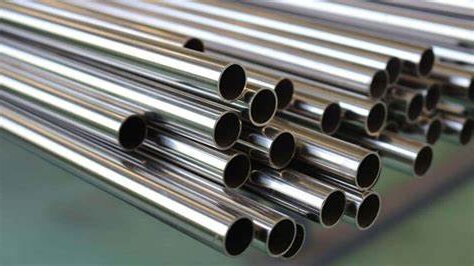
316L stainless steel is a low-carbon, molybdenum-bearing austenitic alloy designed for superior corrosion resistance and excellent weldability. The molybdenum protects against chlorides and pitting, while the maximum 0.03% carbon content prevents sensitization during welding, making it the standard choice for marine, pharmaceutical, and food processing applications.
Despite those clear benefits, we see it misused constantly. Every week, our quoting team reviews RFQs specifying 316L where 304 would work perfectly, driving up raw material costs by 20% to 30% for no functional gain. Conversely, we see designs doomed to fail in the field because 316L was selected for continuous warm seawater immersion instead of a Duplex grade.
For engineering and procurement, 316L should be your baseline choice only when a part requires both heavy welding and reliable performance in wet, chloride-bearing, or harsh washdown environments. If the environment is dry indoors, use 304; if it involves high-stress warm chlorides, upgrade immediately.
TL;DR Material Quick Reference
| Item | Quick Reference |
|---|---|
| Common Designations | UNS S31603 / EN 1.4404 |
| Microstructure | Austenitic |
| Carbon Content | ≤0.03% |
| Molybdenum Content | Typically 2.0% – 3.0% |
| Primary Advantages | Weldability without sensitization; strong localized corrosion resistance |
| Primary Limitations | Higher material cost than 304; rapid work hardening during machining; vulnerable to warm chlorides |
Note: Exact values depend on the material standard (e.g., ASTM A240, ASTM A276), product form (sheet vs. bar), thickness, and condition.
316L Composition, Properties, and Corrosion Limits
The performance of 316L on the shop floor and in the field comes directly from its alloy composition. Understanding these elements explains why it costs more to machine and why it requires specific welding controls.
Low Carbon and Molybdenum
Standard stainless steels rely on chromium to form a protective passive oxide layer. Nickel stabilizes the austenitic structure, improving formability and toughness. 316L modifies this baseline with two critical adjustments:
- Molybdenum (2.0% – 3.0%): Molybdenum stabilizes the passive film in the presence of chlorides (like salt spray or bleach), actively resisting pitting and crevice corrosion.
- Carbon (≤0.03%): Standard 316 allows up to 0.08% carbon. When welded, the heat causes carbon to bind with chromium at the grain boundaries, depleting the surrounding area of its rust protection. This is known as sensitization. The “L” stands for low carbon, which inherently prevents carbide precipitation in the heat-affected zone (HAZ).
| Grade | Chromium (Cr) | Nickel (Ni) | Molybdenum (Mo) | Carbon (C) max |
|---|---|---|---|---|
| 304L | 18.0 - 20.0% | 8.0 - 12.0% | - | 0.03% |
| 316 | 16.0 - 18.0% | 10.0 - 14.0% | 2.0 - 3.0% | 0.08% |
| 316L | 16.0 - 18.0% | 10.0 - 14.0% | 2.0 - 3.0% | 0.03% |
Shop Note: Most modern steel mills produce dual-certified 316/316L. This means the material meets the strict 0.03% carbon limit of 316L while maintaining the slightly higher minimum yield strength of standard 316. Specifying “dual-certified 316/316L” simplifies your supply chain.
Mechanical and Physical Properties
The data below represents typical minimums for annealed 316L sheet and plate. Values for bar stock, tubing, and cold-worked conditions will differ.
| Property | Value / Range (Annealed Minimums) |
|---|---|
| Yield Strength (0.2% offset) | ≥ 170 MPa (25,000 psi) |
| Tensile Strength | ≥ 485 MPa (70,000 psi) |
| Elongation at Break | ≥ 40% |
| Hardness | ≤ 95 HRB (Rockwell B) |
| Density | 7.95 - 8.00 g/cm³ |
| Modulus of Elasticity | 193 GPa |
| Thermal Expansion (0-100°C) | 16.0 μm/m·°C |
| Thermal Conductivity (100°C) | 16.3 W/m·K |
| Melting Range | 1370 - 1400°C |
Translating Data into Manufacturing Reality:
- Work Hardening: While the annealed yield strength is relatively low, 316L hardens rapidly when cold-worked. In our press brake department, forming a 3mm 316L sheet usually requires 20% to 30% more tonnage than forming the same thickness in mild carbon steel, and springback is more pronounced.
- Thermal Expansion and Conductivity: 316L conducts heat poorly and expands significantly when heated. When we weld 316L frames, this trapped heat causes severe dimensional distortion. We must factor in extra labor hours for heavy fixturing, back-step welding techniques, and post-weld straightening.
Corrosion Mechanisms
Stainless steel does not rust under normal conditions because it forms a continuous, self-repairing chromium oxide film. When 316L fails in the field, it is usually because the environment or the fabrication process prevented this film from repairing itself.
| Corrosion Type | Cause | Control Method in 316L |
|---|---|---|
| Pitting | Chlorides breaking through the passive film in localized spots. | The 2-3% Molybdenum addition naturally resists this in moderate chloride environments. |
| Crevice Corrosion | Stagnant liquids under gaskets, in threads, or sharp corners depleting oxygen. | Design out crevices. Ensure continuous fluid flow; use full-penetration welds instead of stitch welds. |
| Intergranular Corrosion | Carbide precipitation from welding heat. | The ≤0.03% carbon limit inherently prevents this. |
| Stress Corrosion Cracking (SCC) | Tensile stress combined with chlorides at elevated temperatures (>60°C). | 316L is highly susceptible to SCC. Requires stress relief or upgrading to Duplex (e.g., 2205). |
| Surface Contamination | Free iron particles from tooling, grinding dust, or carbon steel contact. | Strict shop separation. Chemical passivation (nitric or citric acid) is mandatory after fabrication. |
Selecting 316L for the Service Environment
Specifying 316L is a balance between material cost, machining hours, and operating conditions. Over-specifying drives up manufacturing costs unnecessarily, while under-specifying leads to premature failures and expensive field replacements.
304, 316, and 316L Cost and Application Comparison
Historically, the raw material cost of 316L runs roughly 20% to 30% higher than 304, primarily driven by the volatile market price of molybdenum. When combined with the slower CNC feed rates required to manage 316L’s work-hardening, the final machined part usually costs 15% to 25% more than the exact same part in 304.
| Material | Best Suited For | Main Limitations |
|---|---|---|
| 304 / 304L | Indoor structural parts, architectural trims, standard food processing, freshwater exposure. | Weak performance in coastal air, de-icing salts, and chemical washdowns. |
| 316 | Machined components operating at high temperatures where no welding is required. | High risk of weld sensitization; generally phased out by dual-certified 316/316L. |
| 316L | Coastal environments, welded tanks, pharmaceutical equipment, marine fittings above the waterline. | Susceptible to warm chlorides (SCC); higher material and tooling costs. |
Chlorides, Chemicals, and Temperature
Engineers often ask for a “safe chloride limit” for 316L. In reality, no such fixed number exists because corrosion is a matrix of multiple factors:
- Temperature: Chlorides become exponentially more aggressive as temperatures rise.
- Concentration vs. Evaporation: Splashes on a warm metal surface evaporate, leaving behind concentrated salt deposits that quickly exceed the base fluid’s chloride rating.
- pH Levels: Acidic environments (lower pH) accelerate the breakdown of the passive film.
- Maintenance Regimens: A food-grade hopper might handle benign dry powders, but face daily high-pressure washdowns with aggressive chlorine-based sanitizers. The sanitizer dictates the material choice, not the powder.
Higher-Alloy Alternatives
Never specify 316L for continuous warm seawater immersion. We frequently see parts fail via pitting and cracking under these conditions. When the environment exceeds the limits of 316L, specifying a higher alloy is more cost-effective than absorbing the cost of downtime and replacement.
- If the part operates in warm seawater or faces chlorides under tensile stress, Duplex stainless steels (like 2205) offer twice the yield strength and much higher resistance to stress corrosion cracking.
- For strong sulfuric acids or severe localized corrosion, high-nickel alloys like 904L or super austenitic grades are usually required.
Practical Part Selection Matrix:
| Part Description | Environment | Initial Material Choice | Engineering Notes |
|---|---|---|---|
| Equipment Bracket | Indoor, dry factory floor | 304L | Avoid over-specifying 316L. Save the 20% material premium. |
| Electrical Enclosure | Coastal outdoor (salt spray) | 316L | Requires drainage design, smooth surface finish, and passivation. |
| Food Processing Guard | Periodic chemical washdown | 316L | Requires strict weld control and surface roughness (Ra) limits. |
| Heat Exchanger Tube | Continuous warm seawater | Evaluate Alternatives | 316L will likely fail via pitting/SCC. Consider Titanium or Duplex 2205. |
Cutting, Bending, and Machining 316L
The physical properties of 316L dictate how it behaves on the shop floor. In our manufacturing facilities, every process—from the initial laser cut to the final CNC pass—is built around managing one primary challenge: work hardening.
CNC Machining and Work Hardening
The golden rule for machining 316L is simple: 316L work-hardens rapidly. If a tool dwells, rubs, or takes too shallow of a cut, the surface hardens instantly, and the next pass will likely destroy the cutting insert.
- Tooling & Setup: We strictly use sharp, positive-rake carbide tools. The machine setup and workholding (especially for thin-walled parts) must be extremely rigid to prevent vibration, which causes micro-bouncing and unintended rubbing.
- Feeds and Speeds: You must maintain a constant, heavy feed rate. The tool needs to get under the work-hardened layer from the previous pass. Slowing down the feed rate out of caution is the fastest way to burn out a tool.
- Coolant and Chip Evacuation: 316L has poor thermal conductivity, meaning heat stays in the cutting zone rather than escaping with the chip. High-pressure, through-tool coolant is mandatory to evacuate chips and prevent heat buildup, especially for deep-hole drilling.
- Drilling and Tapping: Tapping 316L is notorious for breaking taps. We use spiral point taps for through-holes to push chips forward and strictly monitor tool wear. A dull drill bit will work-harden the walls of a hole, making it nearly impossible to tap afterward.
Cost Perspective for Procurement: Because of the lower feed rates required to manage work hardening, expect the CNC cycle time for a 316L part to be 15% to 20% longer than 304, and almost double the time of a 6061 Aluminum part. If your design doesn’t strictly need 316L, you are paying a premium purely for machine time.
Laser Cutting and Edge Quality
When profiling 316L sheet metal, the assist gas you choose directly impacts the piece price and the success of subsequent welding steps.
- Nitrogen vs. Oxygen: We cut 316L almost exclusively with high-pressure Nitrogen assist gas. Nitrogen is an inert gas; it blows molten metal away without reacting with it, leaving a clean, silver edge that is ready for welding. Oxygen is cheaper and cuts thicker plate faster, but it leaves a thick, black, chromium-depleted oxide layer on the cut edge. If you weld over an oxygen-cut edge, the weld will be weak and highly susceptible to rust.
- Surface Protection: For parts requiring a cosmetic finish (like No. 4 brushed), we cut with the protective film on. However, fiber lasers require specific laser-rated film; standard PVC film will melt into the cut edge and release toxic, corrosive chlorine gas.
- Thermal Distortion: Thin sheets with high hole density or narrow slots will warp from the laser’s heat input. We manage this by utilizing “flying optics” and sequencing the cut path to distribute heat evenly across the sheet.
RFQ Tip: Nitrogen cutting uses high pressure and consumes significantly more gas, making the laser hourly rate more expensive. However, it eliminates the need for secondary edge-grinding. When sending an RFQ, explicitly state “Nitrogen cut edges only” if the part will be welded.
Bending and Springback
Because of its high ductility and rapid work-hardening rate, 316L acts like a heavy spring in a press brake.
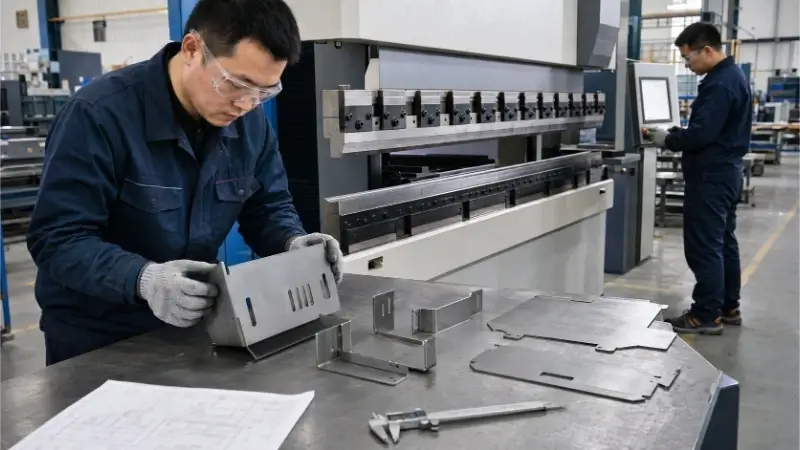
- Tonnage and Tooling: Bending 316L requires significantly more tonnage than mild carbon steel of the same thickness. Pushing a tight internal radius requires immense force and can easily crack the outer surface.
- Grain Direction: Whenever possible, parts should be nested so that bend lines run perpendicular to the material’s rolling direction. Bending parallel to the grain severely increases the risk of outer radius cracking.
- Springback Variability: 316L springs back heavily after the punch releases. Engineers should note that springback varies not just by thickness and V-die opening, but from one material batch (heat lot) to another. If you have tight bend tolerances (e.g., ±0.5°), expect a higher scrap rate during setup as operators dial in the exact over-bend angle for that specific batch of steel.
- Surface Protection: 316L is notoriously sensitive to die marks. To prevent the steel V-die from scoring the surface of cosmetic parts, we use urethane die film during the bending process.
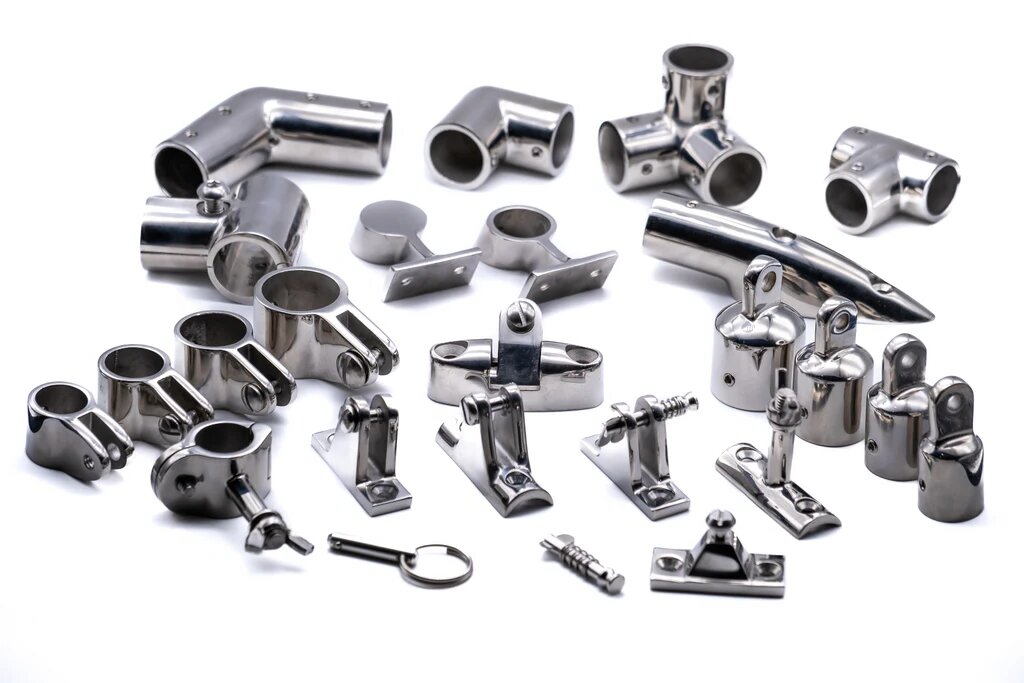
Welding and Finishing Without Losing Corrosion Resistance
A 316L part is most vulnerable to losing its corrosion resistance during welding and surface finishing. The low carbon content of 316L solves one problem (sensitization), but it does not solve the rest.
Core Rule: Low carbon reduces sensitization risk, but it does not prevent heat tint, oxidation, thermal distortion, or cross-contamination.
Welding Heat and Back Purging
We typically weld 316L using TIG (GTAW) for precision sheet metal or MIG (GMAW) for heavier structural frames, strictly specifying 316L filler wire to match the base metal chemistry.
- Distortion Control: 316L expands about 50% more than carbon steel when heated and conducts heat away much slower. If you weld a long continuous seam, the part will warp drastically. We control this using heavy copper chill blocks, rigid clamping, and back-step welding techniques.
- Back Purging: When welding steel pipes, tanks, or thin sheet, the back side of the weld is exposed to atmospheric oxygen. The heat will cause the back of the weld to rapidly oxidize, forming a porous, crusty layer known in the shop as “sugaring.” Sugaring completely destroys corrosion resistance and traps bacteria. To prevent this, the back of the weld must be purged with Argon gas.
- Cost Impact: Back purging requires double the Argon gas consumption and significant extra setup time to tape and seal the backside of the joint. It is a major cost driver. Only specify full-penetration purged welds where sanitary or high-pressure conditions absolutely demand it.
Heat Tint, Pickling, and Passivation
After welding, you will see a rainbow-colored halo around the weld area. This “heat tint” represents an area where the chromium has been pulled to the surface and oxidized, leaving the steel directly underneath depleted of chromium and highly vulnerable to rust.
- Cross-Contamination: Using a carbon steel wire brush or a grinding wheel that was previously used on mild steel to clean a 316L weld is a cardinal sin. It embeds free iron into the stainless surface, which will rust within days. We maintain completely separate, dedicated tools for stainless steel.
| Process | What It Solves | When to Use It |
|---|---|---|
| Mechanical Grinding | Physically removes excess weld reinforcement, spatter, and severe scale. | First step in blending welds for a seamless cosmetic look. Leaves behind free iron and abrasives. |
| Acid Pickling | Uses aggressive acids (Hydrofluoric/Nitric blend) to dissolve heat tint, weld scale, and the chromium-depleted layer. | Mandatory for removing heavy weld oxidation and heat tint. Restores the base metal chemistry. |
| Passivation | Uses milder acids (Nitric or Citric) to remove free iron surface contaminants and accelerate the growth of the passive chromium oxide film. | The final step for any machined or fabricated 316L part. It does not remove weld scale or heat tint. |
Functional and Cosmetic Finishes
The surface finish dictates how easily contaminants, chlorides, or bacteria can cling to the part. A rough surface traps corrosive agents; a smooth surface washes clean.
| Application | Recommended Finish | Acceptance Criteria / Notes |
|---|---|---|
| Hidden internal brackets | 2B (Mill Finish) or Tumbled | Cost-effective. Must still be passivated if machined. |
| Architectural / Appliances | No. 4 (Brushed) | Ensure grain direction is specified on the drawing. Welds must be blended and grained to match. |
| Structural / Welded Frames | Bead Blasted | Uniform matte grey. Great for hiding minor surface scratches and weld blending marks. |
| Pharmaceutical / Medical | Electropolished (EP) | Ra < 0.4μm. Reverses the part's electrical polarity in an acid bath to strip microscopic peaks. |
Specifying 316L Parts for Quality and Cost
Understanding the metallurgy and fabrication limits of 316L is only half the battle. If those requirements are not translated into clear, verifiable manufacturing instructions, factories will either under-deliver on quality or pad their quotes to cover the ambiguity.
Material Standards and MTR Review
The Material Test Report (MTR) is your only proof that you actually received 316L. Without it, you are guessing. For critical applications, we recommend requiring an EN 10204 3.1 certificate, which guarantees the document was validated by an independent testing department at the mill.
When reviewing an MTR, procurement should verify these specific fields:
- Designation: Look for UNS S31603 (US standard) or EN 1.4404 (European standard). Dual-certified material will usually list 316/316L.
- Product Standard: Verify it meets the correct standard for the form (e.g., ASTM A240 for plate/sheet, ASTM A276 for bar stock).
- Carbon (C): Must explicitly state ≤ 0.03%.
- Molybdenum (Mo): Must be between 2.0% and 3.0%. Procurement Tip: Budget mills often run Mo right at the bare minimum of 2.01% to save money. For aggressive environments, look for heats closer to 2.5%.
- Heat Number: This alphanumeric code traces the metal back to the exact furnace batch. It must match the stencil or sticker on the raw material.
The Machinability Trap: Procurement should note that an MTR only proves the metal meets the minimum chemical and tensile standards; it does not measure “machinability.” Budget material from lower-tier mills often contains micro-inclusions. While it legally passes the MTR, it will destroy CNC cutting tools twice as fast, effectively wiping out any savings on raw material cost.
Defeating Material Mix-Ups (PMI Testing)
304 and 316L look completely identical to the naked eye, and material mix-ups at metal service centers happen more often than the industry admits. For critical systems, specify PMI (Positive Material Identification). The factory will use an XRF gun to analyze the finished part, proving the alloy composition is genuinely 316L before it goes in the box.
Drawing and Inspection Requirements
Ambiguous drawings lead to bloated quotes. When a manufacturer sees vague notes, they immediately price in the worst-case scenario for tooling wear and hand-polishing.
Clearly define what matters and, just as importantly, what does not matter. Specifying “cosmetic faces” saves you money because the shop won’t waste labor polishing the hidden bottom of a baseplate.
The “Bad” Drawing Note (Guaranteed to inflate your quote or cause disputes):
MATL: 316L SS
FINISH: Smooth, no sharp edges.
WELDS: Clean.
The “Actionable” Drawing Note (Ensures accurate pricing and verifiable quality):
1. MATERIAL: 316/316L STAINLESS STEEL PER ASTM A240.
2. CUTTING: NITROGEN ASSIST GAS ONLY. NO OXYGEN CUT EDGES.
3. FINISH: BRUSHED NO. 4 FINISH ON SIDE DEFINED BY ‘COSMETIC FACE’ ARROW. GRAIN DIRECTION VERTICAL AS SHOWN.
4. WELDING: TIG WELD WITH 316L FILLER. BACK PURGE ALL FULL PENETRATION WELDS WITH ARGON. NO SUGARING ACCEPTABLE.
5. POST-WELD: REMOVE ALL HEAT TINT VIA ACID PICKLING.
6. PASSIVATION: PASSIVATE COMPLETE PART PER ASTM A967 USING NITRIC OR CITRIC ACID.
7. CERTS: EN 10204 3.1 MTR REQUIRED WITH SHIPMENT.
Conclusion
Successfully deploying 316L stainless steel goes beyond simply selecting a grade from a drop-down menu. While it is the industry standard for heavy weldments and moderate chloride exposure, it is not a cure-all for warm seawater or high-stress environments.
Guaranteeing that this quality translates from the CAD file to the finished part comes down to your drawing notes. Vague specifications invite bloated quotes and inconsistent results, whereas actionable requirements—demanding EN 10204 3.1 MTRs, defined surface roughness, and specific weld treatments—ensure predictable costs and performance.
Ready to quote your next 316L project?
Send us your 3D models, expected quantity, and service environment. Before we cut any metal, our engineering team will run a free Design for Manufacturability (DfM) review—flagging overly tight tolerances, suggesting optimal bend radii, and verifying if 316L is truly the most cost-effective alloy for your application.
Hey, I'm Kevin Lee

For the past 10 years, I’ve been immersed in various forms of sheet metal fabrication, sharing cool insights here from my experiences across diverse workshops.
Get in touch
Kevin Lee
I have over ten years of professional experience in sheet metal fabrication, specializing in laser cutting, bending, welding, and surface treatment techniques. As the Technical Director at Shengen, I am committed to solving complex manufacturing challenges and driving innovation and quality in each project.