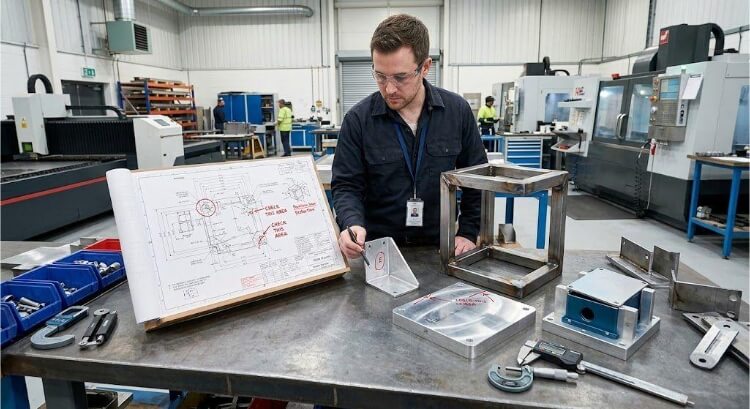
Have you ever launched a new metal part that met the drawing perfectly, only to find the assembly wouldn’t fit later? Or received parts that were “within tolerance,” yet performance in the field failed?
That gap between design intent and production reality is what PPAP, FAI, and CPK are designed to close.
These three tools form the backbone of modern manufacturing quality control. They ensure that every process step — from the prototype to stable mass production — is measurable, traceable, and repeatable. Let’s explore how they fit together in real manufacturing environments.

What PPAP Means and Why It Exists?
The Production Part Approval Process (PPAP) is a standardized method for demonstrating that a supplier’s production process can consistently manufacture parts that meet all customer requirements. Originally developed in the automotive industry, PPAP is now widely used in aerospace, electronics, and precision sheet-metal fabrication — anywhere reliability, safety, and traceability matter.
Rather than reacting to defects after mass production begins, PPAP prevents them by confirming process readiness in advance. It provides a clear, documented link between design specifications, manufacturing steps, and inspection methods.
Research on automotive supply chains shows that over 70% of early quality issues stem from poor process documentation. A properly executed PPAP can reduce these issues by nearly half.
Core Elements of a PPAP Submission
A complete PPAP package typically includes 18 standard elements, though the depth varies by customer and product risk level.
Key items include:
- Design Records – Controlled drawings or CAD files that define the approved part revision.
- Process Flow Diagram – Visual sequence from raw material to final packaging.
- Control Plan – Identification of key process parameters and monitoring methods.
- Dimensional Results – Measured data showing that sample parts meet tolerances.
- Material & Performance Test Reports – Verification of material properties and coatings.
- Process Capability (Cp, Cpk) – Early statistical proof of process stability.
- Part Submission Warrant (PSW) – Supplier’s formal declaration of conformance.
Depending on the risk level, customers may require submissions at Levels 1–5. For example, Level 3 PPAP is common in precision sheet-metal work — including detailed inspection reports, control plans, and CPK data for critical features such as ±0.1 mm bending accuracy.
Why PPAP Matters to Engineers?
PPAP is often misunderstood as a compliance checklist. In reality, it’s an engineering alignment tool that ensures design intent is translated into repeatable manufacturing reality.
For design engineers, it guarantees the supplier understands functional tolerances and material requirements. For production teams, it defines the baseline for setups, tooling, and inspection frequency. For quality engineers, it provides auditable evidence for ISO 9001 or IATF 16949 systems.
Common Pitfalls and How to Avoid Them
Many PPAP submissions fail not because of poor manufacturing, but because of weak communication and incomplete data. Typical mistakes include:
- Mismatched revisions between CAD files, drawings, and inspection reports.
- Unverified measurement systems lead to inconsistent results across inspectors.
- Missing or weak capability studies that can’t statistically prove stability.
- Siloed engineering and quality teams that prepare documents separately.
To avoid these issues:
- Align drawings, process flow, and control plans under one revision before sampling.
- Perform a Measurement System Analysis (MSA) early to verify gauge consistency.
- Involve quality engineers during the DFM review, not after tooling is built.
Case data show that an early cross-functional review can reduce PPAP cycle time by 30% and cut resubmission rates in half.
FAI — First Article Inspection and Its Role in Process Verification
If PPAP verifies the process plan on paper, First Article Inspection (FAI) proves it in the real world. FAI is the first physical confirmation that the manufacturing process can produce a part that truly matches the drawing — not just in theory, but in measurable detail.
During FAI, the first completed part (or assembly) is inspected for dimensions, material, surface finish, and function to ensure everything aligns with the design intent. It acts as a “first checkpoint” between prototype and full production.
According to industry case studies, performing a thorough FAI before mass production can reduce late-stage nonconformities by up to 60%, saving thousands in rework and line stoppage costs.
When is FAI required?
FAI is not a one-time task — it must be performed whenever a process or design change could affect fit, form, or function. Typical triggers include:
- Launch of a new product or part revision.
- Tooling or equipment changes, such as a new die or fixture.
- A switch in material supplier or grade.
- Process relocation or extended downtime (often ≥12 months).
Each of these changes can shift process capability. FAI ensures that every restart begins from a verified baseline rather than an assumption.
FAI vs. PPAP — Different Goals, Same Foundation
Though often used together, FAI and PPAP serve different purposes in the quality control framework.
| Category | FAI | PPAP |
|---|---|---|
| Goal | Verify the first manufactured part against design specs | Validate that the process can repeatedly produce conforming parts |
| Timing | Before or during pilot run | Before full production approval |
| Focus | Physical part verification | Process documentation and statistical proof |
| Output | Dimensional and material inspection report | Comprehensive approval package |
Think of FAI as the physical proof supporting the documented confidence that PPAP provides. A typical workflow in precision sheet metal production looks like this:
Prototype → FAI → PPAP → Production → CPK Monitoring
How to Conduct a Successful FAI?
FAI requires more than checking random dimensions — it follows a structured process that ties every measurement to the drawing.
- Preparation: Review the latest drawing revision, process flow, and control plan. Identify all critical dimensions and tolerances.
- Dimensional Verification: Measure every feature on the drawing using calibrated instruments — from hole diameters to bend radii and flatness. Results are recorded in an FAI report that references each drawing balloon number.
- Material & Finish Verification: Confirm that the material certificates, coatings, and treatments (such as powder coating or anodizing) meet specifications.
- Documentation & Sign-off: Attach inspection results, certificates, and photos. Both quality and engineering teams must sign the report to ensure cross-functional review.
Typical Issues and Lessons Learned
Even experienced manufacturers encounter challenges during FAI. Some common mistakes include:
- Measuring only a few key features instead of the complete drawing.
- Using outdated revision drawings.
- Skipping material verification after supplier changes.
- Treating FAI as a one-person task instead of a cross-department review.
The most effective approach is to view FAI as a design feedback tool rather than just a compliance step. When engineers and quality teams review FAI results together, they often uncover opportunities to simplify part geometry, tighten tolerances where necessary, or improve fixture design.
Why FAI Matters to Engineers?
FAI protects both design intent and production consistency.
It provides engineers with data to:
- Validate that their design can be manufactured as specified.
- Confirm that tooling and setup are performing correctly.
- Detect small deviations before they become costly trends.
In precision sheet metal fabrication, for example, FAI helps confirm critical dimensions such as hole spacing, enclosure alignment, or mounting flatness — all of which affect assembly performance and end-user reliability.
CPK — Quantifying Process Stability and Capability
Once the process has passed FAI and PPAP approval, the next question engineers face is:
Can we maintain the same level of accuracy across every batch?
That’s where CPK (Process Capability Index) comes in. CPK is a statistical measure that describes how well a process can produce parts within its design limits — not just once, but consistently over time. It provides a real-time picture of process stability, variation, and centering — the three pillars of continuous quality control.
Studies show that improving CPK from 1.0 to 1.33 can reduce scrap rates by nearly 70%, thereby improving both yield and delivery reliability.
Understanding Cp and Cpk
Two capability indices are commonly used:
- Cp (Process Potential) – Indicates the theoretical capability if the process were perfectly centered.
- Cpk (Process Performance) – Reflects actual capability, accounting for process drift and mean shifts.
A high Cp but low Cpk indicates the process has potential but isn’t properly centered — a common issue caused by machine bias, setup misalignment, or thermal expansion.
| Indicator | Formula | Meaning |
|---|---|---|
| Cp | (USL – LSL) / (6σ) | Compares tolerance width to total variation. |
| Cpk | min[(USL – X̄) / (3σ), (X̄ – LSL) / (3σ)] | Measures actual process centering and stability. |
Where:
- USL / LSL = Upper / Lower Specification Limit
- X̄ = Process Mean
- σ = Standard Deviation
Interpretation Guide:
| Cpk Value | Process Evaluation | Approx. Defects per Million (DPMO) |
|---|---|---|
| < 1.00 | Not capable | >66,800 |
| 1.00 – 1.33 | Marginal | 63 – 2,700 |
| ≥ 1.33 | Capable | <64 |
| ≥ 1.67 | High capability | <0.6 |
| ≥ 2.00 | World-class | <0.002 |
Example: If a laser-cut slot has a tolerance of ±0.10 mm, a mean deviation of 0.02 mm, and a σ of 0.02 mm, the resulting Cpk ≈ is 1.33 — a capable process ready for production.
How to Improve CPK?
A low CPK is not just a statistic — it’s an early warning. It signals instability caused by uncontrolled variation. Improving it involves combining technical correction with disciplined process control.
- Center the Process: Adjust offsets, press depths, or tool paths to align the mean closer to the nominal value.
- Reduce Variation Sources: Inspect tooling wear, clamp rigidity, or operator technique.
- For example, inconsistent press bending angles often stem from die wear or inconsistent back-gauge pressure.
- Tighten Measurement Systems: Recalibrate gauges and ensure identical measurement methods across operators.
- In some plants, gage R&R variation alone can distort CPK readings by up to 0.2 points.
- Standardize Setup and Maintenance: Establish setup sheets and preventive maintenance routines to minimize machine drift.
- Review Design Tolerances with Engineering: If natural process variation exceeds the design tolerance, collaborate with designers to balance manufacturability and functionality.
Data from production audits show that a 25% reduction in variation can increase CPK by nearly 40%, leading to lower rework and higher first-pass yield.
CPK in Real Manufacturing Scenarios
In sheet metal fabrication, CPK monitoring applies to both dimensional and surface-critical features:
- Bend Angle Repeatability – Press brake forming with ±1° tolerance, tracked by CPK to verify tool wear.
- Hole Position Accuracy – CNC punching or laser cutting monitored for ±0.05 mm consistency.
- Weld Bead Width or Spot Diameter – Ensures uniform penetration and strength.
- Surface Thickness in Coating or Plating – Verifies layer consistency in powder coating or zinc plating.
Each dataset becomes part of an ongoing Statistical Process Control (SPC) program, where trends are analyzed before defects occur. Modern manufacturing systems can automatically calculate and plot CPK in real time, allowing engineers to react before nonconforming parts leave the line.
How Engineers Use CPK Data?
For engineers and quality teams, CPK isn’t just a report — it’s a decision-making tool. It helps answer critical production questions:
- When should tooling be serviced or replaced?
- Is the process trending toward instability?
- Can the process be transferred to another facility without revalidation?
Regular CPK tracking allows you to detect subtle shifts that inspections alone can’t catch. Combined with PPAP and FAI data, it turns your production floor into a predictive quality system, where potential issues are corrected before they affect delivery.
How PPAP, FAI, and CPK Work Together in a Complete Quality System?
FAI, PPAP, and CPK are not separate checkboxes—they are stages of a continuous quality control loop. Each ensures that design, process, and production align with measurable precision.
| Stage | Objective | Primary Tool | Key Output |
|---|---|---|---|
| Prototype / Design Phase | Verify that the part meets design intent | FAI | Dimensional and material inspection report |
| Process Validation | Confirm that the process can consistently produce conforming parts | PPAP | Approved submission package and control plan |
| Ongoing Production | Maintain process stability and detect drift early | CPK | Statistical data and SPC trend charts |
Together, these stages transform quality control from a reactive system into a predictive and data-driven framework. FAI validates the part, PPAP validates the process, and CPK validates the long-term consistency.
Creating a Continuous Feedback Loop
The real strength of these tools comes from their integration. Each stage feeds valuable data back into the next:
- FAI Results → PPAP Refinement: Measurement data from the first article helps engineers update control plans and set capability targets.
- PPAP Data → CPK Monitoring: Once production begins, statistical analysis tracks real-time stability and confirms PPAP assumptions.
- CPK Trends → FAI Rechecks: If process drift or tool wear is detected, a partial FAI verifies that the part still meets specification.
This feedback loop ensures that no deviation goes unnoticed — every variation triggers a review, correction, and revalidation cycle.
Best Practices for Engineers and Quality Teams
A strong quality framework depends on discipline, data, and teamwork. Here are actionable best practices that leading manufacturers follow:
- Integrate Quality at Design Stage: Define critical dimensions and tolerance stack-ups early. Build inspection points into CAD and process routing.
- Document with Consistency: Keep all drawings, flow diagrams, and control plans under a synchronized revision control system.
- Use Data for Decisions: Base tooling or tolerance changes on measured variation and CPK trends, not assumptions.
- Align With Customers: Clarify the required PPAP level, FAI frequency, and acceptable CPK limits before production begins.
- Adopt Digital Quality Tools: Use 3D scanning, automated CMM reports, and SPC dashboards to reduce manual entry errors.
- Maintain Feedback Loops: Treat every inspection, audit, or capability study as a way to refine both product and process.
Conclusion
Quality engineering is not about catching defects — it’s about building confidence in every stage of production. Together, they form a closed quality loop that transforms production from “good enough” to predictable, traceable, and world-class.
If you are preparing for a PPAP submission or need help with FAI and CPK work, our team at Shengen can support you at every step. We provide full sheet-metal quality documentation and capability checks. Our support covers prototype testing and continues through final production.
You can contact us to talk about your project. You can also upload your CAD files for a free DFM check and capability review.
FAQs
What’s the difference between PPAP and FAI?
FAI validates the first article against design specs. PPAP validates the process that will repeatedly produce it.
When should CPK monitoring begin?
Start once full production is underway, after PPAP approval. Continue reviewing monthly or per batch.
How often should FAI be repeated?
Whenever there’s a design, material, or tooling change that could affect form, fit, or function.
How can digital tools improve these processes?
They reduce reporting time, enable real-time CPK visualization, and improve audit data traceability.
Hey, I'm Kevin Lee

For the past 10 years, I’ve been immersed in various forms of sheet metal fabrication, sharing cool insights here from my experiences across diverse workshops.
Get in touch
Kevin Lee
I have over ten years of professional experience in sheet metal fabrication, specializing in laser cutting, bending, welding, and surface treatment techniques. As the Technical Director at Shengen, I am committed to solving complex manufacturing challenges and driving innovation and quality in each project.
Related Resource
Fingerprint Resistant Stainless Steel: How It Works,and How to Choose