Subcontract machining is the process of outsourcing specific CNC operations or complete part production to a third-party machine shop. Manufacturers use it to quickly expand capacity, access specialized equipment like 5-axis mills, and bypass internal production bottlenecks without incurring new capital expenditure (CAPEX).
However, managing an outsourced machine shop requires more than just emailing a CAD file. Treating a tier-one supplier like a vending machine—where you insert a PDF and expect perfect parts to drop out—is a guaranteed path to hidden costs, assembly delays, and liability disputes over scrapped material.
Using this batch as our baseline, this guide will walk you through the exact steps to protect your supply chain. You will learn how to:
- Enforce FAI (First Article Inspection) and manage liability when out-of-tolerance parts arrive at your dock.
- Divide operations between your shop and the supplier to control costs.
- Structure RFQs and lock in drawing revisions to prevent pricing surprises.
- Level quotes by uncovering hidden NRE (Non-Recurring Engineering) and freight costs.
Decide Which Machining Work to Outsource
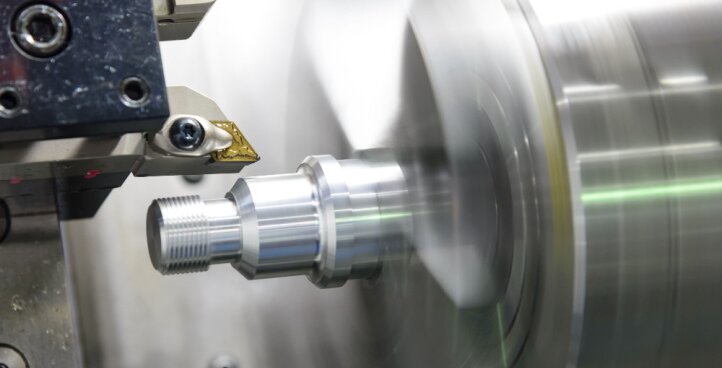
First, identify the operation restricting your schedule. In the case of the positioning blocks, the milling process is the bottleneck—the internal capability exists, but the spindle time does not. In other cases, outsourcing is driven by a lack of specialized equipment, such as 5-axis milling or wire EDM. Once the bottleneck is identified, determine the scope of the outsourced work.
In-House Production
Always establish your internal baseline first. Calculate the next available machine time and map out the completion dates for milling, deburring, and final inspection. Even if the process is mature and the internal scrap rate is a predictable 2%, the only metric that matters is whether the final accepted parts can hit the Day 8 assembly requirement. If they cannot, you must outsource.
Single-Operation Outsourcing
If you outsource only the milling operation, you provide the raw material blanks, and the supplier machines the specified features. You handle deburring and final inspection upon return.
When supplying your own material, establish a clear spoilage allowance—usually 3% to 5% for standard milling, but up to 10% for complex setups or tough alloys. You must explicitly agree on how material will be replaced if the supplier exceeds this allowance. If you do not lock this down upfront, a supplier scrapping your expensive material can easily wipe out the cost savings of outsourcing the operation.
Complete-Part Outsourcing
Under this route, the supplier manages the entire process: purchasing the raw material, machining, deburring, and performing an agreed-upon outgoing inspection. You are only responsible for the receiving inspection.
Complete-part outsourcing carries a higher piece-price, but it shifts the yield risk entirely to the supplier. You are buying guaranteed accepted parts, not just machine hours. If your internal secondary operations are also nearing capacity, this is usually the safest route to protect the Day 8 assembly date.
Prepare Drawings and RFQs Suppliers Can Quote
To accurately compare pricing, every supplier must quote against the exact same data set. The RFQ must define the physical boundaries of the work, the material condition, and the inspection criteria.
Drawings and Scope of Work
An RFQ package must include a 2D PDF drawing and a 3D STEP model tied to the exact same revision level. If they conflict, suppliers will typically program the toolpaths from the STEP model but inspect against the PDF—guaranteeing rejected parts and a standoff over who pays for the rework.
For single-operation outsourcing, document the exact starting condition of the blanks. Clarify which machining steps they are responsible for, and specify what inspection records (e.g., a basic CMM report for critical features) must accompany the returned parts.
Critical Tolerances and DFM
Focus on the features that drive the machining setup and the final acceptance. For the aluminum blocks, the two locating pin holes are critical. The drawing must clarify the hole diameter, true position, and the datum structure. Ask the supplier how they plan to fixture and probe these specific features.
Address design constraints before quoting. If the design includes small internal radii (e.g., R < 1/3 of pocket depth), suppliers will charge a premium for longer cycle times and tool wear. Additionally, if the parts require surface treatments like hard anodizing, explicitly state on the drawing whether the tolerances apply to the pre-plating or post-plating dimensions.
Pre-RFQ Checklist
- Do the 2D PDF drawing and 3D STEP model match the exact same revision?
- Is the boundary of work clearly defined (single-operation vs. complete-part)?
- Which party is responsible for inspecting the critical features?
- Are tolerances specified for pre-plating or post-plating dimensions?
- Does the target delivery date specify when parts ship (Ex-Works) or when they arrive at your dock (DAP/DDP)?
Compare Total Cost and Time to Assembly
To make an informed decision on the 100 aluminum positioning blocks, you must level the quotes. This requires stripping away different quoting formats to compare the true cost per accepted part and the exact date those parts will physically reach the assembly line.
Setup and Batch Pricing
Break down the supplier’s quote into three specific buckets: non-recurring engineering (NRE) such as CAM programming and custom fixtures, setup fees per batch, and the unit machining cost. When planning for repeat orders, confirm that NRE charges will not be billed again.
You must also verify the scope of the quote. Ensure both suppliers are quoting against the same baseline—specifically, whether deburring, final inspection reports, and freight are included. A supplier quoting Ex-Works will look artificially cheaper than one quoting DAP/DDP until the logistics invoice arrives and the parts are held up in transit.
Cost per Accepted Part
Do not base your decision solely on the quoted piece-price. You must calculate the total cost based on the final yield of accepted parts.
For the single-operation outsourcing route, the internal cost breakdown looks like this: Raw blanks (320) + outsourced milling (580) + freight (50) + in-house deburring and final inspection (120) = $1,070 total. Assuming you successfully yield the required 100 acceptable blocks, your true cost is $10.70 per part.
However, manufacturing is unpredictable. If the assembly line strictly requires 100 pieces and the supplier ships 98 due to their own scrap, your line still stops. Always order a 3% to 5% buffer quantity (e.g., 105 parts) to guarantee your absolute minimum is met, and factor that buffer into your total batch cost.
Delivery Date and Route Selection
The following data models the three available routes. All three timelines start on the same day and are measured against the absolute deadline: having 100 accepted parts ready for assembly by Day 8.
Notice that advanced procurement decisions evaluate not just time and money, but also the primary liability.
| Production Route[cite: 57] | Total Batch Cost[cite: 57] | Ready for Assembly[cite: 57] | Primary Risk[cite: 57] |
|---|---|---|---|
| In-House Production[cite: 57] | $980[cite: 57] | Day 11[cite: 57] | Misses assembly deadline[cite: 57] |
| Single-Operation Outsourcing[cite: 57] | $1,070[cite: 57] | Day 7[cite: 57] | Material transit damage / Spoilage[cite: 57] |
| Complete-Part Outsourcing[cite: 57] | $1,150[cite: 57] | Day 8[cite: 57] | Higher upfront piece-price[cite: 57] |
For this batch, single-operation outsourcing is the correct choice. It secures the Day 8 assembly requirement and provides a one-day buffer, all while saving $80 compared to complete-part outsourcing.
However, manufacturing schedules are dynamic. If your internal deburring station were suddenly booked, pushing in-house finishing to Day 9, single-operation outsourcing would fail the schedule constraint. In that scenario, complete-part outsourcing becomes the only viable route to protect the assembly line.
Verify the Supplier and Approve Production
Splitting supplier validation into two distinct phases prevents costly rework. You must verify their physical capability before issuing the PO, and you must approve the physical output before authorizing the full volume run.
Machining and Inspection Capability
Before awarding the work, require the supplier to explain their manufacturing strategy. Ask how they will fixture the blocks and exactly how they intend to measure the true position of the two locating pin holes. If they plan to use standard calipers for a tight true-position tolerance instead of a CMM or dedicated gauge pins, the parts will likely fail at assembly.
For the single-operation route, explicitly document the liability boundary: the supplier verifies only the milled features prior to shipment, while your internal team retains authority for the final post-deburr release.
First Article and Batch Release
Define the First Article Inspection (FAI) requirements before signing the PO. Specify which critical features must be recorded and who holds the final approval authority.
A standard FAI report must clearly document the drawing revision, the specific hole location tolerance, the actual measured value, and a strict Pass/Fail status. Crucially, it must be accompanied by the raw material mill certificate (e.g., EN10204 3.1) to prove they did not substitute your specified alloy with a cheaper alternative.
Do not authorize the remaining 99 pieces until your engineering team signs off on this first article. If batch consistency for a specific tight tolerance remains a high risk, mandate a small pilot run (e.g., 10 pieces) to verify tool wear and setup stability before allowing the full volume release.
Manage Drawing Changes and Rejected Parts
Even with perfect RFQs and approved First Articles, manufacturing is dynamic. Designs change mid-production, and cutting tools wear out. How you manage these exceptions dictates whether a minor machining error escalates into a line-down crisis.
Let’s look at two common post-order scenarios to define exactly who acts first, who makes the final call, and how the assembly schedule is updated.
Drawing Revisions and Work in Progress
The Scenario: Engineering issues a critical design change for the positioning blocks, but the supplier has already machined 50 out of the 100 parts.
- Who acts first: The buyer’s procurement team must immediately issue a formal Stop Work order. If you simply email a new CAD file and assume the supplier will figure it out, you will likely end up paying for 100 obsolete parts.
- Who decides: The supplier must immediately halt the spindles, physically quarantine the Work in Progress (WIP), and report the exact count (e.g., 50 finished, 10 semi-finished, 40 untouched blanks). Your engineering team then reviews the WIP state to decide the path forward: Can the 50 finished parts be reworked to the new revision, or must they be scrapped? Because the design change originated internally, procurement must accept financial liability for the obsolete WIP. This is typically managed through a formal Engineering Change Order (ECO).
- How the schedule updates: Before production resumes, procurement must issue a revised PO. This document must explicitly state the new drawing revision, authorize any agreed-upon scrap or rework costs for the 50 obsolete pieces, and establish a new baseline delivery date based on the remaining machine hours required.
Nonconforming Parts and Recovery
The Scenario: The 100 blocks arrive at your dock, but your receiving inspection finds that the true position of the locating pin holes is out of tolerance.
- Who acts first: Your internal quality team must immediately quarantine the batch—both physically in a locked cage on the floor and digitally in your ERP system—to guarantee these parts do not accidentally reach the assembly line.
- Who decides: Quality inspects a larger sample to determine the scope (is the whole batch bad, or just the last 20 pieces due to tool wear?). Engineering then steps in to evaluate the actual assembly impact. They dictate the recovery path: sort the good from the bad, return the bad parts to the supplier for rework, scrap and remake, or accept the out-of-tolerance parts under a formal concession (use-as-is deviation) if they will still physically assemble.
- How the schedule updates: The supplier does not dictate the new timeline; procurement does. Based on the actual count of cleared, usable parts (e.g., only 80 blocks passed), procurement updates the production planner. The planner then decides whether to push the assembly date or force the supplier into an expedited short-run to replace the 20 scrapped parts. Finally, before the next batch is ordered, Quality must demand a Corrective Action Report (CAR or 8D) to ensure the supplier has fixed the root cause of the setup error.
Stop Hoping for Good Parts. Start Engineering Your Supply Chain.
Subcontract machining is not a weakness; it is a strategic extension of your factory’s capacity. However, treating an outside machine shop like a vending machine—where you insert a PDF and expect perfect parts to drop out—is a guaranteed path to hidden costs, assembly delays, and endless liability disputes.
Predictable outsourcing requires treating your suppliers as an extension of your own shop floor. By defining the exact boundary of work, tying quotes to strict revision levels, enforcing FAI standards, and managing WIP changes through formal ECOs, you shift from simply buying machine hours to securing guaranteed capacity.
Ready to scale your production without the CAPEX? Stop dealing with vague quotes and unverified tolerances. Send your next RFQ with a locked-in STEP/PDF package, define your datum structures upfront, and build a resilient supply chain that actually protects your assembly line.
Hey, I'm Kevin Lee

For the past 10 years, I’ve been immersed in various forms of sheet metal fabrication, sharing cool insights here from my experiences across diverse workshops.
Get in touch
Kevin Lee
I have over ten years of professional experience in sheet metal fabrication, specializing in laser cutting, bending, welding, and surface treatment techniques. As the Technical Director at Shengen, I am committed to solving complex manufacturing challenges and driving innovation and quality in each project.