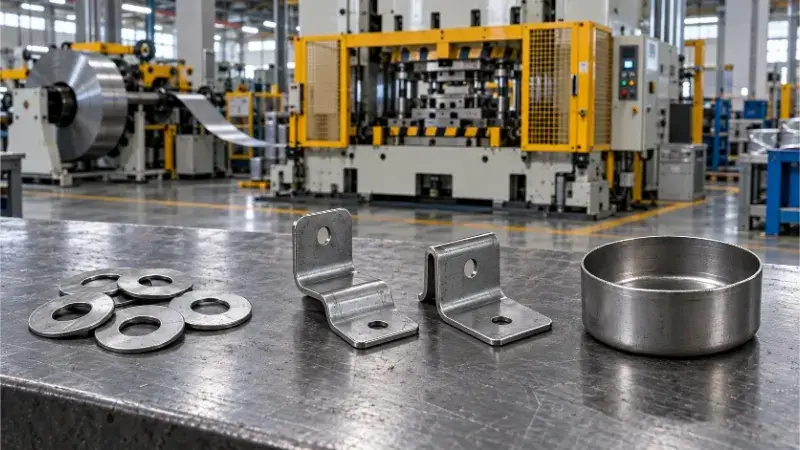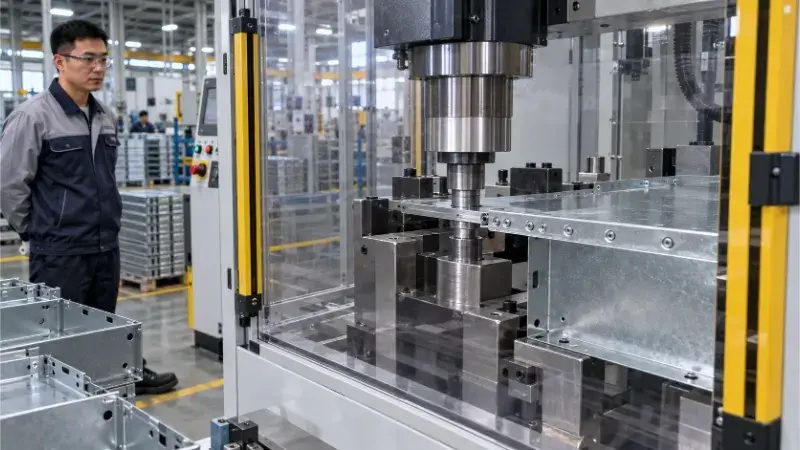
Deep draw metal stamping is a manufacturing process used to form flat sheet metal into hollow, seamless parts. It requires a significant upfront investment in tooling, but it becomes highly cost-effective at higher production volumes.
The process involves simultaneously stretching and compressing metal. If the part geometry, material properties, or tooling clearances are mismatched, you will face high scrap rates from material tearing or wrinkling.
This guide explains the basics of deep drawing, the types of parts it works well for, and how to evaluate the engineering and cost factors before committing capital to tooling.

Deep Draw Metal Stamping in Simple Terms
Deep draw metal stamping turns flat sheet metal into deep hollow parts. A clear process view helps explain why shape, material, and tooling matter so much.
From flat sheet to hollow part
The deep draw metal stamping process begins with a flat metal blank. A mechanical or hydraulic press uses a punch to press this blank into a die cavity.
The metal forms around the punch to match the die’s shape. A part is classified as “deep drawn” when the depth of the formed shape is strictly greater than its diameter.
Deep drawing vs regular stamping
Standard stamping is usually used for cutting, piercing, or shallow bending. In these processes, the material thickness remains mostly consistent.
Deep drawing forces the metal to flow. The material stretches over the punch and compresses as it moves into the die. Managing this plastic deformation requires precise die clearances (often set at 110% to 115% of the material thickness), specialized progressive dies, and industrial lubrication to control friction heat.
One-piece structure with fewer welds
A primary benefit of deep drawing is that it creates a seamless part from a single piece of sheet metal.
Because there are no joints, you do not need secondary welding or fastening. Zero welds mean zero porosity and no heat-affected zones. Eliminating welds also removes the risk of joint failure and significantly reduces assembly cycle times.
Parts That Fit Deep Draw Stamping
Deep drawing works best when the part shape matches the forming method. Round shells, box housings, sealed parts, and repeat orders usually bring the most value.
Round cups and cylindrical shells
Cylindrical shapes work best for deep drawing. As the punch enters the die, the metal flows evenly from all sides.
This balanced radial stress distribution reduces the risk of material failure. Typical applications include battery casings, sensor covers, and motor housings. Tooling for round parts is mathematically simpler to design and much faster to machine.
Box-shaped and rectangular housings
Drawing a rectangular box is more complex than forming a cylinder. The metal tends to gather at the corners, creating high stress concentrations.
We regularly form rectangular enclosures for electronics. However, to form these successfully without tearing, vertical corner radii typically need to be at least 5 to 6 times the material thickness.
Forcing a sharp 90-degree internal corner is possible, but it requires additional draw stations. This directly increases your tooling cost, extends lead times, and raises the risk of high scrap rates.
Sealed and low-weld structures
If a component needs to be waterproof or hold pressure, deep drawing is a practical option. The seamless walls naturally prevent leaks.
This makes it easier to meet IP67 or IP68 environmental ratings without relying on secondary sealants, gaskets, or extensive pressure testing of welded seams.
Stable high-volume parts
Tooling for deep drawing represents a significant capital expense. Progressive or transfer dies typically range from $10,000 to over $50,000, and development takes several weeks.
Because of this, the process is not suitable for prototyping or small runs of 500 parts. For production runs under 5,000 pieces, alternative processes like hydroforming, metal spinning, or laser cutting paired with press braking are usually more cost-effective.
Deep drawing becomes the most efficient choice at volume. The ROI tipping point usually starts around 30,000 to 50,000 units per year. Once the tooling cost is amortized, the unit cost decreases to absolute minimums over the product lifecycle.

Material Choices and Forming Behavior
Material choice affects forming success, cost, and part quality. Good drawability, stable supply, and the right service performance all need early review.
R-value and N-value
Instead of guessing whether a specific metal will form successfully, tooling engineers look at two hard metallurgical metrics: the R-value (plastic strain ratio) and the N-value (strain hardening exponent).
The R-value measures a material’s ability to resist thinning as it is pulled. An R-value greater than 1.5 indicates excellent deep drawability. The N-value measures how much the metal hardens as it stretches. A higher N-value (e.g., 0.20 or higher) means the metal distributes stress more evenly, preventing localized tearing.
Low-carbon steel and stainless steel
Low-carbon, cold-rolled steels (like DC04 or 1008) are the baseline workhorses for deep drawing. They offer an ideal balance of low cost, high ductility, and minimal tool wear.
Stainless steel, particularly the 304 series, is highly formable but presents a specific manufacturing challenge: severe work hardening. As 304 stainless steel is drawn into the die, it becomes stiffer rapidly.
The Penalty: This requires significantly higher press tonnage and forces manufacturers to use expensive carbide tooling and premium extreme-pressure lubricants to prevent the steel from galling (cold welding) to the die.
Aluminum, copper, and brass
Non-ferrous metals behave very differently under the punch. Brass is generally considered the easiest metal to deep draw due to its natural lubricity and high ductility.
Aluminum requires strict alloy selection. Standard architectural aluminum, such as 6061-T6, will almost certainly fracture when deep-drawn due to its rigid crystalline structure. To get a lightweight drawn part, you must specify deep-drawing grades such as 5052-H32 or 3003, which provide the necessary elongation.
Material availability and lead time
Engineering the perfect part out of a specialized aerospace alloy is useless if you cannot source the sheet metal.
For high-volume stamping, stick to standard commercial sheet thicknesses and highly common alloys.
The Penalty: Specifying a rare-metal grade often requires a custom mill run. This can trigger a 5-ton minimum order quantity (MOQ) and add 12 to 16 weeks to your raw material lead time before toolmaking even begins.
Quick Material Formability Reference:
| Material Grade | Deep Drawability | Tool Wear & Friction | Practical Application |
|---|---|---|---|
| Cold Rolled Steel (DC04) | Excellent | Low | General automotive, large housings |
| Stainless Steel (304) | Good (High work hardening) | High (Requires carbide dies) | Medical, food-grade enclosures |
| Aluminum (5052-H32) | Good | Medium | Lightweight electronics casings |
| Aluminum (6061-T6) | Poor (Will fracture) | N/A | Do not specify for deep drawing |
| Brass (C26000) | Excellent | Very Low | Connectors, high-speed transfer parts |
Design Rules That Affect Forming Success
A deep-drawn part can fail before production if the design ignores forming limits. Draw depth, radius, wall thickness, holes, and trimming, as they all shape the final result.
Draw depth and redrawing stages
You cannot push a flat blank into a deep tube in a single strike.
The Rule: The maximum depth of a single draw is roughly 0.75 to 1.0 times the diameter of the punch. The initial draw should not reduce the blank diameter by more than 50%.
The Penalty: If your part design requires a depth of two or three times the diameter, it mandates multiple “redrawing” stages. Each redraw requires an additional progressive die station, which directly increases your overall tooling cost by 20% to 30% per station.
Punch radius and die radius
The radii on your CAD model dictate the flow of the metal.
The Rule: Design your die radius to be 4 to 10 times the material thickness. The punch radius should be at least 4 times the material thickness.
The Penalty: If the die radius is too sharp, the metal will snap over the edge and tear. If it is too large, the metal will lose tension and wrinkle. Tighter internal radii are physically possible but will require an additional coining station at the end of the line, which will drive up tooling costs.
Wall thickness variation
You must design your part with the understanding that deep drawing is a sheet metal forming process, not precision CNC machining.
During the draw, the vertical side walls stretch, resulting in 10% to 15% thinning, while the bottom center may retain its original thickness or slightly thicken.
The Penalty: Do not assign tight +/- 0.01mm tolerances to wall thicknesses across the entire part. This will cause your manufacturer to decline to quote the job. Instead, specify the minimum acceptable thickness required for your structural integrity.
Holes, slots, and side features
A common CAD mistake is placing holes or cutouts on the flat blank before simulating the draw.
The Penalty: As the metal flows into the die, a perfectly round hole on the flat blank will distort into an unpredictable oval on the finished vertical wall.
The Rule: All side features, holes, and slots must be added after the metal has been fully drawn. This requires adding secondary piercing stations or cam-driven side-action punches to the progressive die to ensure geometric accuracy.
Trimming and edge control
Metals have a directional grain structure from the rolling mill. Because of this anisotropy, the metal will not flow perfectly evenly into the die.
This causes the top edge of the drawn cup to form irregular, wavy peaks known as “earing.” You cannot deep draw a part to a precise, perfectly flat final height directly from the forming punch. Your design and tooling budget must account for a final pinch-trim or a secondary machining operation to remove the eared material and establish the final dimension.

Cost Drivers and Tooling Strategy
Deep drawing can lower unit cost, but tooling decisions shape total project cost. Volume, forming stages, prototype plans, and secondary operations all affect the final price.
Tooling cost and production volume
Hard tooling for deep drawing is a sunk capital cost. A complex progressive or transfer die can easily exceed $30,000 to $80,000 to engineer and machine.
The Reality: You must amortize this tooling across the life of the product. If your annual volume is under 10,000 units, the amortized tooling cost will ruin your unit economics. Deep drawing is strictly a high-volume play, with unit prices dropping to pennies only at the 50,000 to 100,000+ mark.
Number of forming stages
Every change in shape, diameter reduction, or pierced hole requires a separate station within the die.
The Penalty: Each additional station makes the die block longer and requires a higher-tonnage press to operate. This increases the tooling cost by thousands of dollars. Keep the part geometry as simple as possible to minimize the number of drawing stations.
Prototype-to-production path
You cannot prototype a deep-drawn part using the final production process without paying for the final tooling. Do not commit $50,000 to a progressive die until the design is proven.
The Strategy: For early concept validation, use CNC machining or laser cutting. Once you need to test the actual material flow and strength, we often build low-cost stage tooling (soft dies). This allows you to validate the exact deep draw mechanics for a fraction of the cost before locking in the final high-volume hard tooling.
Secondary operations
A deep-drawn part is rarely finished the moment it ejects from the press.
The Hidden Costs: Heavy, extreme-pressure drawing lubricants must be chemically washed off before plating or painting. Irregularly shaped edges must be pinch-trimmed or machined flat. If severe work hardening occurred, the parts might require an annealing heat treatment to restore ductility. Every secondary touchpoint adds labor, time, and cost to the final piece price.
Common Defects and Process Control
Most deep-drawing defects are caused by poor material flow, friction, or poor tool setup. Wrinkling, cracking, thinning, scratches, and springback all need controlled process planning.
Wrinkling and blank holder force
Wrinkling occurs on the part’s flange when compressive forces cause the metal to buckle as it is pulled into the die cavity.
The Fix: The press operator must adjust the Blank Holder Force (BHF). Enough pressure must be applied to the outer edge of the blank to keep the metal flat as it flows. However, if the BHF is too high, it completely restricts flow, and the punch will tear the bottom out of the part.
Cracking and draw ratio
Cracking typically occurs near the bottom corner radius, where the punch exerts the maximum tensile force on the metal.
The Fix: Cracking indicates that the draw ratio (blank diameter vs. punch diameter) is too aggressive. To fix this, tooling engineers must either increase the punch radius, switch to a more highly ductile material grade, or break the operation into multiple, shallower redrawing stages.
Thinning and wall thickness control
Metal stretches during the draw. Some thinning at the bottom radius is physically unavoidable.
The Standard: As an industry rule, expect and accept up to 15% to 20% localized thinning in these high-stress zones. If this exceeds your structural limits, engineers must widen the die clearance or upgrade to a heavier industrial lubricant to encourage the material to slip rather than stretch.
Scratches, galling, and lubrication
Under immense pressure and friction, microscopic bits of the sheet metal can cold-weld to the steel tooling. This is called galling, and it leaves deep, vertical scratches on the finished parts.
The Fix: Galling is prevented by maintaining a constant barrier of drawing fluid. For tough materials like stainless steel, standard tooling is not enough. Punches and dies must be coated with Titanium Nitride (TiN) or machined from solid tungsten carbide to withstand the friction.
Springback and forming simulation
Sheet metal has elastic memory. After the punch retracts, the metal will try to spring back slightly toward its original flat shape, throwing the part out of tolerance.
The Fix: You cannot eliminate springback, but you must predict it. Modern tooling engineers run Finite Element Analysis (FEA) forming simulations before cutting any steel. The tooling is then intentionally machined to “overbend” the metal, allowing it to relax exactly into the specified CAD tolerance.
Conclusion
Deep draw metal stamping is not a trial-and-error process. The financial risks of poorly designed tooling are too high. Success requires locking in the right material, respecting the physical limits of bend radii, and understanding exactly how metal flows under pressure.
Before you finalize your CAD or commit your budget to hard tooling, get a rigorous engineering review.
Send us your STEP files for a full Design for Manufacturability (DFM) assessment. We will pinpoint exactly where your metal might tear, provide a realistic tooling cost breakdown, and outline a clear path from soft-tool prototyping to reliable mass manufacturing. Reach out to our engineering team today to get started.
Hey, I'm Kevin Lee

For the past 10 years, I’ve been immersed in various forms of sheet metal fabrication, sharing cool insights here from my experiences across diverse workshops.
Get in touch
Kevin Lee
I have over ten years of professional experience in sheet metal fabrication, specializing in laser cutting, bending, welding, and surface treatment techniques. As the Technical Director at Shengen, I am committed to solving complex manufacturing challenges and driving innovation and quality in each project.