Capacity planning in a sheet metal shop involves balancing machine availability, labor, and the flow of work-in-progress (WIP). Effective scheduling is not about maximizing machine uptime, but about controlling the movement of parts from the laser to the shipping dock.
This article outlines the practical constraints of sheet metal fabrication. We will explain how to calculate baseline capacity and manage the common bottlenecks that affect lead times.

How to Calculate Real Shop Capacity?
A schedule built on theoretical maximums is difficult to maintain on the shop floor. True capacity calculations require separating total available hours from actual productive time.
Machine hours
A standard 8-hour shift rarely provides 8 hours of productive cutting or bending time. To find the real capacity, you must apply an Overall Equipment Effectiveness (OEE) factor. While a well-maintained fiber laser may reach 80% OEE, a manual press brake often operates closer to 60% or 65% due to frequent manual interventions.
This gap is caused by routine but necessary downtime, including machine changeovers, material loading, and First Article Inspections (FAI). For example, if a job requires switching from 6mm carbon steel to 1.5mm aluminum, the time spent changing nozzles, lens calibration, and gas settings must be deducted from the available production window.
Labor hours
Total headcount is a misleading metric for capacity. Available labor hours must be adjusted for non-production activities such as shift handoffs, safety briefings, and material handling.
In a typical fabrication environment, it is standard practice to factor in a 5% to 10% buffer for absenteeism and indirect labor tasks. Scheduling at 100% labor utilization leaves no room for these variables, which often results in a production backlog by mid-week.
Skill matrix
Machine capacity is strictly limited by the availability of qualified operators. An idle robotic welding cell provides zero capacity if the only technician capable of programming it is assigned to another project.
Effective planning maps capacity against specific certifications and skill levels. For instance, a shop with ten welders may only have three certified for structural TIG welding. Cross-training operators—such as teaching a laser loader to perform basic deburring or press brake operation—is a reliable method to prevent specific labor categories from becoming a total shop standstill.
Routing accuracy
The reliability of a schedule depends on the accuracy of the Estimated Time vs. Actual Time. If a routing assumes a 2-minute cycle for a complex bracket, but the operator consistently takes 5 minutes due to difficult part orientation, the plan will fail.
Regular time studies are necessary to update the ERP system. Accurate routings should account for the physical reality of the part, including the time required for orientation, stacking, and internal transport between work centers.
Where the Shop Reaches Its Capacity Limit?
Every fabrication facility has specific processes that dictate its total throughput. Identifying these limits allows managers to pace the rest of the shop to avoid excess WIP.
Cutting output
Modern fiber lasers have extremely high throughput. Consequently, the cutting department is rarely the primary bottleneck; instead, it often acts as a WIP generator.
If the laser outpaces the downstream processes, the floor becomes congested with pallets of flat blanks. To maintain a steady flow, cutting schedules should be paced to match the throughput of the next operation, usually bending or welding.
Bending capacity
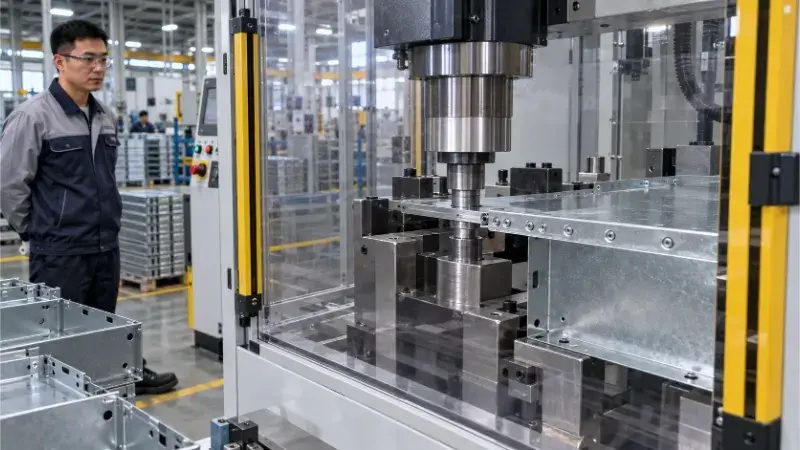
Press brakes are the most common capacity limit in sheet metal work. Bending throughput is driven more by setup complexity than by machine speed.
For example, a part requiring four different bends with two different tool sets may take 20 minutes to set up for a 30-second run. When the job mix shifts toward low-volume, high-complexity parts, the effective capacity of the bending department can drop significantly. Managers must balance “long-run” simple parts with “short-run” complex parts to keep the brakes moving.
Welding capacity
Welding is a manual, heat-intensive process that introduces significant variability. Beyond the arc time, capacity is consumed by fixturing, tacking, and post-weld cleaning.
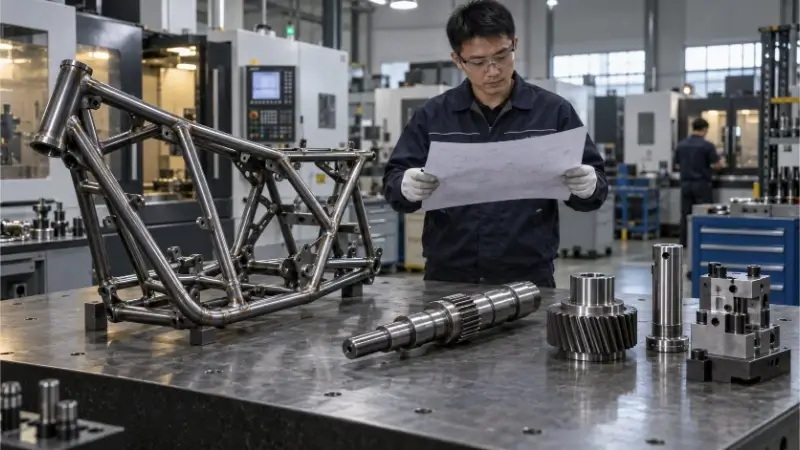
A critical ripple effect in welding is heat distortion. If a technician spends 15 minutes welding a frame but then requires 30 minutes of manual straightening or secondary grinding to meet tolerances, the department’s capacity is effectively cut by two-thirds. Controlling heat input and using precision fixtures are engineering requirements, not just quality ones.
Finishing queues
Surface treatments like powder coating or anodizing are often the final production constraint. For in-house lines, capacity is fixed by the conveyor speed and curing oven volume.
When finishing is outsourced, the shop loses direct control over the timeline. A standard 3-to-5-day lead time from a coating vendor must be treated as a fixed “dead period” in the capacity plan. Any delay in the fabrication stages prior to finishing will likely result in a missed final delivery date, as finishing vendors rarely have the flexibility to “rush” parts without significant cost.

How Part Complexity Changes Capacity Demand?
Part complexity directly alters how much raw capacity a job consumes. A schedule based solely on part quantity will fail if the design requires intricate handling, multiple tool changes, or strict tolerances.
Bend count
The number of bends on a single part multiplies the risk of error and the time required for handling. Every subsequent bend relies on the accuracy of the previous one, leading to potential tolerance stack-up.
This is particularly true when bending materials like aluminum or high-strength steel, where unpredictable springback requires the operator to make manual adjustments for individual pieces. A slight variation can turn the final bend into scrap, wasting not only the bending capacity but also the material and the upstream laser time.
Setup load
Machine capacity is quickly consumed by the number of physical tool changes required, not just the machine run time. In high-mix environments, an operator may need to switch from standard V-dies to specialized gooseneck tools multiple times per shift, causing setup times to easily exceed actual processing times.
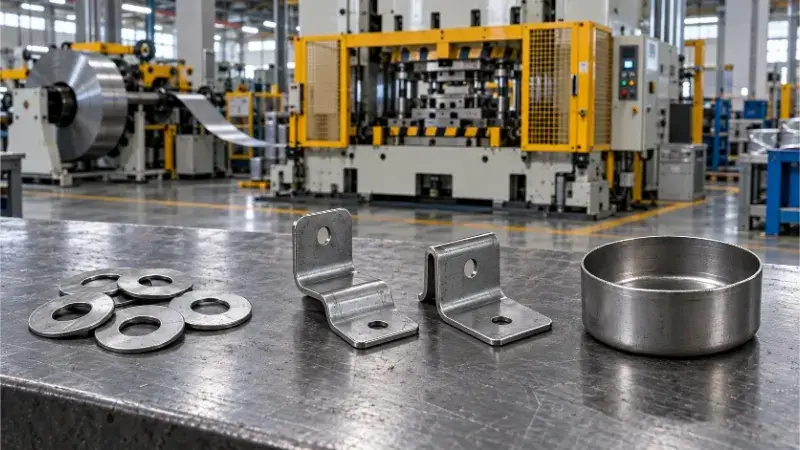
To mitigate this, advanced shops utilize stage tooling setups, where multiple die sets are loaded across the press brake bed simultaneously to complete all bends in one handling. As production volumes scale, it is often necessary to transition complex, multi-setup parts to sheet metal stamping to release trapped press brake capacity and maintain steady mass manufacturing output.
Welding content
Estimating welding capacity based purely on the linear inches of a seam is usually inaccurate. The complexity of the joint dictates the pace. Laying down a simple stitch weld is fast and predictable.
However, requiring a continuous, watertight seam demands careful heat control to prevent warping, significantly slowing the travel speed. Out-of-position welding or restricted access inside a tight chassis further reduces throughput and increases the likelihood of secondary grinding or rework.
Inspection burden
Strict Geometric Dimensioning and Tolerancing (GD&T) requirements create a hidden bottleneck in the quality department. The real capacity killer is not just the queue for the Coordinate Measuring Machine (CMM), but the fact that a press brake or CNC machine often sits idle while waiting for the quality lab to approve the First Article Inspection (FAI).
Until that first part is verified, the operator cannot safely run the rest of the batch. This hidden idle time is why seemingly simple parts with strict tolerances often carry a significantly longer quoted lead time from the procurement perspective.
How Scheduling Rules Protect Flow and Delivery?
Even with accurate data, a shop floor can quickly fall into chaos without strict operational rules. Scheduling rules act as physical traffic controls, preventing work centers from being overloaded and protecting delivery dates.
Job release
Releasing a job to the floor simply because the raw material has arrived is a common scheduling error. Jobs should only be released at the rate the primary bottleneck can process them.
Releasing work too early floods the fast upstream processes, like the laser cutter. This leads to an overproduction of flat blanks that will sit on pallets for days, waiting for the downstream operations to catch up.
WIP control
Limiting Work-in-Progress (WIP) is essential for maintaining predictable lead times. Excess WIP doesn’t just consume floor space; it ties up working capital in unfinished goods that cannot be invoiced.
Furthermore, sheet metal parts left sitting in WIP for too long risk surface oxidation (especially carbon steel). This often forces an unplanned pickling or secondary sanding operation before the parts can be sent to powder coating, instantly disrupting the weekly schedule.
Bottleneck sequencing
To maximize throughput, jobs at the bottleneck operation should be sequenced to minimize downtime. If the press brake is the known constraint, it is usually more efficient to group orders that use the same tooling setup together.
While this may occasionally override strict First-In-First-Out (FIFO) rules, it preserves the limited capacity of the constraint. Saving 40 minutes of tooling changeovers at the bottleneck directly translates to more parts shipped at the end of the week.
Schedule freeze
Constant re-shuffling of the daily plan destroys productivity. Tearing down an active setup to run a rush order means paying for the setup time twice, instantly eroding the profit margin on both jobs.
Implementing a schedule freeze—typically a fixed 24 to 48-hour window where the production plan cannot be altered—protects operators from the disruption of emergency orders. If a rush order arrives, it must be slotted outside this frozen zone to ensure that current WIP is completed efficiently.

How to Protect Capacity When Demand or Supply Shifts?
Scheduling a shop floor to 100% capacity guarantees failure. A single machine fault or delayed material delivery will derail the entire week’s production. Maintaining a reliable schedule requires building elasticity into the system.
Buffer capacity
Managing capacity effectively requires maintaining a buffer capacity—typically leaving 15% to 20% of available hours unscheduled. This buffer acts as a shock absorber for the production floor.
When unpredictable setup times, minor material defects, or mandatory rework occur, this reserved time absorbs the impact. It allows operators to catch up without delaying the primary production flow or missing customer delivery dates.
Material shortages
Global supply chains are volatile. When a material shortage occurs, the schedule must be highly elastic to prevent equipment from sitting idle. However, a shortage isn’t always physical.
Sometimes the metal is actually on the rack, but the Mill Test Reports (MTRs) haven’t cleared quality control. A dynamic system must flag material as “unavailable” until both the physical stock and the compliance paperwork are ready for the floor.
Rush order screening
Rush orders disrupt standard flow and introduce significant risk to established delivery dates. Before accepting an expedited job, management must conduct strict rush order screening to calculate the true cost of the disruption.
Interrupting an active run doesn’t just double your setup time. It often guarantees you will scrap another piece of material to re-calibrate the machine when you resume the original job, instantly eroding the profit margin on both orders.
Outside capacity
Internal capacity has physical limits. When shop utilization consistently exceeds the safety buffer, leveraging outside capacity becomes a strategic necessity rather than a last resort.
Partnering with a fabrication expert isn’t just about dumping overflow work. A strategic partner acts as an extension of your own floor, utilizing the same engineering standards—from Design for Manufacturing (DFM) review to final inspection—ensuring that outsourced components drop seamlessly into your final assembly line.
How to Keep Capacity Data Useful?
Capacity planning is only as good as the data feeding it. If the assumptions in your scheduling software do not match the physical reality of the shop floor, the system will generate impossible schedules.
OEE baseline
Establishing an accurate Overall Equipment Effectiveness (OEE) baseline is the first step in maintaining a realistic schedule. This metric forces a shop to look beyond raw machine speed and account for actual availability and quality yield.
A schedule built on a realistic 65% OEE will always outperform a schedule built on a theoretical 90% OEE. It prevents the system from overpromising capacity that doesn’t physically exist.
Downtime loss
Unrecorded downtime corrupts capacity planning data. The most destructive downtime isn’t a blown hydraulic pump; it’s the 10 minutes an operator spends waiting for a forklift to move a pallet, or searching for the correct inspection caliper.
These unrecorded micro-stoppages silently bleed capacity. Consistently tracking these minor delays allows engineering teams to identify root causes and adjust the baseline capacity down to a realistic, achievable level.
Rework loss
A scrapped part steals capacity twice: once when it was fabricated incorrectly, and again when it must be remade. Failing to account for rework loss artificially inflates available production hours.
If a specific welding operation historically has a 5% rework rate, the schedule must automatically allocate the necessary time and material to cover that historical yield drop. Ignoring this reality guarantees schedule overruns.
Routing updates
Shop floor processes naturally evolve. If engineers implement a new fixture that cuts welding time by 10 minutes, but the ERP data remains static, the schedule will quickly drift from reality.
Continuous routing updates are mandatory. When process improvements reduce cycle times, those new standards must immediately be reflected in the routing data so the scheduling system can reclaim and accurately reassign that newly freed capacity.
Conclusion
Capacity planning in a sheet metal shop is not just a scheduling task. It is a daily control job that connects machine time, labor, part complexity, material readiness, and delivery promises. A shop can look busy and still lose output if bottlenecks are ignored, routing data is wrong, or urgent orders keep breaking the flow.
The stronger approach is to plan around real capacity, not theoretical capacity. That means checking where the shop truly slows down, controlling WIP, protecting key processes, and updating planning data as production changes.
If your project includes tight lead times, mixed part complexity, or unstable demand, early planning matters. Send us your drawing, BOM, or RFQ, and our engineering team can review the workload, process flow, and production risks before manufacturing starts.
Hey, I'm Kevin Lee

For the past 10 years, I’ve been immersed in various forms of sheet metal fabrication, sharing cool insights here from my experiences across diverse workshops.
Get in touch
Kevin Lee
I have over ten years of professional experience in sheet metal fabrication, specializing in laser cutting, bending, welding, and surface treatment techniques. As the Technical Director at Shengen, I am committed to solving complex manufacturing challenges and driving innovation and quality in each project.