301 stainless steel is an austenitic alloy renowned for its rapid work-hardening rate. In sheet metal fabrication, it is the primary material for high-strength spring clips, electrical contacts, and brackets. Unlike 304, 301 is specified by temper (from 1/4 hard to full hard) to balance formability and spring force.
However, moving a 301 stainless steel part from a rapid prototype to mass manufacturing presents unique engineering challenges. Its aggressive work-hardening rate makes it notoriously difficult to stamp and bend. A minor oversight in material specification or grain direction often leads to micro-cracking on the outer bend radius or accelerated tool wear on the production line.
This guide outlines the essential Design for Manufacturing (DFM) rules, temper selection criteria, and purchasing factors you need to successfully source reliable 301 sheet metal components.

301 vs. 304 Stainless Steel: The Work-Hardening Advantage
Engineers often compare 301 and 304 stainless steel during the initial material selection phase under standards like ASTM A666. While both are austenitic alloys and look identical, their performance under mechanical stress is distinctly different.
Chemical Composition and Yield Strength
The main difference lies in their chemical makeup. 301 contains nominally 17% Chromium and 7% Nickel, which is slightly lower than the 18/8 ratio found in 304. It also allows for a higher carbon content (up to 0.15% compared to 0.08%).
This altered chemistry makes the austenite structure less stable. As a result, it transforms into martensite much faster when deformed, which gives 301 significantly higher yield strengths when cold-worked.
Work-Hardening Rates Explained
Work-hardening occurs when a metal becomes harder and stronger as it is bent, rolled, or stamped. 301 work-hardens at a much higher rate than 304, making it highly effective for parts that need to flex and return to their original shape under load.
While 304 is usually preferred for deep-drawn parts due to its sustained formability, 301 is the standard for flat springs and clips. The rapid increase in strength during cold working is exactly what gives 301 its mechanical advantage in these applications.
Material Cost vs. Tooling Wear Cost
Because 301 contains less nickel than 304, the raw material is often slightly less expensive. However, purchasing managers must evaluate the total manufacturing cost at volume, as the high work-hardening rate causes rapid wear on punch and die components.
When setting up a mass production run, stamping 301 often requires harder tool steels or carbide tooling inserts to maintain tolerances. The upfront savings in raw material can sometimes be offset by increased tooling maintenance and downtime over the life of the project.
Specifying 301 Tempers for Sheet Metal Parts
Unlike 304, which is typically purchased in an annealed condition, 301 is almost always specified by its temper. The temper indicates the amount of cold rolling the material underwent at the steel mill, dictating its hardness and formability.
Annealed State Forming Limits
In its annealed state, 301 is relatively soft and ductile. It works well for severe forming operations or deep drawing processes where the final part does not require spring force.
However, annealed 301 does not possess the high-yield spring characteristics required for clips or contacts. If a component requires complex deep-drawn geometries but still needs high wear resistance, it is generally better to select a different alloy.
1/4 and 1/2 Hard Applications
Quarter-hard and half-hard tempers offer a practical balance between strength and formability. 1/4 hard 301 yields a minimum tensile strength of 125,000 psi, while 1/2 hard reaches 150,000 psi. These are commonly specified for heavy-duty structural brackets and chassis components.
These tempers can be formed with standard press brake tooling, but they require proper radius planning. As a general rule, the minimum inside bend radius for 1/4 and 1/2 hard 301 should be maintained between 1t to 1.5t (material thickness) to prevent surface tearing.
Full Hard and Extra Hard Spring Characteristics
Full hard (185,000 psi minimum tensile strength) and extra hard tempers are reserved for high-cycle spring applications and electrical contacts. Forming these tempers is difficult and requires strict adherence to Design for Manufacturing (DFM) guidelines.
Successfully stamping full hard 301 typically requires a minimum inside bend radius of 2t to 3t. Additionally, engineering drawings must strictly orient the bend axis perpendicular (transverse) to the grain direction. Bending parallel to the rolling direction on a full hard temper will almost certainly result in fracture.
DFM Rules for 301 Stainless Steel Fabrication
Designing for 301 stainless steel requires acknowledging its high yield strength and tendency to spring back. Proper Design for Manufacturing (DFM) prevents costly tooling modifications and limits scrap rates during mass production.

Minimum Bend Radius by Temper State
The temper of 301 directly dictates how tight a bend can be before the outer surface fractures. Pushing below the recommended limits typically causes micro-cracking, which severely compromises the fatigue life of the part.
For quick reference during the CAD design phase, follow these minimum inside bend radii based on material thickness (t):
| Temper | Minimum Inside Bend Radius |
|---|---|
| Annealed | 0.5t – 1.0t |
| 1/4 & 1/2 Hard | 1.0t – 1.5t |
| Full Hard | 2.0t – 3.0t (Up to 4.0t for heavy gauges) |
Calculating and Managing Springback
Springback in cold-worked 301 is severe. Depending on the temper, material thickness, and bend radius, a 301 part may spring back anywhere from 2 to 10 degrees after the forming pressure is released.
To manage this, tooling must be designed to overbend the material. During the prototyping phase, the exact overbend angle is established through trial runs. This physical data is then used to design the permanent production tooling.
Grain Direction vs. Bending Axis
The cold rolling process used to create 301 tempers produces a directional grain structure. Bending parallel (longitudinal) to this grain acts like bending a piece of wood along its fibers—it splits.
To prevent fracture, the bend axis must be oriented perpendicular (transverse) to the rolling direction. If a component features multiple bends at 90-degree angles to each other, the part is usually nested at a 45-degree angle to the grain direction on the raw sheet.
Cost Consideration: While this 45-degree blank orientation decreases material yield and slightly increases the unit cost, it is a non-negotiable step to prevent field failures in multi-axis brackets.
Hole-to-Edge Distance Requirements
Punching holes near the edge of high-temper 301 creates localized stress. The high shear strength of the material amplifies this effect, causing the material edge to bulge or distort if pierced too close to the perimeter.
Rule of Thumb: Maintain the distance from the edge of a hole to the edge of the material (or the start of a bend radius) at a minimum of 1.5t to 2t. For full hard and extra hard tempers, increasing this web distance to 2.5t or more helps prevent fracturing.
Manufacturing 301: Prototype to Mass Production
The transition from making a dozen prototypes to stamping hundreds of thousands of parts is where 301 projects often face bottlenecks. Different fabrication methods interact with the material’s properties in distinct ways.
Laser Cutting Heat Affected Zones (HAZ)
During prototyping, flat blanks are usually cut using fiber lasers. Laser cutting introduces intense, localized heat to the material, creating a Heat Affected Zone (HAZ) along the cut line.
This heat can locally anneal the edges of a tempered 301 sheet, slightly reducing its hardness and altering how the edge behaves. As a result, a laser-cut prototype may form differently than a mass-production part that is sheared or punched out with a cold stamping die.
Engineering Recommendation: For critical spring components, final design validation should always be performed using a hard-tooled sample rather than a laser-cut prototype to ensure the formability matches mass production conditions.
Press Brake Bending Challenges
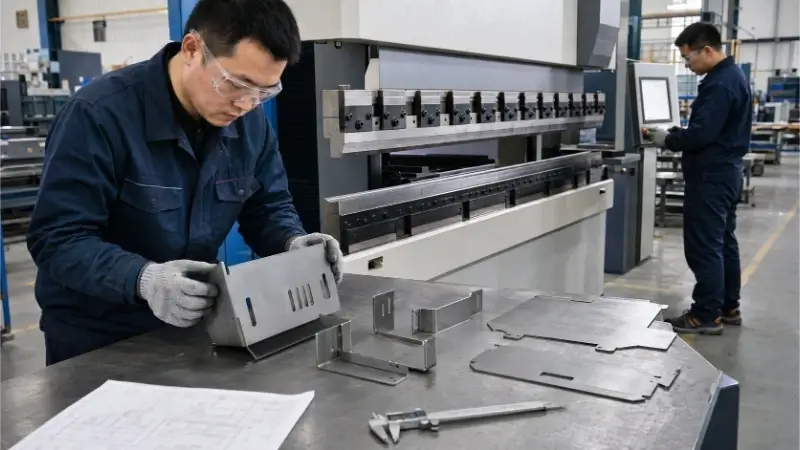
Low-volume runs and prototypes utilize CNC press brakes. Because 301 has a much higher yield strength than mild steel or 304, it requires significantly more bending tonnage.
Press brakes typically use air bending, which makes springback harder to control precisely across different material batches. If a steel mill delivers a new batch of 301 that sits at the high end of the acceptable hardness tolerance, the press brake operator will need to manually adjust the ram depth to compensate for the increased springback.
Progressive Die Stamping Tooling Design
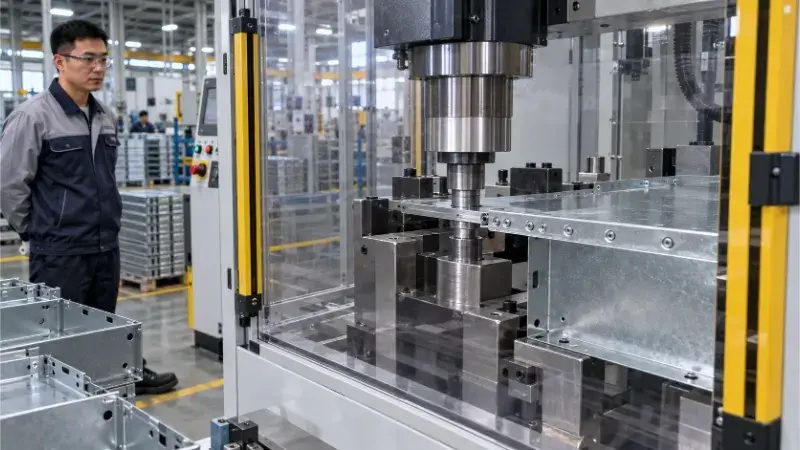
Mass production relies on progressive die stamping. When designing dies for 301, tool wear is the primary concern. The material’s tendency to work-harden aggressively during cutting and forming operations quickly dulls standard tool steels.
To maintain tight tolerances over long runs, punches and die sections are usually manufactured from high-wear materials like D2 tool steel or specialized carbide inserts. Furthermore, these tools often require PVD coatings (such as Titanium Nitride) combined with heavy-duty lubrication to prevent galling—a condition where the stainless steel micro-welds itself to the tooling surface under high pressure.
Common 301 Engineered Components
301 stainless steel is rarely used for standard enclosures or flat panels. It is specified for functional components that must endure repeated mechanical stress, retain structural rigidity, or provide consistent clamping force.

Spring Clips and Custom Fasteners
Spring clips, retaining rings, and custom snap-fit fasteners are the most common applications for 301 sheet metal. These parts typically utilize 1/2 hard to full hard tempers. The high work-hardening rate ensures that the clip can be repeatedly flexed during assembly or operation without exceeding its yield strength and permanently deforming.
Electrical Contacts and Terminals
While copper alloys (like beryllium copper) are preferred for pure electrical conductivity, 301 stainless steel is frequently used for battery contacts and connector terminals where high mechanical retention is the primary requirement.
Because stainless steel has relatively low electrical conductivity, 301 contacts are usually subjected to secondary plating processes, such as nickel, tin, or gold plating. This combination of high mechanical retention and plated conductivity makes 301 highly effective for EV battery pack contacts, automotive sensor terminals, and medical device connectors.
EMI Shields and Structural Brackets
For electronic devices, 1/4 hard 301 is often specified for internal chassis brackets and Electromagnetic Interference (EMI) shields. The material provides excellent rigidity at thinner gauges, allowing engineers to reduce the overall weight and footprint of an assembly. The natural corrosion resistance of 301 also eliminates the need for secondary anti-corrosion coatings in most indoor environments.
The 301 Stainless Steel RFQ Checklist
When moving a 301 part into production, the Request for Quote (RFQ) and engineering drawings must contain specific material details. Omitting these details often leads to inaccurate pricing, inconsistent part quality, or costly forming failures.
Defining Edge Conditions (Slit vs. Deburred)
Raw 301 coil is typically supplied with a #3 slit edge. Slitting leaves microscopic burrs and stress fractures along the material edge. If a tight bend is located near a slit edge, these micro-fractures can easily propagate into deep cracks during forming.
Engineering Recommendation: If your part features bends close to the perimeter, clearly specify a deburred or conditioned edge (like a #5 square edge or #1 round edge) on the drawing. This alerts the manufacturer to include edge-rolling or vibratory deburring operations before the final forming steps.
Specifying Rolling Direction on Drawings
As established in the DFM rules, bending parallel to the grain on hard tempers leads to cracking. However, manufacturers cannot assume the grain direction unless it is explicitly called out on the 2D drawing.
If the grain direction is critical to the part’s survival, the drawing must include a directional arrow and a note stating: *”Grain direction must run perpendicular to the primary bend axis.”* Failure to include this note means the manufacturer will optimize the blank nesting for maximum material yield, which may align the grain parallel to the bend.
Batch-to-Batch Temper Consistency
Steel mills produce 301 tempers within a tolerance range. For example, a 1/2 hard batch might have a tensile strength anywhere between 150,000 psi and 185,000 psi. If your progressive die is dialed in for the lower end of that hardness scale, a new batch of material hitting the upper limit will cause under-bending and dimensional failures.
Purchasing Tip: Always request Material Test Reports (MTRs) with each production batch. For highly sensitive spring components, you may need to negotiate a tighter custom hardness tolerance with the supplier, rather than accepting the standard commercial range.
Specifying Tangle-Free Packaging for Spring Components
A frequently overlooked aspect of sourcing 301 spring clips or open-ended contacts is how they behave in transit. When thousands of small spring components are bulk-packed in a single box, they inevitably interlock and tangle, causing significant downtime on your assembly line.
Purchasing Tip: For high-volume orders of complex clips, specify packaging requirements on your RFQ. Requesting “tangle-free packaging,” such as layered blister trays, custom thermoformed trays, or tape-and-reel packaging for automated assembly, will save your operators countless hours of manual detangling.
Conclusion
Successfully manufacturing components from 301 stainless steel requires a balance of material science and practical tooling experience. While the alloy offers excellent spring properties and high tensile strength, its aggressive work-hardening rate demands strict adherence to bend radius limits, grain direction controls, and robust progressive die design.
Whether you are transitioning from laser-cut prototypes to high-volume progressive stamping, or struggling with inconsistent springback on an existing part, working with a specialized sheet metal manufacturer ensures these variables are controlled. Proper planning at the DFM and RFQ stages will minimize tooling wear, eliminate cracked parts, and reduce long-term production costs.
Ready to move your 301 stainless steel project into production?
At Shengen, our engineering team brings over 10 years of sheet metal fabrication and progressive stamping experience to the table. We understand the precise overbend calculations, tooling wear factors, and temper controls required to manufacture 301 components reliably and cost-effectively.
Stop guessing on bend radii and material tempers. Send us your STEP files and PDF drawings today for a comprehensive DFM review and a competitive manufacturing quote.
FAQs
Is 301 stainless steel magnetic?
In its annealed state, 301 is generally non-magnetic. However, because it transforms into martensite when cold-worked, 1/4, 1/2, and full hard 301 components will exhibit strong magnetic properties.
Can you weld 301 stainless steel?
Yes, but it requires caution. The higher carbon content in 301 makes it susceptible to carbide precipitation (intergranular corrosion) in the heat-affected zone. Spot welding works well for thin gauges, but TIG welding usually requires post-weld annealing to restore full corrosion resistance.
How does 301 compare to high-carbon spring steel?
High-carbon spring steel can achieve higher absolute strength levels and is generally cheaper. However, 301 stainless steel offers inherent corrosion resistance. Using 301 eliminates the need for secondary rust-prevention treatments (like zinc plating or oiling) required by standard spring steels.
Hey, I'm Kevin Lee

For the past 10 years, I’ve been immersed in various forms of sheet metal fabrication, sharing cool insights here from my experiences across diverse workshops.
Get in touch
Kevin Lee
I have over ten years of professional experience in sheet metal fabrication, specializing in laser cutting, bending, welding, and surface treatment techniques. As the Technical Director at Shengen, I am committed to solving complex manufacturing challenges and driving innovation and quality in each project.