Outsourcing sheet metal production has become a strategic decision rather than a cost shortcut. According to a 2024 Deloitte manufacturing survey, over 65% of global OEMs outsource at least part of their fabrication to improve flexibility, shorten lead time, and reduce capital spending.
For many manufacturers, outsourcing converts heavy fixed costs—machines, labor, and maintenance—into variable costs that can scale with demand. Yet poor supplier selection can lead to serious losses in quality, delivery, or intellectual property protection.
This guide outlines the critical checks every buyer should perform before choosing a fabrication partner. It combines engineering insight with practical sourcing steps to help procurement and engineering teams build sustainable, high-performing supply chains.

Why More Companies Outsource Sheet Metal Production?
Outsourcing sheet metal work is about optimizing resources, not just cutting expenses. It allows companies to focus on design and product development while relying on specialized suppliers for high-precision fabrication.
Core Advantages That Drive the Trend
Cost Efficiency and Capital Control
Building an in-house fabrication workshop can require over USD 500,000 in machinery, including fiber-laser cutters, press brakes, and robotic welders. By outsourcing, companies shift this burden to suppliers that already maintain these assets—reducing capital exposure and payback time.
Access to Advanced Equipment and Expertise
Modern suppliers invest in fiber-laser cutting systems (±0.1 mm accuracy), servo-press brakes with automatic angle correction, and robotic welding cells that reduce rework rates by up to 40%. Few buyers can match this level of internal precision, especially for complex assemblies or multi-material projects.
Scalability and Production Agility
When demand fluctuates, external partners can ramp production quickly without hiring new staff or expanding facilities. This agility helps manufacturers avoid underutilized capacity during slow seasons while still delivering during spikes.
Faster Time-to-Market
Suppliers with integrated DFM review, tooling, and finishing capabilities can cut prototype-to-production lead times by 30–50%, accelerating launch cycles and boosting competitiveness in fast-moving industries.
Strategic vs. Tactical Outsourcing
Not every outsourcing decision follows the same logic. Buyers should clearly distinguish between strategic and tactical outsourcing.
- Strategic outsourcing focuses on building a long-term partnership. The supplier understands your product standards, tolerances, and material specifications, often contributing engineering feedback and process improvements.
- Tactical outsourcing solves short-term capacity or cost issues—for instance, overflow production or a one-off batch. It’s fast but limited in collaboration depth.
An effective sourcing plan often combines both: strategic partners handle stable programs, while tactical partners provide flexibility for urgent or low-volume work.
Key Considerations Before Choosing an Outsourcing Partner
Outsourcing success depends on more than pricing. The right partner must demonstrate the capacity, discipline, and engineering awareness to support your designs from prototype through mass production.
Technical Capabilities and DFM Support
A reliable supplier should cover the full fabrication chain—laser cutting, CNC punching, bending, welding, grinding, and surface finishing—under one roof. This minimizes hand-offs and improves process control.
Assess their material expertise as well. Handling stainless steel, aluminum, and carbon steel requires different bend radii, filler metals, and thermal management. A diverse portfolio signals real production experience.
Suppliers that provide Design for Manufacturing (DFM) feedback early can reduce costly design errors and streamline production. Ask for examples of design adjustments that saved time or improved tolerances.
Certifications, Quality Systems, and Traceability
Quality assurance is not optional—it repeatedly determines whether outsourced parts meet specifications.
Look for certifications such as ISO 9001:2015, IATF 16949, or AS9100, depending on your industry. These frameworks confirm the supplier’s ability to maintain process consistency.
Ask how they conduct inspections: in-process measurement (during cutting and bending) is more effective than post-production sampling. Review whether they use SPC data, CMM inspection, or digital inspection reports.
Traceability should extend from raw material to final shipment. For critical projects, request FAI (First Article Inspection) documentation or PPAP approval records to verify repeatability before scaling up.
Equipment and Digital Integration
Modern fabrication relies on precision and automation. Evaluate the supplier’s machine list—not just what they have, but how recent and accurate it is.
- Fiber-laser cutters (±0.1 mm) outperform older CO₂ lasers (±0.25 mm).
- Servo-driven press brakes offer better springback control than hydraulic types.
- Robotic welding cells ensure uniform bead geometry and reduce operator variation.
Digital integration matters just as much as hardware. A supplier running CAD/CAM-linked ERP or MES systems can track orders, monitor production in real time, and share live status updates—improving visibility and coordination.

Evaluating Supplier Reliability and Communication
Even the most advanced equipment means little if a supplier cannot deliver consistently or communicate effectively. In sheet metal outsourcing, reliability and transparency are what transform a contract manufacturer into a long-term partner.
Reputation and Track Record
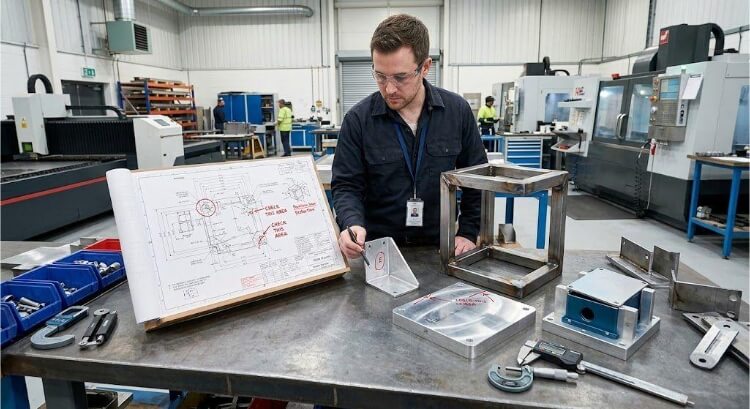
Before awarding a project, check how well the supplier has performed in similar cases. Request case studies, reference contacts, or sample project photos to evaluate their experience in comparable industries such as enclosures, medical devices, or automation frames.
Reliable suppliers maintain on-time delivery (OTD) rates above 95% and a rework rate below 2%. These metrics are not marketing claims—they are measurable indicators of process stability.
If these numbers are unavailable, ask for internal production logs or quality performance dashboards.
A site visit (or a well-documented virtual audit) can reveal more than brochures ever will.
Look for:
- Organized material flow from cutting to assembly
- Labeled raw materials and clear traceability
- Maintenance logs for machines and tools
- Clean welding and bending areas, showing real process control
Disorganization and poor material tracking usually indicate hidden lead-time risks.
Communication and Responsiveness
Smooth communication is the backbone of every successful outsourcing project. Misunderstandings in drawings, tolerances, or finishing requirements often cause rework and delivery delays.
Test communication quality early—before the first order:
- How fast do they respond to your RFQ or technical question?
- Do they provide detailed answers or generic replies?
- Are they comfortable discussing DFM suggestions or tolerance adjustments?
An engineering team that communicates with precision will usually manufacture with precision.
For international projects, set up structured communication routines—such as weekly progress calls, milestone reports, and shared production dashboards.
Also, verify whether the company uses digital tracking tools (e.g., ERP systems or cloud-based order systems) to provide transparent updates. This helps you anticipate issues early, rather than reacting to them after delays occur.
Tip: A trustworthy supplier never hides a problem. If they proactively report potential delays or technical concerns, it’s a sign of strong management, not weakness.
Hidden Costs and Risk Management in Outsourcing
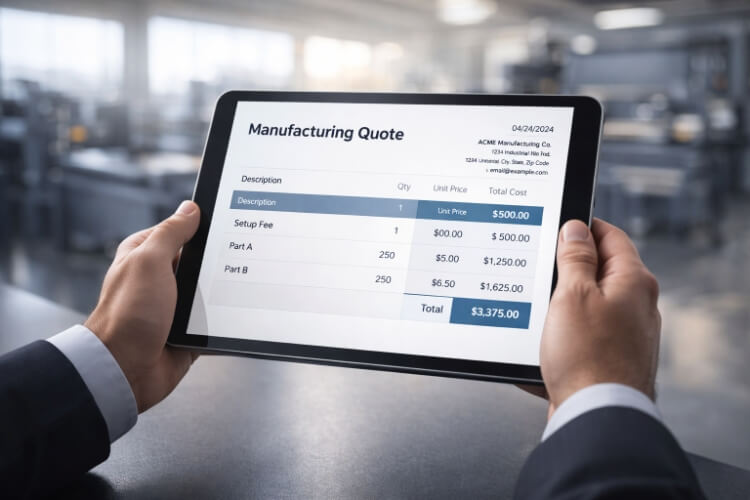
Many buyers underestimate the true cost of outsourcing. The unit price may look low, but total expenses can climb once shipping, rework, and delays are added. A complete Total Cost of Ownership (TCO) analysis prevents these surprises.
Total Cost Beyond Unit Price
When comparing quotations, consider all indirect and hidden costs:
| Cost Category | Examples | Potential Impact |
|---|---|---|
| Logistics & Customs | Freight, tariffs, insurance | Adds 5–15% to landed cost |
| Packaging & Compliance | Testing, labeling, certifications | Delays shipment if missing |
| Currency & Payment Terms | Exchange rate swings, transaction fees | Affects profit margin |
| Rework or Late Delivery | Replacement parts, express freight | Cancels cost savings |
| Communication Delay | Misunderstood specs or revisions | Increases lead time unpredictably |
When evaluating suppliers, always calculate landed cost per usable part, not just per quoted part. A vendor that is 10% cheaper on paper but delivers 20% late can actually cost more overall due to production downtime.
Managing Supply Chain Risks
Even the best suppliers face disruptions—from material shortages to logistics bottlenecks. Buyers should develop a risk control plan early in the outsourcing relationship.
Dual Sourcing for Stability
Maintain at least two qualified suppliers for critical components. This redundancy minimizes downtime during geopolitical or raw-material fluctuations.
Performance Monitoring
Track each supplier’s performance monthly. Key metrics include:
- On-time delivery rate (target ≥ 95%)
- Defect rate (target ≤ 2%)
- Response time to corrective actions (within 48 hours)
- Average lead-time variance (target ≤ ±10%)
Data Protection and IP Security
Sign Non-Disclosure Agreements (NDAs) before sharing CAD files or drawings—request written statements on data storage and server location to confirm that your product files are securely handled.
Continuous Review and Corrective Actions
Regular performance reviews strengthen mutual accountability. If a problem occurs, analyze root causes together and track follow-up actions in writing.
How to Conduct a Supplier Evaluation Checklist?
A well-executed supplier audit is one of the most effective tools to verify a fabricator’s real capabilities. Many suppliers can present impressive profiles online—but an audit, even virtual, reveals whether their systems, processes, and culture align with your quality and delivery goals.
On-Site or Virtual Audit Essentials
A structured audit should cover five key areas: process control, workplace organization, equipment management, quality assurance, and operator competency.
Below are practical checkpoints buyers can use during evaluation:
Factory Layout & Workflow Efficiency
Observe whether the production floor follows a logical sequence: laser cutting → forming → welding → surface finishing → inspection. Smooth material flow reduces handling time and quality risks. Disorganized movement signals inefficiency and hidden delays.
Material Traceability & Inventory System
Ask how materials are labeled and tracked. A strong ERP system should record material heat number, supplier lot, and storage location, ensuring traceability for each part batch.
Machine Maintenance & Calibration
Request calibration records for bending machines, welding power sources, and measuring tools. A supplier performing preventive maintenance at least once per quarter typically maintains tighter process control.
Operator Qualification
Skilled technicians are essential for consistent quality. Verify operator certifications (e.g., AWS D1.1 welding, ISO 9606) and the frequency of internal training. Ask how new operators are qualified and monitored.
Process Documentation
Review standard operating procedures (SOPs), inspection instructions, and deviation handling methods. Consistent documentation prevents variation between shifts or operators.
Comprehensive Buyer Checklist
Here’s a buyer checklist you can adapt for supplier comparisons. It integrates technical, operational, and management aspects with clear verification methods.
| Evaluation Area | Key Questions | Evidence to Request | Why It Matters |
|---|---|---|---|
| Quality System | Do they have ISO 9001 or IATF 16949 certification? | Certificate copy, audit report | Confirms consistency and compliance |
| Production Capability | What processes are in-house vs outsourced? | Machine list, process map | Identifies true fabrication scope |
| Lead Time & Capacity | How long is the typical cycle time per batch? | Production plan, scheduling chart | Ensures realistic delivery promises |
| Engineering Support | Do they offer DFM or tolerance review? | Example of past DFM feedback | Prevents design flaws early |
| Traceability | How are materials and batches tracked? | ERP screenshots, labeling photos | Guarantees accountability |
| Maintenance | Are machines regularly serviced and logged? | Maintenance calendar | Reduces downtime and variation |
| Communication | How fast do they respond to RFQs and changes? | Email or report samples | Reflects operational discipline |
Scoring Tip:
Rate each category on a 1–5 scale, then calculate the total to identify the top-performing suppliers objectively. A total score of ≥ 80/100 typically indicates strong readiness for long-term cooperation.
Global vs Local Outsourcing: Making the Right Choice
Selecting where to outsource—locally or internationally—depends on your company’s goals, product type, and tolerance for lead-time risk. There is no universal best option; the right balance often combines both.
Advantages of Local Partners
Local outsourcing provides faster communication, shorter shipping times, and easier on-site audits.
It’s especially effective for prototypes, assemblies that require frequent design iterations, and parts with tight tolerances and cosmetic requirements.
- Lead time: Typically 30–50% shorter than overseas production.
- Quality control: Easier to visit and verify.
- IP protection: Reduced risk of data leakage.
- Regulatory compliance: Simplified adherence to domestic standards (e.g., UL, CE, FDA).
Local partnerships work best for industries demanding confidentiality or regulatory oversight, such as medical devices, aerospace, and electronics.
Advantages of Overseas Partners
Overseas manufacturing, especially in countries with mature fabrication supply chains, offers significant cost competitiveness and production scalability. Suppliers often have access to a wide range of materials, surface treatments, and finishing options within one ecosystem.
- Cost savings: Typically 20–40% lower per unit, depending on complexity and logistics.
- Integrated capabilities: Laser cutting, stamping, machining, and powder coating are often handled under one roof.
- High capacity: Ability to support mass production with short setup times.
However, buyers should factor in longer transit time (2–6 weeks), customs procedures, and possible currency fluctuations. Proper packaging and buffer stock planning help prevent disruptions in high-volume supply chains.
Design Tip: Use identical technical drawings, revision control systems, and QC standards across both supplier types. This ensures seamless handoff and consistent results between regions.
KPIs and Continuous Monitoring After Outsourcing
Outsourcing doesn’t end when the first batch ships—it’s the beginning of a long-term relationship that must be measured, reviewed, and continuously improved.
Performance Metrics That Matter
Reliable suppliers treat performance data as a language of trust. Buyers should define measurable KPIs early in the partnership and review them regularly. Here are key metrics commonly used in sheet metal outsourcing performance management:
| KPI | Target / Benchmark | Why It Matters |
|---|---|---|
| On-Time Delivery (OTD) | ≥ 95% | Reflects supply reliability and planning accuracy |
| Defect Rate (PPM) | ≤ 2,000 PPM (0.2%) | Indicates process capability and quality consistency |
| Lead Time Variance | ±10% | Measures schedule control and workflow efficiency |
| Response Time to Issues | ≤ 48 hours | Tests communication and problem-solving culture |
| Cost Variance vs. Quotation | ≤ 5% | Tracks pricing stability and hidden cost exposure |
| Engineering Support Rating | ≥ 4/5 (internal survey) | Reflects collaboration depth and DFM effectiveness |
When suppliers consistently meet these targets, it signals a mature, stable, and data-driven operation. If KPIs fall outside tolerance, corrective actions should be launched immediately, with clear root-cause analysis and follow-up dates.
Pro Tip: Digitize your KPI review process. Use shared dashboards or automated spreadsheets linked to inspection and delivery data—this reduces manual reporting errors and provides transparency for both teams.
Feedback Loop for Long-Term Collaboration
High-performing outsourcing partnerships are built on mutual feedback, not punishment. Quarterly Supplier Performance Reviews (SPRs) provide a platform to discuss issues, recognize progress, and plan improvements together.
Key discussion points can include:
- Analysis of recent defect trends and improvement actions
- Process or automation upgrades under development
- Capacity forecasting for upcoming orders
- New material or finishing technologies available
- Suggestions for cost or cycle-time reduction
Leading manufacturers also implement Supplier Development Programs—joint engineering workshops or process-improvement projects that strengthen cooperation. This not only enhances product quality but also drives innovation through shared expertise.
Example:
A European energy-storage OEM reduced welding rework by 35% after inviting its sheet metal supplier to participate in fixture redesign and weld-sequence optimization. Such collaboration transforms outsourcing from a transactional relationship into a true engineering partnership.
How to Maintain Transparency and Trust?
Trust in outsourcing grows when both sides share data and communicate openly.
Buyers should:
- Provide timely design revisions and forecasts.
- Avoid sudden, unannounced changes in order volume.
- Publicly recognize supplier achievements when performance improves.
Suppliers, in turn, should:
- Deliver transparent quality reports and shipping updates.
- Notify buyers immediately of potential risks.
- Suggest technical or cost-saving improvements proactively.
This two-way accountability reduces friction and builds long-term confidence—turning the buyer-supplier link into a competitive advantage rather than a cost center.
Conclusion
Outsourcing sheet metal production is not just a cost decision; it’s a strategic extension of your manufacturing capability. Done right, outsourcing becomes a force multiplier—delivering faster turnaround, higher quality, and global scalability without the overhead of full in-house production.
Looking for a trusted sheet metal fabrication partner? Our engineering team provides free DFM feedback, quotation within 24 hours, and full ISO-based quality documentation for every project. Contact us today to discuss your design files or request a detailed supplier checklist to simplify your sourcing process.
FAQs
What should I check first when outsourcing sheet metal production?
Start by verifying the supplier’s technical capabilities, quality certifications (ISO/IATF), and equipment precision. These determine whether they can meet your tolerance and finish standards.
How do I calculate the true cost of outsourcing?
Consider the Total Cost of Ownership (TCO)—including material, freight, packaging, customs, and rework costs. A low quote doesn’t always mean lower overall spending.
What makes a sheet metal supplier reliable?
Consistency in on-time delivery, defect rate, and communication responsiveness. Top suppliers maintain OTD > 95% and rework < 2%.
Should I choose local or overseas outsourcing?
Local suppliers offer faster feedback and easier audits, while overseas vendors provide lower unit costs and larger capacity. A hybrid sourcing model often works best.
How can I protect my design and data when outsourcing internationally?
Always sign Non-Disclosure Agreements (NDAs) and confirm the supplier’s data security and server storage practices before sharing CAD files.
Hey, I'm Kevin Lee

For the past 10 years, I’ve been immersed in various forms of sheet metal fabrication, sharing cool insights here from my experiences across diverse workshops.
Get in touch
Kevin Lee
I have over ten years of professional experience in sheet metal fabrication, specializing in laser cutting, bending, welding, and surface treatment techniques. As the Technical Director at Shengen, I am committed to solving complex manufacturing challenges and driving innovation and quality in each project.
Related Resource

Fingerprint Resistant Stainless Steel: How It Works,and How to Choose