Many sheet metal parts look simple on a drawing. In production, they are not always easy to make well. The forming method behind a bracket, enclosure panel, housing, or cover can directly affect cost, lead time, repeatability, and how smoothly the part moves into stable production.
That is why sheet metal forming should not be viewed as only a shaping step. It is also a manufacturing decision. The right process can improve stiffness, reduce assembly work, and support consistent output. The wrong process can lead to avoidable problems in angle control, surface quality, and design flexibility.
This guide looks at the practical side of sheet metal forming. It explains what sheet metal forming is, which processes are most common, and how those process choices affect manufacturing results in real projects.

What Is Sheet Metal Forming?
Sheet metal forming is the process of changing flat metal into a new shape by applying controlled force. The material is pushed past its elastic limit so it keeps the new shape after the force is removed. In simple terms, the sheet becomes a structural part through deformation, not through heavy cutting or multi-piece assembly.
This matters because forming is often what turns a flat blank into a useful production part. A bend can add stiffness to a mounting bracket. A drawn wall can create depth in a housing. A formed profile can reduce welding, simplify assembly, and improve consistency across repeat runs. In many projects, the value of forming is not only that the shape can be made. The value is that the shape can often be made with fewer steps and a better production plan.
The material does not behave the same way in every forming method. In bending, the sheet changes angle along a line. In deep drawing, the material flows into a die cavity to create depth. In roll forming, the profile is built step by step through a sequence of rollers. The method changes, but the basic idea stays the same. Shape comes from controlled deformation, and production success depends on how well that deformation is controlled.
Which Sheet Metal Forming Processes Are Most Common?
Sheet metal forming includes several process types, but they do not solve the same kind of problem. Some processes are better for flexible production and folded shapes. Others are better for deeper forms, long repeated profiles, or higher-volume output.
Bending
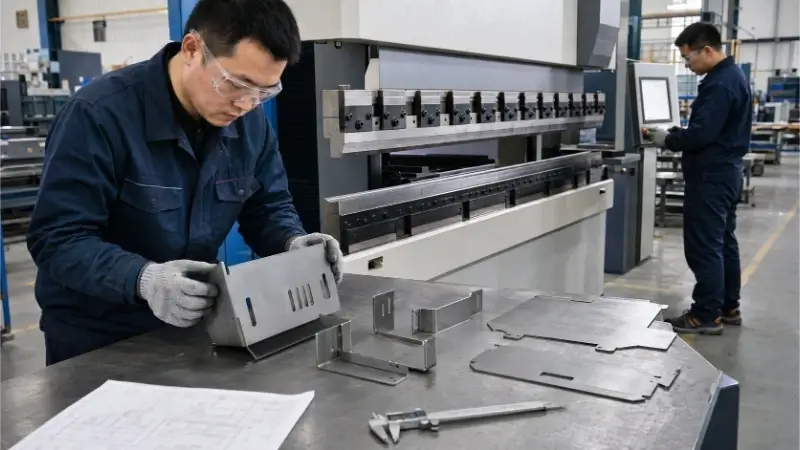
Bending is the most practical starting point for many sheet metal parts. It is widely used for brackets, enclosure panels, covers, trays, and support parts built around angles and flanges.
Its biggest advantage is flexibility. For low- to medium-volume work, bending supports fast changes without the cost and commitment of dedicated tooling. This makes it a strong choice for prototypes, pilot builds, and parts that may still change after testing, assembly review, or customer feedback.
At the same time, bending only stays simple when the design follows forming limits. Tight radii, short flanges, poor hole placement, or unfavorable grain direction can quickly turn a basic bend into cracking, distortion, or angle variation. As a starting point, many general designs use an inside bend radius close to 1t, then adjust it based on material, temper, thickness, and cosmetic needs.
In real projects, good bending results usually come from good part design before they come from machine tonnage. For holes or slots near a bend, many teams also use about 1.5t to 2t as an early spacing guideline when space allows. This usually reduces the risk of hole pull, local deformation, and later assembly problems.

Stamping
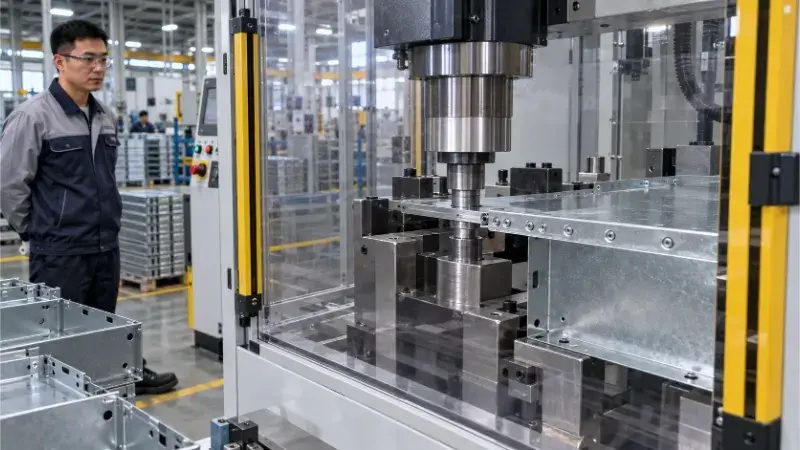
Stamping becomes more attractive when part demand is stable and the design is no longer changing. It uses dedicated tooling in a press to form parts quickly and repeatedly. That is why it is common in larger production programs.
Its main strength is production efficiency. Once the tooling is built and the process is stable, stamping can lower piece-part cost, improve repeatability, and support faster output across repeat orders. For mature parts such as repeat brackets, hardware components, appliance panels, or shielding parts, this often makes it a stronger long-term choice than flexible fabrication alone.
The trade-off is upfront commitment. Tooling cost is higher, and design changes become less forgiving once production tooling is in place. That is why stamping usually makes sense when the geometry is already stable, the order pattern is predictable, and the expected volume is high enough to justify the investment.

Deep Drawing
Deep drawing is used when a part needs real depth, not just folded edges. It is commonly chosen for shells, housings, cups, and box-like shapes where simple bending cannot create the geometry cleanly.
Its value is not only geometric. A drawn part can reduce seams, simplify assembly, and create a cleaner one-piece structure. In the right application, such as a battery housing, formed shell, or metal canister, this can improve both part consistency and downstream manufacturing efficiency.
Deep drawing is more sensitive than basic bending. The process depends on stable material flow, part depth, corner shape, and draw ratio. These factors all affect whether the part can be formed successfully. As an early check, deeper shell parts usually carry more risk when the draw depth becomes large compared with the part opening and material thickness.

Roll Forming
Roll forming is best suited for long parts with a constant cross-section. Instead of shaping one part at a time, the material passes through a series of rollers that gradually build the final profile.
This process works well for channels, rails, trims, and support sections that repeat over long lengths. Its main advantage is consistency and speed in continuous production, especially when the same section is needed again and again.
Its limitation is also clear. Roll forming is not a general solution for mixed part shapes or short-run custom parts. It makes the most sense when the section stays constant along the full length and the production volume is high enough to support the setup.

Hydroforming
Hydroforming is usually selected for parts that need smoother contours or more controlled material flow than standard forming methods can provide. It uses fluid pressure to help shape the metal into more complex forms.
This makes it a more specialized choice than bending or standard stamping. It is not the default solution for general sheet metal work, but it can be effective when part geometry, surface transitions, or performance needs make conventional forming less suitable.

How to Choose the Right Forming Process?
The right forming process is usually decided before production starts. The choice depends on the part shape, production volume, material, and cost target.
Part Geometry
Part geometry is usually the first thing to review. A simple mounting bracket with a few bends does not need the same process as a deep housing or a long support rail. The shape shows whether the part is mainly based on bend angles, part depth, or a constant cross-section.
If the part is mostly flat and has folded features, bending is often the most practical option. If the part needs more depth and smoother wall transitions, deep drawing may be a better choice. If the cross-section stays the same from one end to the other, roll forming often makes more sense. In many cases, the geometry already points to the right process before cost is discussed.
Production Volume
Production volume changes how teams choose the process. For low-volume work, flexible methods often make more sense because they avoid high tooling cost at the start. For repeat production, the choice often moves toward methods that reduce cycle time and lower part cost.
That is why bending is common in prototypes, pilot runs, and early-stage products that may still change. Stamping becomes more attractive when the demand is steady enough to support dedicated tooling. In real quoting work, the main question is not whether tooling can reduce cost. The real question is whether demand is stable enough to pay that tooling cost back.
Material Behavior
Material choice affects forming more than many teams expect. Two parts can share the same drawing but behave very differently when the material changes. Strength, ductility, thickness, and springback all affect which process will stay stable in production.
For example, stainless steel usually has more springback than mild steel. Some aluminum grades are more sensitive in tight bends. A process that works well for a carbon steel bracket may need different allowances, different tooling, or even a different plan for an aluminum cover or a stainless steel enclosure panel.
Tolerance Needs
Tolerance requirements show how much process control the part really needs. Some parts only need to meet function. Other parts also need better alignment, a cleaner appearance, or a tighter fit during assembly. These differences can change which process makes the most sense.
A flexible process may be enough for general industrial parts with realistic tolerance needs. A more controlled process may be better when repeatability matters more across larger production runs. Cosmetic parts are also less forgiving than internal functional parts because small changes are easier to see and easier to reject.
Which Materials Work Best for Sheet Metal Forming?
Material choice affects much more than corrosion resistance or strength. It affects how easily the part forms, how much springback appears, how small the bend radius can be, and how stable the result stays during production.
Stainless Steel
Stainless steel is often chosen when corrosion resistance, appearance, or long service life matters. It is common in industrial equipment, food-related products, medical parts, and visible housings.
Aluminum
Aluminum is widely used when lower weight matters. It is common in electronics, transport products, housings, covers, and parts where easier handling or lower mass supports the design.
Carbon Steel
Carbon steel is often the most practical starting point for general sheet metal work. It offers a good balance of cost, strength, availability, and formability. That is why it is so common in brackets, panels, supports, cabinets, and enclosure parts.
Galvanized Steel
Galvanized steel is often chosen when corrosion protection is needed but the project does not want to move to a higher-cost stainless option. It is widely used in cabinets, covers, HVAC parts, and general industrial products.
Copper and Brass
Copper and brass are usually chosen for special applications rather than general structural sheet metal work. They are common in electrical parts, conductive components, decorative products, and some custom industrial assemblies.
Design Rules That Affect Part Quality
Many sheet metal forming problems do not start at the machine. They start in the drawing. A part may look clean in CAD, but small design choices often decide whether it forms smoothly, holds size, and stays cost-effective in production.
Bend Radius
Bend radius has a direct effect on how safely the material can form. If the radius is too tight for the material and thickness, the risk of cracking increases. This is even more common in harder materials or less forgiving tempers.
As a practical starting point, many general designs begin with an inside bend radius near 1t. Teams then adjust it based on material, thickness, and surface requirements. This is not a fixed rule, but it is a useful early check that helps prevent overly aggressive geometry.
Hole-to-Bend Spacing
Features placed too close to a bend often create avoidable problems. Holes may deform, slots may move, and local areas may lose size accuracy after forming.
For many parts, keeping features about 1.5t to 2t away from the bend zone is a practical early guideline when space allows. The exact safe distance still depends on geometry, tooling, and material, but tighter spacing usually brings more risk.
Flange Length
Very short flanges are often harder to form than they appear on the drawing. They can reduce tool access, weaken bend control, and make the final shape less consistent from part to part.
A workable flange length gives the process more stability. It makes the bend easier to form, inspect, and repeat. When the flange design is too aggressive, the part may still be possible to make, but the production window becomes smaller and less forgiving.
Corner Relief
Corner relief helps control the material where bends meet or where the shape changes direction. Without enough relief, the material may tear, overlap, or build stress that affects both part shape and appearance.
This is one of those small drawing details that matters a lot in real production. A simple relief change can reduce forming problems without changing the function of the part. That is why corner relief is often one of the easiest ways to improve manufacturability early.
Springback Allowance
Springback is a normal material response, not a special defect. Metal tries to recover slightly after forming, and the design should expect that behavior from the beginning.
This matters even more with materials such as stainless steel and some aluminum grades, where springback is easier to notice. If the design assumes the formed angle will stay exactly where it was pressed, repeatability problems become more likely.

Common Forming Problems and Their Causes
Sheet metal forming can produce clean and efficient parts, but only when design, material, and process work well together. In most cases, understanding the cause matters more than simply naming the defect.
Cracking
Cracking usually happens when the material is forced to deform more than it can safely handle. Tight bends, lower-ductility materials, poor grain direction, or overly aggressive geometry can all push the part too close to its limit.
This problem often looks like a shop-floor defect, but the root cause usually begins earlier. If the design leaves too little margin, the process may only work under ideal conditions instead of normal production conditions. In many cases, a crack is the visible result of an overstrained design, not just a bad production run.
Wrinkling
Wrinkling happens when the material loses stability under compressive stress during forming. It is more common in drawing and shaping operations where the sheet must move and spread over a wider area.
Wrinkling usually points to a control problem rather than a simple force problem. Material flow may not be supported well, or the geometry may be asking the sheet to move in an unstable way. When wrinkles appear in a drawn shell or housing, the issue is often linked to part shape, blank control, or forming setup.
Surface Damage
Surface damage includes scratches, pressure marks, galling, and tool marks. For internal parts, some of these marks may be acceptable. For visible covers, outer panels, and cosmetic housings, they can quickly become rejection issues.
This problem is easy to underestimate because the part geometry may still be correct. But when the product depends on appearance, surface condition matters as much as size accuracy. Tool condition, lubrication, handling, and part protection all affect this result.
When Sheet Metal Forming Makes Sense?
Sheet metal forming is not the right choice for every metal part. It works best when the part shape, expected volume, and manufacturing goals all support efficient sheet forming.
Prototype-to-Production Work
Sheet metal forming makes sense when a project needs to move from prototype to repeat production without changing the manufacturing approach too much. A part built on good bend geometry or a stable formed shape is often easier to scale than a part that depends too much on temporary machining or short-term fixes.
This is especially true when the design team already has a clear sense of the likely production path. Early builds can stay flexible, while the part still moves toward a more repeatable process later.
Lightweight Parts
Forming is a strong choice when a part needs useful strength without extra weight. A flat sheet can gain stiffness and function through bends, flanges, ribs, and drawn features instead of depending on thicker material or solid stock.
This makes forming attractive for products where lower weight improves handling, installation, transport, or product performance. It is one of the most practical ways to build strength through geometry instead of extra mass.
Enclosures and Brackets
Many practical sheet metal parts fall into this group. Enclosures, covers, brackets, trays, and support parts are often built around bends, folded edges, and simple formed features. These are exactly the kinds of shapes that forming handles well.
In these cases, forming often provides a cleaner and more efficient solution than building the same function from several separate parts. A single formed part can improve stiffness, reduce welding, and simplify assembly.
Cosmetic Metal Parts
Forming also makes sense for parts where appearance matters, as long as the process is controlled with that goal in mind. Covers, visible panels, housings, and exterior metal parts often need both size accuracy and good surface quality.
A well-controlled forming process can support both needs. But cosmetic parts are less forgiving than internal functional parts. Tool marks, scratches, and surface variation become easier to see and more costly to accept.
Conclusion
Sheet metal forming is one of the most practical ways to turn flat metal into strong, repeatable, and cost-effective parts. But good results depend on more than choosing a process by name. Part geometry, material behavior, production volume, tooling strategy, and design discipline all affect whether a part will run smoothly in real production.
If you are developing a sheet metal part and want to confirm the right forming method before production, our team can review the design from both an engineering and manufacturing point of view.
We support projects from prototype to repeat production. Our team can help with process selection, material review, manufacturability feedback, and quotation support for custom sheet metal parts. Send us your drawings or project requirements, and we can help you evaluate a practical path for forming, cost control, and production readiness.
Hey, I'm Kevin Lee

For the past 10 years, I’ve been immersed in various forms of sheet metal fabrication, sharing cool insights here from my experiences across diverse workshops.
Get in touch
Kevin Lee
I have over ten years of professional experience in sheet metal fabrication, specializing in laser cutting, bending, welding, and surface treatment techniques. As the Technical Director at Shengen, I am committed to solving complex manufacturing challenges and driving innovation and quality in each project.