Grinding stainless steel is the process of removing welds, burrs, excess material, or surface defects from stainless steel parts. The main risks are heat discoloration, work hardening, iron contamination, surface scratches, and uneven finishing. Good results depend on the right abrasive, light pressure, clean tools, stable speed, and clear inspection standards.
This guide explains how stainless steel reacts during grinding. It also shows how to choose the right abrasives, control grinding settings, and reduce common production defects.
Key Takeaways
- Stainless steel holds heat near the grinding zone, so light pressure and sharp abrasives are critical.
- Ceramic abrasives work well for heavy material removal and batch production.
- Aluminum oxide and zirconia can still be useful for light-duty grinding, prototypes, and lower-cost work.
- Grinding defects often come from heat, wheel loading, cross-contamination, and poor grit sequence.
- Batch consistency depends on clear inspection standards, not only operator experience.

Material Behavior During Stainless Steel Grinding
Stainless steel reacts differently from mild steel during grinding. Heat buildup, work hardening, wheel loading, and surface sensitivity decide whether the result is clean or costly.
Heat buildup and thermal distortion
Stainless steel conducts heat only about one-third as efficiently as standard carbon steel. Instead of dissipating rapidly through the part, the heat generated by the grinding wheel stays concentrated right in the grinding zone.
This localized heat buildup makes the material highly susceptible to thermal distortion. If not managed carefully, it easily causes thin sheet metal parts to warp out of tolerance and results in irreversible heat tint on the surface.
Work hardening during grinding
When abrasive tools become dull, or when an operator applies too much pressure for too long, the abrasive stops cutting and starts rubbing. This excessive friction causes the surface of the stainless steel to work harden.
Once the surface lattice structure hardens, subsequent grinding passes become much more difficult. Operators are forced to apply more pressure, which drastically accelerates tool wear and generates even more destructive heat.
Wheel loading and material smearing
High-ductility alloys, particularly 300-series stainless steels like 304 and 316, tend to produce chips that melt and stick to the abrasive media. This buildup is commonly known in the shop as wheel loading.
When the abrasive grain is covered in smeared metal, it completely loses its ability to cut cleanly. This immediately reduces grinding efficiency, increases tool drag, and spikes the surface temperature.
Surface sensitivity and corrosion risk
Stainless steel components are often used in applications where both aesthetics and functional corrosion resistance are strictly evaluated. Deep scratches, heat-affected zones, and iron contamination can physically compromise the material’s protective passive layer.
Therefore, managing the grinding process is not just about aggressive material removal. It is fundamentally about protecting visual uniformity and preventing delayed rust spots that lead to rejected parts long after they leave your shop floor.
Grinding Methods and Abrasive Selection
Selecting the right abrasive and tool for the specific operation prevents excessive heat and premature tool wear.

Weld grinding and heavy material removal
Removing heavy MIG or TIG weld seams requires aggressive material removal. Typical tools for this stage include heavy-duty abrasive belts, rigid grinding wheels, and ceramic flap discs.
The key to heavy grinding on stainless steel is staging the process. Attempting to grind a heavy weld flush in a single, deep pass traps heat and often leads to over-grinding, surface gouging, and severe heat discoloration.
Edge deburring and surface blending
When dealing with laser-cut edges, stamped profiles, or blending weld transitions, the goal shifts from heavy stock removal to creating smooth, safe, and visually consistent edges. This requires finer abrasives, lighter pressure, and controlled passes.
On cosmetic surfaces, direction matters just as much as depth. Ensuring the abrasive scratch pattern perfectly aligns with the desired final grain direction is a critical step in the blending phase.
Ceramic alumina for production grinding
For continuous production and heavy material removal, ceramic alumina is the industry standard. Ceramic grains are engineered to micro-fracture during use, which continuously exposes fresh, sharp cutting edges.
This self-sharpening mechanism allows the abrasive to cut faster and run cooler over a longer period. While the initial purchase price is higher, the reduction in tool changeovers and heat-related defects generally lowers the total cost per part in volume production.
Zirconia and aluminum oxide for lighter work
Zirconia and aluminum oxide remain viable for specific shop environments. Zirconia offers good durability for medium-duty grinding and weld blending, while aluminum oxide is a cost-effective option for light surface work and low-volume prototypes.
However, limitations exist for both materials. They will dull much faster than ceramics when subjected to the high heat and heavy pressure required for aggressive stainless steel grinding.
CBN for precision grinding
Cubic Boron Nitride (CBN) superabrasives are highly effective, but their application is distinct. They are primarily utilized in CNC surface grinding, cylindrical grinding, and when machining hardened stainless alloys to tight tolerances.
CBN provides excellent dimensional stability and tool life when paired with high-pressure coolant. However, it is generally unnecessary, overly expensive, and impractical for manual weld grinding or general sheet metal fabrication.
| Abrasive type | Best use | Main advantage | Limitation |
|---|---|---|---|
| Ceramic alumina | Heavy MIG/TIG weld removal and production | Sharp cutting and longer life | Higher initial cost |
| Zirconia | Medium grinding and weld blending | Good durability | Can load under poor control |
| Aluminum oxide | Light grinding and low-volume work | Lower cost and easy to source | Shorter life in heavy grinding |
| CBN | Precision grinding and hardened alloys | Strong dimensional stability | Not needed for most manual grinding |
Process Control Parameters
Even with the correct ceramic abrasive, a poor grinding technique will destroy a stainless steel part. Consistent process control separates high-quality fabrication operations from those plagued by high rework rates.
Pressure and contact time
Operators must let the abrasive do the work rather than leaning heavily into the grinder. Excessive pressure does not increase material removal linearly; instead, it exponentially increases heat generation and work hardening.
Keep tool contact times short. Using multiple light, rapid passes is always safer and more effective than attempting to force the wheel through the material in a single, heavy pass.
Speed and feed balance
A common machine shop error is running the spindle too fast while feeding the workpiece too slowly. This imbalance causes the abrasive grains to rub against the surface rather than cut into it.
Speed, feed rate, and applied pressure must be carefully matched to the abrasive’s optimal cutting zone and the machine’s overall rigidity. The absolute goal is continuous material shearing, not friction.
Grit sequence control
Skipping grit sizes to save production time is a false economy. Jumping directly from a 36-grit roughing disc to a 120-grit finishing belt leaves deep, microscopic gouges that are only exposed during final polishing.
A disciplined grit sequence gradually removes the scratch pattern of the previous step. For high-end cosmetic parts, transitioning to structured abrasives (such as 3D pyramid engineered belts) for the final passes ensures a highly consistent Ra value without removing excess material.
Coolant and heat control
In CNC precision grinding, flood coolant must be delivered at high enough pressure to pierce the thermal vapor barrier and reach the actual cutting zone.
In manual sheet metal fabrication where liquid coolant is impractical, heat control relies entirely on operator technique. This means utilizing intermittent grinding, taking deliberate breaks to let the part air-cool, and avoiding grinding in concentrated areas for too long.
Tool separation and cleaning
Never use a grinding wheel, flap disc, or wire brush on stainless steel if it has previously touched carbon steel. There are no exceptions to this rule.
A single embedded ferrite particle transferred from a shared tool will compromise the stainless surface. This cross-contamination acts as a catalyst, causing distinct rust blooms upon exposure to ambient moisture after delivery.
Grade-Specific Grinding Differences
Treating all stainless steel as the same material is a recipe for scrapped parts. Different microstructures require specific adjustments in grinding parameters.
304 and 316 austenitic stainless steel
As the most common fabrication alloys, 304 and 316 are notoriously gummy and highly prone to work hardening.
More importantly, excessive grinding heat doesn’t just cause aesthetic heat tint; it triggers metallurgical sensitization. This occurs when chromium carbides precipitate at the grain boundaries due to elevated temperatures, stripping the local area of its protective chromium. For parts destined for harsh marine or medical environments, this inevitably leads to rapid intergranular corrosion.
430 and other ferritic stainless steels
Ferritic grades like 430 do not work harden to the same extreme degree as the 300 series. However, they are highly sensitive to surface scratching and thermal discoloration.
Since these grades are predominantly used in cosmetic applications like architectural panels and appliance housings, maintaining a perfectly consistent scratch pattern and visual grain is the primary manufacturing challenge.
400 series martensitic stainless steels
Grades such as 410, 420, and 440C are formulated for high hardness and wear resistance. Grinding these hardened alloys requires stricter control over wheel selection, speed, and coolant flow.
Pushing too hard on martensitic grades can easily induce localized micro-cracking and degrade the mechanical integrity of the precision part.
17-4 PH and hardened stainless alloys
Precipitation-hardening (PH) alloys are engineered for extreme strength, making them highly sensitive to localized thermal shock. Grinding these alloys in their aged states (such as H900 or H1150) requires extreme thermal control.
Excessive localized grinding temperatures will actually alter the local temper. This mechanically degrades the exact structural properties you just paid to heat-treat.
Defect Prevention and Quality Control
Most grinding defects come from controllable process mistakes. Heat marks, scratches, rust spots, and uneven finishes can be reduced with clear standards and inspection.

Heat tint and burn marks
Discoloration—ranging from pale straw yellow to dark blue—indicates that the metal has overheated and the protective chromium oxide layer is damaged. Different colors represent varying depths of thermal damage.
To prevent this, operators must utilize sharper abrasives, reduce manual pressure, and implement staged grinding passes.
Chatter marks and uneven scratches
Chatter marks are visible, repeating ripples that ruin a cosmetic finish. In machine grinding, they typically stem from inadequate clamping rigidity or spindle runout. In manual operations, chatter is the direct result of uneven operator pressure or a degraded backing pad.
Identifying the mechanical source is step one. Step two often involves utilizing advanced tooling, such as unitized wheels (non-woven compressed abrasives), which are highly forgiving and excel at blending out minor chatter to rescue a cosmetic surface.
Cross-contamination and rust spots
“Stainless” does not mean stain-proof. Iron contamination from shared shop environments is the number one cause of customer rust complaints.
Beyond strict tool isolation, high-end fabrication shops rely on chemical passivation (using nitric or citric acid baths) as a final manufacturing step to dissolve any stray iron particles and artificially restore the protective oxide layer.
Surface roughness and visual samples
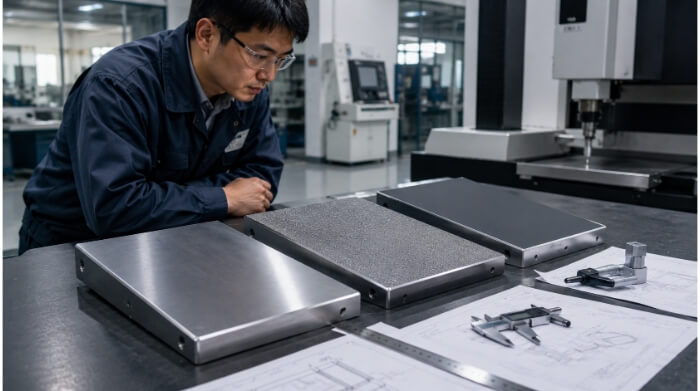
Relying solely on a numeric Ra or Rz surface roughness value is dangerous for cosmetic parts. Two surfaces with the exact same Ra value can look completely different if the brushing direction or gloss level varies.
Always establish approved, physical visual limit samples with your client before starting production. Clarify the acceptable scratch levels for both visible “A-surfaces” and hidden structural areas.
Batch consistency and automation
Manual grinding is inherently variable. As operator fatigue sets in throughout a shift, applied pressure fluctuates, leading to inconsistent surface finishes and dimensional drift.
For high-volume production, transitioning to robotic cells equipped with active force compliance end-effectors is often necessary. These automated systems actively adjust to the part’s geometry in real-time, removing the human variable and ensuring that the 1,000th part off the line has the exact same finish as the very first.
| Defect | Main cause | Production risk | Control method |
|---|---|---|---|
| Heat tint | Excessive localized heat | Sensitization and corrosion risk | Reduce pressure, use sharp ceramic grains |
| Deep scratches | Wrong grit sequence | Excessive finishing and rework | Use staged grinding steps and structured abrasives |
| Wheel loading | Soft, ductile material buildup | More heat and slower grinding | Dress tools frequently, use active coolants |
| Rust spots | Iron particle contamination | Customer rejection after delivery | Strictly separate tools, apply passivation |
| Uneven finish | Manual pressure variation | Unacceptable batch inconsistency | Use robotic cells with active force compliance |
Conclusion
Mastering stainless steel grinding requires more than just buying the right abrasive. It demands a strict understanding of material behavior, thermal management, and step-by-step process control.
A minor operator error in the grinding booth can ruin an otherwise perfectly cut or machined part. Leaving surface finishing to chance drives up your Cost of Poor Quality (COPQ) and delays critical assembly schedules.
Need stainless steel parts with clean grinding, stable finishing, and reliable quality? Send us your drawings, material requirements, surface finish standard, and batch quantity. Our team can review your project and provide a practical manufacturing solution.
Hey, I'm Kevin Lee

For the past 10 years, I’ve been immersed in various forms of sheet metal fabrication, sharing cool insights here from my experiences across diverse workshops.
Get in touch
Kevin Lee
I have over ten years of professional experience in sheet metal fabrication, specializing in laser cutting, bending, welding, and surface treatment techniques. As the Technical Director at Shengen, I am committed to solving complex manufacturing challenges and driving innovation and quality in each project.