In precision manufacturing, safety is never optional. Small servo presses might look compact and clean, but they still deliver a potent force. Without the proper safety design, operators can face risks such as hand injuries or tool damage as servo systems get faster and more programmable; safe design and setup become even more critical.
A safe small servo press system has several layers of protection. These include physical guards, sensors, interlocks, and emergency stop buttons. Each part works together to stop accidents, detect unusual conditions, and protect both the operator and the machine. When a system is designed with safety in mind, it stays reliable and reduces downtime.
Modern presses are smarter, but that doesn’t automatically make them safer. The key is designing a servo press setup that keeps both people and productivity secure.

Understanding Safety in Servo Press Systems
Safety in servo press systems depends on both accurate control and solid mechanical design. Unlike older presses, servo-driven models move through digital motion programs.
What Makes Servo Presses Different from Traditional Presses?
Servo presses use electric motors instead of hydraulic or pneumatic systems. This setup removes the risk of oil leaks or air pressure loss. However, it introduces a new concern — every motion depends on software commands. Each stroke, speed, and force follows programmed instructions.
This digital control offers excellent precision. However, a minor programming error can lead to unsafe movement. To avoid this, servo presses rely on constant feedback from encoders, torque sensors, and position monitors. These sensors check that the RAM moves exactly as expected during each cycle.
Safety depends heavily on the accuracy of feedback. A high-resolution encoder (20-bit or higher) can detect position changes as small as 0.001 mm. When the system spots an abnormal movement, it can stop the motion immediately.
⚙️ Example: In a 5 kN servo press used for smartphone connector assembly, the torque limit can stop the ram within 8 milliseconds after detecting overload. This prevents damage to both the die and the part.
Common Safety Challenges in Compact Press Systems
Compact servo presses are typically installed near operators or integrated into test setups. Their small size presents special safety challenges, especially when there is limited space for guards or covers.
Pinch points are the most frequent danger. The slight slide gap and short stroke make it easy for hands or tools to reach risky areas. Clear shields, light curtains, or two-hand controls help prevent accidents.
Overloads occur when parts are misaligned or too tight, preventing them from fitting correctly. Servo presses manage this with torque limits, usually set around 110–120% of rated capacity. If the limit is reached, motion stops, and the system records the event for checking.
Motion errors, such as encoder drift or synchronization loss, can occur due to vibration or electrical noise. Engineers often add backup sensors or perform reference checks to ensure accurate readings.
Mechanical Safety Design
Mechanical safety is the foundation of a servo press’s reliability. Every part of the structure must be able to handle repeated stress, control vibration, and prevent deformation.
Frame Strength and Stability
The press frame is the core of safety. It carries all the force generated by the servo motor. If the frame bends or shifts, accuracy drops, and safety risks increase.
Small servo presses usually work between 1 and 30 kN. Even a 0.1 mm deflection at full load can change tool alignment and damage parts. To prevent this, engineers utilize high-strength steel, precision-machined guideways, and reinforced weld seams when constructing frames.
Finite Element Analysis (FEA) helps simulate how the frame handles stress. Designers aim to keep stress levels under 60% of yield strength, which ensures long-term rigidity even after millions of cycles.
⚙️ Example: A 10 kN tabletop press with a C-frame design kept ±0.005 mm forming accuracy after one million continuous cycles. This shows that stiffness directly supports both precision and safety.
Overload Protection Systems
Overload protection acts like a built-in safety valve for the press. Modern servo presses use real-time torque control, current limits, and sometimes mechanical clutches to stop motion before damage occurs.
When resistance exceeds the preset torque — usually 110–120% of rated capacity — the system stops immediately and retracts the ram. This protects both the tooling and the press body.
Some systems incorporate mechanical clutches that automatically disengage when the torque exceeds the limit. This feature is helpful in high-speed operations where every millisecond counts.
⚙️ Example: In a connector assembly setup, an overload trip stopped a 3 kN press in just 6 ms. The quick stop prevented tool breakage and limited downtime to under 10 minutes.
Guarding and Enclosures
Physical guards are the first line of defense. They separate the operator from moving parts while maintaining high visibility.
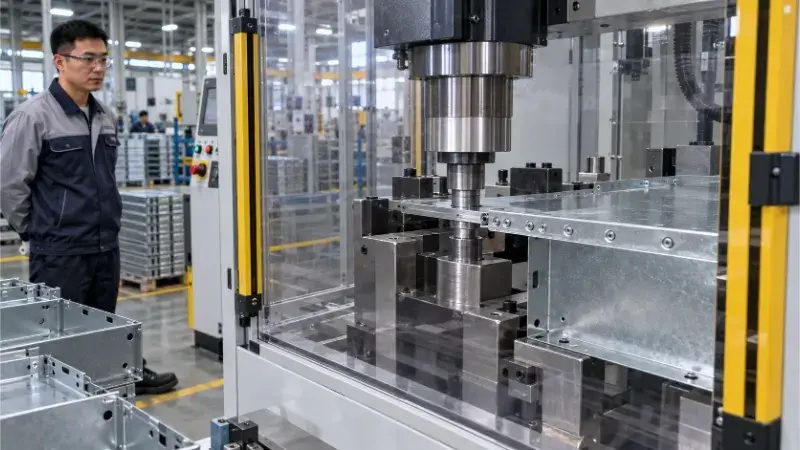
Compact servo presses often use transparent polycarbonate guards. These are impact-resistant and let operators clearly see the workspace. Panels and doors are fitted with safety interlocks, so if a guard opens, power to the motor is immediately cut off.
Light curtains and area scanners provide an additional layer of protection. If a hand or object breaks the beam, the press stops within 10–20 milliseconds. These systems are most effective in operations that require frequent manual loading and unloading.
⚙️ Example: A light curtain placed 300 mm from the die surface stopped a 5 kN press before the ram moved more than 4 mm — enough space to prevent injury.
Electrical and Control System Safety
Once the frame and mechanics are secure, the following line of defense is the electrical and control system. These systems prevent unwanted motion, detect faults in real time, and safely isolate power during maintenance or emergencies.
Emergency Stop and Safe Torque Off (STO)
The emergency stop (E-stop) is the most direct safety feature on any servo press. When pressed, it cuts motor signals and stops the ram instantly. Most presses respond in under 10 milliseconds, leaving no time for further movement.
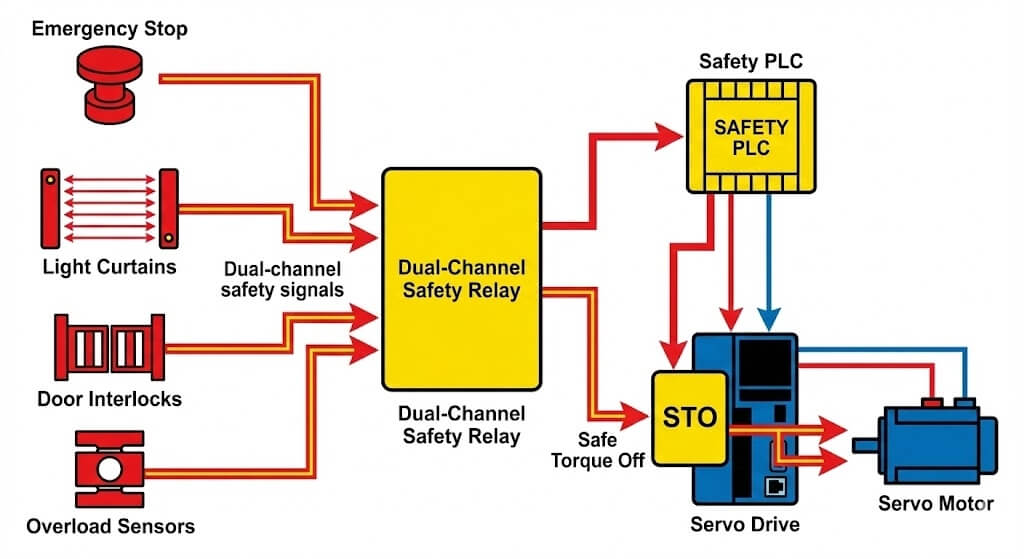
The Safe Torque Off (STO) function adds another level of control. Instead of cutting all power, STO removes the motor’s ability to produce torque but keeps the logic power on. This prevents unplanned motion while allowing quick system recovery once the problem is fixed.
⚙️ Example: In a 2 kN servo press used for PCB assembly, the STO stopped torque output instantly while keeping position data intact. Maintenance staff cleared the jam and restarted production without needing a complete reboot.
Redundant Circuit Design
Servo presses utilize dual-channel safety circuits for all key signals, including E-stops, interlocks, and light curtains. Each channel works independently, and both must confirm a safe state before motion begins.
If one channel fails, the system immediately detects the mismatch and stops the press. Safety relays monitor both channels to ensure that timing and contacts are functioning correctly.
Wiring follows fail-safe principles, meaning that a broken wire or loose connector automatically sets the system to “unsafe.” This design avoids single-point failures that could cause accidents.
⚙️ Example: A 10 kN press with dual-channel relays detected a 25 ms delay on one side. The PLC identified the issue immediately and blocked reactivation until the fault was resolved.
Power Isolation and Lockout Mechanisms
Safe maintenance depends on complete power isolation. Each press should have a main disconnect switch that cuts off all incoming power, including control voltage and servo drive power.
During servicing, the Lockout/Tagout (LOTO) procedure ensures that no one can accidentally restore power. Each technician locks the switch and attaches a tag with their name to it. Power can only return after all locks are removed.
Residual charge in capacitors can still pose a danger. Modern presses use bleeder circuits to discharge stored energy within 30–60 seconds after shutdown.
⚙️ Example: A technician adjusting tooling shuts off the main breaker, applies LOTO, and waits for the “Capacitor Discharge Complete” light before entering the guard zone — a procedure aligned with OSHA and CE standards.

Motion Control and Software Safety
Motion control defines how a servo press moves in every situation. Since servo systems rely on programmed motion rather than fluid power, safety is derived from meticulous software setup, verified limits, and intelligent fault detection.
Programmable Limits and Safe Zones
Servo presses control stroke, speed, and force with digital precision. These settings operate within software-defined safe zones, which serve as built-in limits. The machine constantly tracks its position and torque to make sure movement stays within those limits.
Programmable limits act like invisible walls. If the ram travels beyond its set range or exceeds the allowed force, the controller immediately stops the motion. For example, a 10 kN servo press can be limited to 75 mm travel and 8.5 kN of force during setup to prevent tool contact.
Safe zones are beneficial during part changeovers or manual operations. In setup mode, features such as Safe Limited Speed (SLS) and Safe Position (SP) slow the press to under 10 mm/s, allowing operators time to react before any full-force motion occurs.
⚙️ Example: In a connector assembly line, the SLS mode slowed motion by 90% during fixture calibration, allowing safe manual adjustments without cutting power.
💡 Tip: Always recheck travel and force settings after program changes. Even a slight coordinate shift can push the ram outside its safe range.
These programmable limits keep the press under complete control, ensuring that each motion follows the right path — and that the system reacts instantly when anything unusual happens.
Force–Displacement Monitoring
Each servo press cycle produces a force–displacement curve, illustrating how force changes throughout the stroke. By comparing this curve with a stored reference, the press can detect minor deviations before they cause damage or safety risks.
If the actual curve differs by more than ±3–5%, the system stops motion and alerts the operator. This real-time comparison helps identify early tool wear, material changes, or alignment errors.
⚙️ Example: During a pin insertion process, a gradual 0.15 mm shift in the displacement curve over 200 cycles revealed a worn bushing. Maintenance replaced it before it caused damage.
Safety PLC Integration
At the center of software-based safety is the Safety PLC—a specialized controller that manages all safety logic, apart from the primary motion control.
A Safety PLC uses dual processors and certified software to meet ISO 13849 (PL e) or IEC 62061 (SIL 3) standards. It monitors inputs such as E-stops, interlocks, and sensors, reacting immediately if any unsafe condition appears.
Besides basic stop functions, it enables advanced safe motion modes such as:
- SLS (Safe Limited Speed): Restricts speed when operators work inside protected zones.
- SOS (Safe Operating Stop): Holds position while the torque stays off for inspection.
- SDI (Safe Direction): Allows movement in only one direction during certain operations.
⚙️ Example: During a test run, the Safety PLC noticed irregular encoder feedback and activated SOS mode. The press stopped mid-motion, preventing a collision between the tool and the part.
Operator Interface and Ergonomics
The operator interface is where technology connects with people. Good ergonomics and straightforward controls turn safety from a requirement into a natural habit.
Human–Machine Interface (HMI) Safety Features
The HMI should make safe operation simple. A clean layout, bright color indicators, and logical screen flow help operators react quickly and correctly.
Modern servo presses often use touchscreen HMIs that display the machine’s status at a glance:
- Green – “Ready”
- Yellow – “Warning”
- Red – “Stop”
These signals are supported by sound alerts for key events such as overloads or when a guard door opens. Two-step confirmation prompts prevent accidental cycle starts by requiring operators to verify actions before continuing.
⚙️ Example: In a connector assembly line, adding a two-step confirmation to the HMI reduced accidental starts by 35%.
Workstation Design and Accessibility
Ergonomic design keeps operators comfortable and alert. Poorly placed pedals, switches, or work surfaces can lead to fatigue and impaired reactions during critical moments.
A good setup fits the operator, not the other way around. Adjustable table heights (850–950 mm), angled fixtures, and tiltable trays enable workers to maintain natural postures during extended shifts.
Lighting is also essential. Soft LED lighting near the press reduces glare and shadows, improving visibility when placing or inspecting parts. Non-slip floors and clear foot space help prevent accidental pedal activation.
⚙️ Example: Redesigning a workstation for a 5 kN bench press improved cycle speed by 12% and nearly eliminated wrist strain complaints.
Training and Authorization Levels
Training turns built-in safety features into absolute protection. Operators must understand not only how to run the press but also how to interpret its signals, alarms, and status lights.
Comprehensive training should include:
- Safe start-up and shutdown steps
- E-stop and STO testing procedures
- Reading and understanding force–displacement curves
- Correct responses to overload or motion faults
Tiered access control also helps prevent mistakes. Operators run approved programs, technicians handle setup, and engineers adjust system parameters. Access is ensured through passwords or RFID cards, which provide traceability and prevent unauthorized edits.
⚙️ Example: A three-tier access system — Operator, Technician, Engineer — cut programming errors by 40% and reduced downtime from incorrect settings.
Maintenance and Risk Reduction Practices
A servo press remains safe only when its safety systems are maintained regularly. Preventive and predictive maintenance ensure the press performs safely and accurately throughout its lifespan.
Routine Inspections and Sensor Calibration
Regular checks are the foundation of a safe system. Operators should inspect all emergency stops, interlocks, and light curtains at the start of each shift.
Mechanical parts, such as slide rails, bolts, and guide pins, should be checked for looseness, scratches, or unusual wear. A quick vibration test is also helpful — any reading over 0.3 mm/s RMS can indicate misalignment or imbalance.
Sensors and encoders also need scheduled calibration to maintain precision. For most light-duty presses, a 6–12 month cycle works well. In high-use systems, calibration is recommended every three months.
⚙️ Example: A facility running 25,000 cycles per week recalibrates torque sensors every quarter. Sensor drift dropped from 0.4% to under 0.05%, keeping force accuracy within safety limits.
Predictive Monitoring and Data Logging
Digital monitoring takes maintenance a step further. The servo press continuously records motor current, temperature, and force–displacement data. By studying these readings, engineers can spot minor issues before they turn into major faults.
Predictive analysis looks for trends — a gradual rise in motor torque or slower response time often signals wear or misalignment. When a reading deviates by more than 5% from the normal range, the system alerts maintenance staff to investigate.
⚙️ Example: A 3 kN servo press showed a slow increase in torque readings. The maintenance team found a worn ball screw bearing and replaced it during planned downtime, avoiding a full production stop.
Spare Parts and Replacement Policies
Even the best-designed press relies on the quality of its parts. Using uncertified or mismatched components can lower safety ratings and break compliance with regulations.
All replacement parts — sensors, relays, and drives — should match the original Performance Level (PL) or Safety Integrity Level (SIL). Maintain a clear inventory of certified spares, including those with traceable serial numbers and accompanying documentation, to ensure accurate and timely replacement.
Critical safety parts such as E-stop relays and light curtains should be replaced every 3–5 years, or sooner if they are exposed to heat, vibration, or dust.
⚙️ Example: One facility replaced all safety relays every four years. As a result, unexpected circuit faults dropped by 70% compared to replacing them only when they failed.
Conclusion
Safety in small servo presses is more than an add-on — it is the foundation that supports precision manufacturing. Every layer, from mechanical design to motion software, contributes to stable performance and operator protection. When these systems are properly checked, maintained, and utilized, they work together to create a production setup that is both safe and reliable.
Ready to improve the safety and performance of your servo press systems? Our engineering team can evaluate your current setup, verify compliance with standards, and recommend safety upgrades tailored to your specific needs. Contact us today to discuss your project or request a detailed risk assessment.
FAQs
What safety standards should a small servo press meet?
A small servo press should comply with ISO 12100 for risk assessment, ISO 13849 or IEC 62061 for control reliability, and OSHA 1910/ANSI B11 for guarding and operational safety, depending on the region where it is installed.
How does Safe Torque Off (STO) protect operators?
STO instantly turns off the motor’s torque while keeping control power active. This stops motion safely without shutting down the entire system, allowing for quick and secure maintenance or tool changes.
What is the difference between mechanical and software safety?
Mechanical safety relies on the machine’s structure and physical guards to prevent contact or injury. Software safety manages programmable limits, force monitoring, and Safety PLC logic to prevent unsafe motion within defined zones.
Can servo presses be safely used with cobots or automated systems?
Yes. Servo presses work safely with collaborative robots when equipped with SIL 3-rated drives, safe communication protocols such as PROFIsafe or EtherCAT Safety, and zoned monitoring that allows humans and robots to share a workspace safely.
How often should safety inspections be performed?
Daily functional checks are essential before production starts. Full calibration, validation, and data review should be carried out every 3–6 months, or anytime hardware or software changes are made.
Hey, I'm Kevin Lee

For the past 10 years, I’ve been immersed in various forms of sheet metal fabrication, sharing cool insights here from my experiences across diverse workshops.
Get in touch
Kevin Lee
I have over ten years of professional experience in sheet metal fabrication, specializing in laser cutting, bending, welding, and surface treatment techniques. As the Technical Director at Shengen, I am committed to solving complex manufacturing challenges and driving innovation and quality in each project.