Warping in sheet metal welding isn’t accidental — it is predictable physics. When a weld heats the metal, it expands. When it cools, it contracts. If one side cools faster or shrinks harder, the sheet curves toward the weld. On thin material, even tiny variations stack into visible distortion. Warping doesn’t begin when the part bends — it starts when heat input stops being controlled.
Most distortion isn’t caused by one mistake. A series of slight thermal imbalances causes it. The key is not fighting movement at the end, but controlling how metal moves from the start.
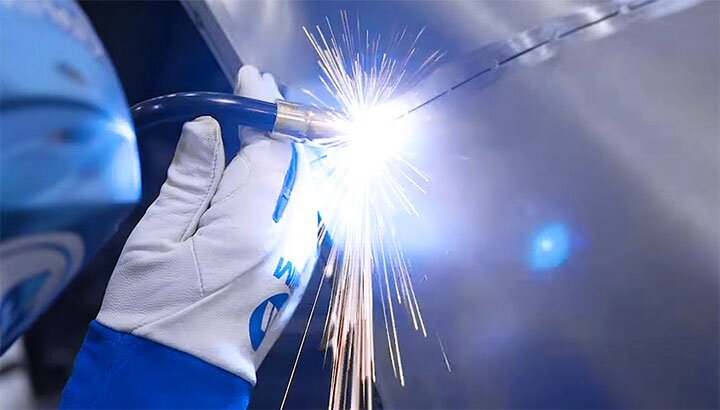
Why Sheet Metal Warps During Welding?
Every weld is a heat–shrink event. Distortion occurs when expansion and contraction are unequal, unbalanced, or restricted. Understanding this mechanism is the foundation of prevention.
Common causes of warping:
| Distortion Source | Consequence |
|---|---|
| Excess heat input | Large contraction force → curvature |
| One-sided cooling | Pulls part toward hotter zone |
| Long continuous seams | Shrinkage accumulates instead of dissipating |
| Residual stress trapped during welding | Warping increases hours or days later |
A panel may move only 0.15–0.25mm with each weld pass — but after 10 passes, you’re holding a 2–3mm problem. Distortion doesn’t come from a significant error — it comes from ten small ones.
Understanding the Mechanics Behind Distortion
Distortion becomes manageable once you know what drives it. The variables are consistent: heat input, cooling rate, restraint, and material response. Control those, and you control warping.
Thermal Expansion + Uneven Cooling
Weld zones heat up faster than the surrounding sheet. They expand outward, then contract unevenly as cooling begins. That contraction pulls the sheet toward the bead.
Thin-gauge materials (≤2.0mm) are most sensitive because:
✔ low mass heats quickly
✔ temperature differential grows faster
✔ small pull = big visible curvature
Typical movement range under poor heat control: 1–3mm per 300–600mm span. This is enough to misalign doors, frames, or hole patterns — even if dimensions looked good beforehand.
Residual Stress — The Distortion You Don’t See Yet
A part can leave the weld bench flat, then twist the next morning. Why? Because restrained metal cools under tension. When clamps are removed or the structure vibrates in service, the trapped stress redistributes, and the geometry shifts.
Residual stress increases when:
| Condition | Risk Result |
|---|---|
| Part over-clamped | Distortion appears after release |
| Welds cool inconsistently | Deferred curvature or twisting |
| Thick–thin assembly transitions | Stress concentrates near joint |
A part that appears correct today can shift tomorrow. Distortion is not always immediate — sometimes it’s delayed.
Material Sensitivity — Not All Metals Behave the Same
Different alloys respond differently to heat. Designing welds without considering conductivity or thermal expansion is one of the fastest paths to warping.
| Material | Distortion Risk | Practical Approach |
|---|---|---|
| Stainless steel | ★★★★☆ (high) | Pulse + fast travel; avoid overheating |
| Aluminum | ★★★★☆ (medium/high) | Faster weld, distribute heat; consider preheat only if needed |
| Mild steel | ★★★☆☆ (moderate) | Most stable, but still heat-limited |
Two identical welds can produce double or triple the distortion, depending on the material. Technique must match alloy — not personal habit.
Weld Design Strategies to Reduce Distortion
Good welding begins long before the arc is struck. If the joint design requires unnecessary weld volume or unbalanced heat load, distortion is inevitable — even with skilled execution.
Optimize Joint Style for Minimal Heat Input
Oversized welds do not make parts stronger — they make them distort. Reducing weld size often reduces warping by 30–50% without reducing strength.
Better alternatives include:
✔ right-sized fillets instead of full-sized beads
✔ plug/slotted joints when continuous seams provide no structural gain
✔ multiple short welds instead of one long shrink band
A smaller weld is not a weaker weld — it is a controlled one.
Reduce Weld Volume Where Possible
Two high-impact methods:
Stitch / Intermittent Welding
Short beads spaced across the seam limit cumulative contraction. Ideal for large enclosures, HVAC skins, and machine covers.
Alternate Weld Splitting
Divide one long seam into multiple heat-balanced sections.
Use Symmetrical & Sequenced Weld Paths
Balanced welding = balanced shrink.
If one side takes all the heat first, that side wins the pull. Alternating sides, back-stepping, or skip-sequencing spreads heat, equalizes stress, and reduces curve formation.
Distortion doesn’t come from welding — it comes from welding all in one direction.
Welding Techniques & Parameter Control
Even the best joint design will warp if heat input is uncontrolled. Welding sheet metal is not about melting metal — it is about controlling temperature over time. A 5–10 second dwell variation or 10–20% amperage shift can be the difference between flat and twisted.
The rule is simple:
- Heat in slowly.
- Let it escape evenly.
- Never let heat collect in one direction.
Lower Heat Input = Lower Distortion
Every joule of heat that enters a sheet must exit again.
If too much heat accumulates before cooling can balance it, the metal curves.
Actionable adjustments:
| Parameter | Shift | Result |
|---|---|---|
| Amperage ↓ 10–15% | Smaller heat zone | Less contraction force |
| Travel speed ↑ 10–25% | Shorter dwell time | Lower peak temperature |
| Wire feed ↓ slightly | Less filler = less shrink | Smoother finish |
| Pulse settings ON | Heat cycles vs continuous burn | More stable sheet form |
Reducing the average heat input by ~15% often results in a 30–50% reduction in distortion in a 0.8–2.0mm sheet. You don’t fix warping later — you prevent it at the trigger.
Control Travel Technique & Sequence
Speed is not the goal — controlled energy delivery is.
Use patterns that avoid building heat in the same direction:
✔ Skip-welding (never chase heat in a straight line)
✔ Back-step welding for long panels
✔ Stagger beads to allow natural recovery between passes
Weld in segments: heat–cool–heat–cool, never heat–heat–heat. Metal remembers the last Place that got hottest.
Material-Based Technique Optimization
Each material has its own thermal personality. You cannot weld stainless like steel or aluminum like you would stainless: change the technique, not just the settings.
| Material | Heat Behavior | Best Approach |
|---|---|---|
| Stainless steel | Holds heat → bends easily | Pulse arc + short bead cycles |
| Aluminum | Transfers heat but expands aggressively | Faster travel, avoid long dwell zones |
| Mild steel | Most forgiving | Still responds to long-seam heat buildup |
Fixturing, Clamping & Backer Support
A fixture is not a restraint — it is a guide. It should direct how the metal moves, not suppress movement entirely. Over-clamping traps stress and causes warpage later; good fixturing controls expansion, rather than fighting it.
Smart Fixturing Strategy
✔ Use 3-point support instead of full-surface press
✔ Clamp critical geometry — not the entire part
✔ Place tacks before heavy welds to stabilize the datum
✔ Release clamps gradually to avoid sudden stress release
A part held perfectly flat during welding often warps the moment it’s freed. Flat under the clamp ≠ is in service.
Chill Bars, Heat Sinks & Thermal Spreaders
Heat sinks don’t stop distortion — they slow down the concentration of heat, allowing contraction to occur more evenly. The goal is to flatten the thermal curve, not freeze the part.
Useful tools:
| Tool | Function | Ideal Use Case |
|---|---|---|
| Copper chill bars | Pull heat away ~15–30% faster | Thin stainless or mild steel sheet |
| Ceramic backing | Supports bead root without overheating | TIG/MIG linear joints |
| Aluminum blocks | Spread heat to larger area | Wide panel welds |
On a 1.2–1.6mm sheet, the use of a chill bar can reduce edge pull by 0.5–1.8mm, depending on the seam length. One accessory can save one hour of post-grind correction.
Clamp + Sequence = One System, Not Two
Clamping controls geometry. Sequence controls heat paths. When combined, they prevent distortion instead of reacting to it.
If you tighten everything, then weld straight across, distortion will find its exit point. If you clamp smartly and weld in balance, distortion has no direction to escape.
Documenting fixture layout, tack locations, and weld order converts warping from operator-dependent to factory-controlled.
Stress Relief, Counter-Deformation & Post-Weld Correction
Even with optimal heat control and fixturing, ultra-thin sheets, long linear seams, and multi-panel builds may still distort. In fabrication reality, prevention is primary, but post-weld correction is the necessary second line of defense.
Mechanical Stress Relief (Peening & Vibration)
Peening stretches the weld surface to counter the shrinkage force. Used correctly, it distributes contraction stress into the surrounding metal, reducing the concentrated pull that causes a curve.
Key execution rules:
| Technique | When to Use | How It Helps |
|---|---|---|
| Light uniform peening | Panel still warm | Diffuses shrink tension across bead |
| Progressive tapping | Long seams | Maintains flatter cooling geometry |
| Avoid heavy blows | Thin sheet | Prevents HAZ hardening and cracking |
In testing, warm-stage peening has reduced final bow by 25–40% on 1.2–2.0mm gauge sheet panels.
Too light does nothing. Being too aggressive creates new problems. Controlled rhythm is the skill.
Thermal Stress Relief (PWHT When Needed)
Residual stress is often invisible but active. PWHT releases locked tension by elevating metal to a relaxation temperature without altering its base structure.
Approximate working ranges:
| Material | Stress-Relief Temp | Notes |
|---|---|---|
| Mild steel | 550–650°C | Most responsive to PWHT |
| Stainless | Lower/slower cycles | Avoid sensitization risk |
| Aluminum | Limited benefit | Strength reduction risk — use caution |
PWHT is not required for all parts — but for frames, door skins, and seam-heavy structures, it can determine whether flatness holds 6 hours or 6 months.
Counter-Deformation (Predictive Pre-Bend Method)
If you know where metal will move, you can move first.
This technique intentionally bends or offsets a component slightly before welding, allowing contraction to pull it into the correct final geometry.
Practical working values:
✔ Reverse bias: 0.3–1.5mm depending on seam length
✔ Validate with a test panel before production run
✔ Works extremely well for enclosures and cover plates
Example scenario:
A 700mm × 900mm panel consistently warped ~2.0mm after the final bead. Introducing a 0.8mm reverse-pre-bend resulted in a final distortion of just 0.2–0.4mm — a 75% improvement without extra processing.
Straightening — Correction, Not Strategy
Straightening should never replace prevention. It is a refinement tool, not a workflow model. Common controlled correction methods:
| Method | Best Use Case |
|---|---|
| Press flattening | Mild warp with uniform curvature |
| Spot-heat shrinking | Targeted high-stress areas |
| Mechanical rollers | Large sheets with smooth bow |
Grinding away the bead to straighten is rarely worth the structural cost — it weakens the joint and encourages crack formation under vibration.
Conclusion
Warping in sheet metal welding often begins when heat is applied unevenly, and the metal cools at different rates. The pull from this cooling changes the shape of the part. You can control this by reducing weld volume, maintaining a balanced heat input, utilizing planned weld sequences, holding the workpiece securely, and releasing stress as needed. With the right approach, distortion becomes predictable and, in many projects, easy to manage.
If you are welding frames, panels, enclosures, or any parts that need tight flatness and clean alignment, we can support your process. We can help you plan a weld order, control temperature, set up fixtures, and prevent warping before it happens. Please send us your drawings or share your distortion problem. We will look at it and offer practical suggestions.
Hey, I'm Kevin Lee

For the past 10 years, I’ve been immersed in various forms of sheet metal fabrication, sharing cool insights here from my experiences across diverse workshops.
Get in touch
Kevin Lee
I have over ten years of professional experience in sheet metal fabrication, specializing in laser cutting, bending, welding, and surface treatment techniques. As the Technical Director at Shengen, I am committed to solving complex manufacturing challenges and driving innovation and quality in each project.