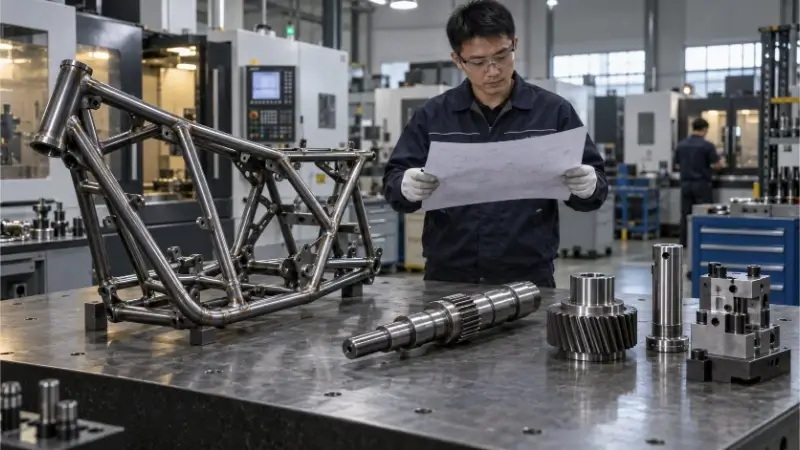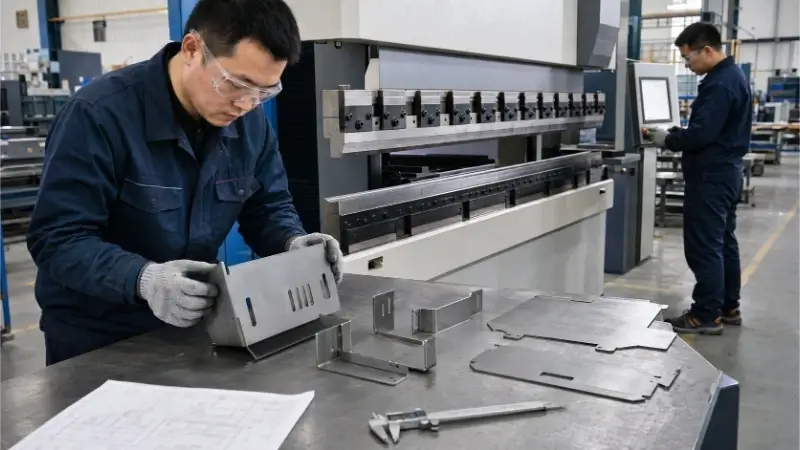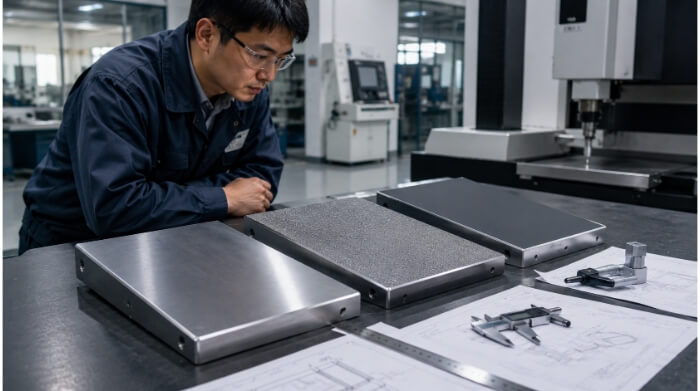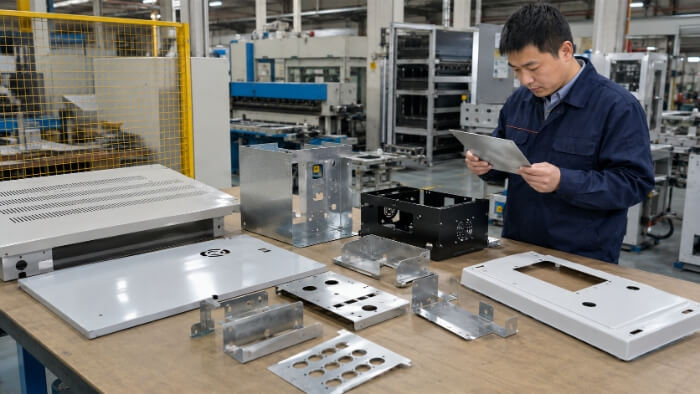
The main difference between 4140 and 4130 steel is their carbon content. 4140 contains 0.40% carbon, providing higher strength and deeper hardenability. 4130 contains 0.30% carbon, offering superior weldability and toughness. Both are chromium-molybdenum (chromoly) alloys, but they serve completely different manufacturing needs.
Generally speaking, if your project involves heavily loaded machined parts—like transmission shafts, gears, or hydraulic pins—4140 is usually the better choice. If you are designing welded tubing, racing chassis, or fabricated sheet metal frames, the forgiving weldability of 4130 makes it the industry standard.
Here is what you actually need to know before putting either grade on a purchase order.

4130 vs. 4140 Steel: What Actually Changes
Beyond the spec sheet, minor carbon shifts drive major manufacturing differences. Here is exactly how these two alloys compare before hitting the shop floor.
| Comparison | 4130 steel | 4140 스틸 |
|---|---|---|
| Nominal carbon | About 0.30% | About 0.40% |
| Strength potential | 보통에서 높음 | 더 높은 |
| Hardenability | 낮추다 | 더 높은 |
| 용접성 | Generally better | Requires tighter control |
| 성형성 | Generally better | More limited at higher hardness |
| Common stock forms | Often tubing and sheet | Often bar, plate and forgings |
| Typical parts | Welded frames and tubing | Shafts, gears and wear parts |
| Main manufacturing risk | Weld distortion and HAZ quality | Cracking, tool wear and heat-treatment distortion |
| 내식성 | Requires protection | Requires protection |
These are general differences, not guaranteed properties. Both grades must be compared in the same condition, product form, and section size.
Sourcing Note: When sourcing internationally, always request an EN 10204 3.1 Material Test Report (MTR) to verify the actual carbon and manganese levels of your specific batch. International equivalents (like 42CrMo4 for 4140 or 25CrMo4 for 4130) may have slight allowable chemistry variations that affect your welding parameters and heat-treatment recipes.
Why Material Condition Changes Strength and Hardness?
Judging a steel by its grade name alone can wreck your production tolerances. You must understand how raw chemistry and thermal history dictate actual machining performance below.
Chemistry Behind the Difference
Both 4130 and 4140 are chromium-molybdenum (chromoly) low-alloy steels. The primary difference is the carbon content. 4140 contains roughly 0.40% carbon and typically a higher manganese range, while 4130 sits at about 0.30% carbon.
The chromium and molybdenum additions in both grades improve hardenability and dictate how the steel responds to heat treatment. Neither grade contains enough chromium to prevent rust. Both will oxidize quickly on the shop floor if left exposed to moisture and require secondary surface treatments (like black oxide, nickel plating, or phosphating) for corrosion resistance.
Hardness Versus Hardenability
When reviewing material specifications, hardness and hardenability are distinct concepts. Hardness indicates how hard the material is in its current state. Hardenability determines how deep that hardness can penetrate the cross-section during the quenching process.
Because of its higher carbon and manganese levels, 4140 provides better hardenability in thicker sections. However, specifying “4140 steel” on a drawing does not guarantee a specific hardness—the final hardness depends entirely on the heat-treatment cycle applied after rough machining.
Shop Note: Annealed 4140 can be much easier to machine than hardened 4130. Always confirm the supplied condition before comparing the grades.
엔지니어링 팁: For heavily loaded parts, do not simply call out “4140” on the drawing. Specify the required state, such as “4140 Q&T to 28-32 HRC” for prehardened stock, or specify the core hardness and case depth required after finish machining. This prevents critical miscommunications with your machine shop.
Compare Like for Like
To accurately evaluate the two grades, you must look at identical supply conditions. The data below shows typical mechanical properties for a 1-inch cold-drawn round bar based on standard reference ranges.
| 재산 | 4130 Annealed | 4140 Annealed | 4130 Normalized | 4140 Normalized |
|---|---|---|---|---|
| 항복 강도 | ~52,000 psi | ~60,000 psi | ~63,000 psi | ~95,000 psi |
| 인장강도 | ~81,000 psi | ~95,000 psi | ~97,000 psi | ~148,000 psi |
| 연장 | ~28% | ~25% | ~25% | ~17% |
| 경도 | ~156 HB | ~197 HB | ~197 HB | ~302 HB |
When setting up your RFQ or evaluating data sheets, always verify the context behind the numbers. Strength and hardness values will shift based on:
- The data source (testing standard vs. marketing material)
- Material condition (annealed, normalized, prehard, or quenched and tempered)
- Product form (seamless tube, cold-drawn bar, or forged block)
- Section size (a 4-inch bar will show different core properties than a 1-inch bar)
- Whether the numbers represent typical historical averages or guaranteed minimums
Cost Driver Note: Understanding these numbers is critical for quoting. For instance, moving from annealed 4140 (
197 HB) to normalized 4140 (302 HB) nearly doubles the yield strength, but it will also increase your tool wear during CNC milling and require more rigid setups, directly driving up the piece price.
4130 vs. 4140 Steel for Welding
Welded assemblies fail when thermal stress is mismanaged. Neither of these chromoly grades can be welded like standard mild steel; striking an arc without a strict thermal protocol is a guaranteed path to scrapped parts.

Heat-Affected Zone Risk
When welding chromoly steel, the rapid heating and cooling cycle alters the crystalline structure directly adjacent to the weld—the Heat-Affected Zone (HAZ). Cracking in this zone is typically driven by a combination of a brittle HAZ, rapid cooling rates, diffusible hydrogen trapped in the weld, and highly constrained joint designs that fight thermal contraction.
The most critical metric here is the Carbon Equivalent (CE). 4140’s CE is significantly higher than 4130’s, pushing it deep into the “high cracking risk” zone. This isn’t just theory; it means your welder cannot skip preheating without guaranteeing a failure. While 4130 is more forgiving, thick-walled 4130 tubing or highly constrained 4130 joints demand the exact same caution.
Preheat and Filler Metal
Preheating slows the cooling rate, preventing the HAZ from hardening into a brittle structure. There is no universal preheat temperature (e.g., 550–800°F is merely a reference for specific thick-walled parts, not a blanket rule). Your parameters must be calculated based on the material’s supply condition, Carbon Equivalent, cross-sectional thickness, joint constraint, and ambient shop temperature.
For filler metals, blindly matching the tensile strength of the base metal is often a mistake.
Welding Tip: Undermatching the filler metal (using a lower-strength filler) can significantly improve weld ductility, acting as a shock absorber for residual stresses. Conversely, overmatching increases the risk of the weld cracking before the base metal yields.
Strict low-hydrogen practice (using freshly baked low-hydrogen electrodes) is far more critical to joint survival than the strength rating on the filler box. If the entire assembly will undergo quenching and tempering 이후 welding, you must select a filler metal chemistry capable of responding to that specific heat treatment.
Cooling, PWHT, and Inspection
How you handle the part immediately after the arc stops is just as critical as the weld itself. Engineering drawings must distinguish between these thermal steps:
- Controlled slow cooling: Wrapping the part in ceramic blankets to slow the temperature drop.
- Hydrogen bake-out: Holding the part at an elevated temperature immediately after 용접 to allow trapped hydrogen to diffuse out.
- Stress relief: Heating the assembly below the critical transformation temperature to relax locked-in welding stresses (mandatory before precision machining).
- Post-Weld Heat Treatment (PWHT): A full thermal cycle to reset the metallurgical structure of the entire assembly.
Visual inspection is inadequate for chromoly welds. Mandate Magnetic Particle Testing (MT) or Dye Penetrant Testing (PT). For thick-walled 4140 weldments, specify delayed crack inspection (waiting 24 to 48 hours after cooling before NDT) to catch hydrogen-induced cold cracking.
How to Machine 4130 and 4140 Steel?
Machining performance depends entirely on the microstructural state. Using generic feed and speed data across different material conditions will rapidly destroy tooling and scrap parts.
Stock Condition Changes Machinability
The shop floor reality is that a softer material is not always easier to machine.
Annealed 4130 can be overly soft and “gummy.” It often produces long, stringy chips that wrap around tooling, cause built-up edge (BUE), and leave a torn surface finish. Normalized 4130 breaks chips more predictably due to its slightly harder structure.
Normalized 4140 (typically around 300 HB) offers an excellent balance of chip breaking and surface finish, though it demands rigid setups and high spindle torque. Prehardened 4140 (28-32 HRC) is common for direct-to-finish parts to avoid post-machining heat treatment, but it will significantly accelerate tool wear. Do not accept the broad claim that “normalized 4140 is always easier to machine than 4130″—machinability is a complex intersection of material state, machine rigidity, and the specific cut.
Tool Wear and Dimensional Control
When machining these grades, your process engineering must account for specific risks:
- Prehardened 4140 dramatically increases abrasive wear. Expect to index inserts frequently, and budget for coated carbide or ceramic tooling if turning above 45 HRC.
- Interrupted cuts (like splines or keyways) on hardened stock will easily chip brittle carbide grades; use tougher grades or edge-prepped tools.
- Deep hole drilling requires high-pressure, through-tool coolant to evacuate chips and prevent work-hardening at the bottom of the bore.
- Tool rubbing (from low feed rates or dull edges) will rapidly work-harden the surface, destroying subsequent finishing tools.
- Machining aggressive profiles into thin-walled sections releases residual stresses, causing the part to warp out of tolerance on the machine table.
Plan the Operation Sequence
To hold tight tolerances, especially on asymmetric parts, your manufacturing routing must accommodate thermal changes.
Select Stock Condition → Rough Machine → Stress Relieve or Heat Treat → Check Hardness and Distortion → Finish Machine or Grind
엔지니어링 팁: Always leave a finishing allowance—typically 0.015” to 0.030” (0.4mm – 0.8mm) depending on part length—on all critical dimensions before heat treatment to account for warpage and decarburization.
Complete all tight-tolerance bearing fits, bores, and critical parallelism checks 이후 the final heat treatment. If the required final hardness exceeds 45 HRC, plan for hard turning or cylindrical grinding.
How Heat Treatment Affects Final Part Performance?
Heat treatment unlocks the engineering limits of chromoly, but it is also the most common cause of scrapped, warped, or cracked parts.
Core and Surface Hardening
The thermal process dictates the final mechanical limits. Common approaches include:
- Normalizing: Refines the grain structure, providing a uniform, moderately strong baseline.
- Quenching and Tempering (Q&T): The standard process for high core strength. 4140 has superior hardenability and achieves higher Q&T hardness deeper into the cross-section than 4130.
- Induction Hardening: Excellent for 4140 gears and shafts; hardens just the outer surface while leaving a tough, ductile core.
- Nitriding: A low-temperature surface treatment producing a very hard, thin wear layer with near-zero dimensional distortion.
While 4140 can technically be quenched to 50–55 HRC, it is brittle at that state. For most industrial applications, 4140 is tempered back to the 30–45 HRC range to balance strength with impact toughness.
Distortion and Decarburization
Uneven heating or quenching causes thin sections to cool rapidly while thick sections remain hot, resulting in severe warpage. Sharp internal corners or abrupt cross-section changes act as stress concentrators—during the violent quench phase, these are prime locations for quench cracking. Furthermore, heating in a non-protective atmosphere causes decarburization (carbon leaching from the surface), leaving a soft skin that fails to harden.
To mitigate these risks:
- Design parts with generous radii and eliminate sharp internal corners.
- Keep cross-sectional thicknesses as uniform as possible.
- Leave a grinding allowance to remove any potential decarburization layer.
Shop Note – Protect Your Threads: If you are nitriding or induction hardening, specify exactly which threaded holes must be masked. A fully hardened internal thread is brittle and will snap under torque during assembly.
Hardness and Final Inspection
Vague drawing callouts lead to rejected parts. Your RFQ and engineering drawings must explicitly define the heat-treatment parameters.
Do not just write “Harden.” You must specify:
- The exact target hardness range (e.g., 32-36 HRC).
- Exactly 어디 the hardness should be tested (surface vs. core).
- The required effective case depth if utilizing induction hardening or nitriding.
- Acceptable limits for decarburization.
- Post-heat-treatment NDT requirements (e.g., MT testing for quench cracks).
Corrosion Note: 4130 and 4140 are not corrosion-resistant steels. Surface hardening offers minimal rust protection. Depending on your environment, you must specify secondary finishes such as black oxide, nickel plating, 인산염, 또는 분체 도장.
4130 vs. 4140: Which Costs Less Overall?
Looking only at raw material prices per pound will ruin your project budget. You must evaluate the total cost of manufacturing, from sourcing minimums to heat-treatment scrap rates.
Stock Forms and Lead Times
Material availability dictates your initial costs and lead times. Depending on your supply chain:
- 4130 is generally much easier to source as seamless tubing and thin sheet metal.
- 4140 is highly available in round bar, heavy plate, and prehardened bar stock.
- Plate and forging inventory for both grades varies heavily by geographic region.
- Specifying non-standard sizes or highly specific heat-treated states will trigger Minimum Order Quantities (MOQs) and significantly extend procurement times.
- International equivalents (such as specifying 42CrMo4 in Europe for a 4140 part) are close, but they are not exact drop-in replacements. Assuming they are identical without reviewing the material certs can cause heat-treatment failures.
Do not assume a 4140 bar is always cheaper than a 4130 tube. Inventory and base pricing fluctuate constantly based on region, cross-section, mill volume, and supply condition.
Processing and Quality Costs
The raw material invoice is only a fraction of the final piece price. Procurement managers must evaluate the true cost structure:
Total Cost = Material + Machining + Welding + Heat Treatment + Inspection + Rework + Logistics
Cost Driver Note: The true margin killer isn’t the price per pound of steel; it is the scrap rate caused by heat-treatment distortion or undetected micro-cracks. A cheaper raw material that yields a 15% scrap rate during production is far more expensive than premium stock.
Here is how the true costs compare on the shop floor:
| Cost factor | 4130 | 4140 |
|---|---|---|
| Material availability | Often better for tubing | Often better for bar stock |
| CNC 가공 | Usually manageable at moderate hardness | Higher tool cost when prehard |
| 용접 | Generally easier to control | Strict heat control is mandatory |
| 열처리 | Lower maximum hardness | Wider hardness range |
| 점검 | Depends on application | Often highly critical after hardening or welding |
| Rework risk | Welding distortion | Cracking, distortion, and tool wear |
Purchase Price Versus Service Life
Evaluating cost requires looking at the lifecycle of the part.
For a welded equipment frame, 4130 becomes more cost-effective because it drastically reduces the labor hours spent on preheating, post-weld heat treatment, and NDT crack inspections compared to forcing 4140 into a welded assembly.
Conversely, for a high-load transmission shaft, 4140 is the economical choice. Its deeper hardenability prevents premature wear and cyclic fatigue failure in the field, saving thousands of dollars in downtime and replacement costs.
The correct question for a purchasing team is never “Which grade is cheaper?” It is:
Which grade meets the required service life at the lowest total manufacturing risk?
How to Choose 4130 or 4140 Steel?
The final material decision comes down to the geometry of your part and the forces it must survive. Here is where each alloy belongs on the factory floor.
엔지니어링 팁: The most common mistake engineers make is over-engineering. Specifying 4140 for a mildly stressed frame simply buys you unnecessary welding headaches and higher machining costs without adding functional value.
Welded Tubing and Frames
4130 works exceptionally well for structural and tubular applications. It is usually the preferred choice for:
- Welded machine frames
- Structural tubing
- Equipment supports
- Racing chassis
- 롤 케이지
- Aircraft tubular structures
- Lightweight welded assemblies
Why it fits: The global supply chain is built around 4130 tubing. It offers a highly manageable welding risk profile while providing an excellent balance between yield strength and fabrication ease, particularly for assemblies requiring tube bending and complex weld nodes.
Loaded and Wear-Critical Parts
4140 dominates in high-stress, heavy-machining applications. It is typically specified for:
- Transmission shafts
- Machine spindles
- Hydraulic pins
- 기어
- Sprockets
- CNC fixtures
- 고강도 패스너
- Heavy-duty mounting components
Why it fits: 4140 provides a much higher overall strength potential and superior thick-section hardenability. It responds exceptionally well to targeted surface hardening (like induction or nitriding), making it the optimal choice to combat severe abrasion, contact wear, and cyclic loading.
Cases Where Neither Grade Fits
Sometimes, neither chromoly grade is the right tool for the job. If your project matches the requirements below, consider these standard alternatives:
| Requirement | Alternative to consider |
|---|---|
| Basic welded structure | 1018 or another low-carbon steel |
| Greater thick-section toughness | 4340 |
| Deep carburized case | 8620 |
| 강력한 내식성 | 스테인레스 스틸 |
| Abrasion-resistant plate | AR-grade steel |
| Moderate strength at lower cost | Medium-carbon steel |
결론
Choosing between 4130 and 4140 requires more than comparing tensile strength. It requires aligning the material’s metallurgy with your specific manufacturing sequence.
Our goal is to de-risk your production. Send your CAD drawings, expected loads, material condition, heat-treatment requirements, and annual volume to Shengen. Our engineering team will review the material choice, machining route, welding risks, and inspection requirements before production begins.
안녕하세요, 저는 케빈 리입니다

지난 10년 동안 저는 다양한 형태의 판금 제작에 몰두해 왔으며 다양한 워크숍에서 얻은 경험에서 얻은 멋진 통찰력을 이곳에서 공유했습니다.
연락하세요
케빈 리
저는 레이저 절단, 굽힘, 용접 및 표면 처리 기술을 전문으로 하는 판금 제조 분야에서 10년 이상의 전문 경험을 갖고 있습니다. Shengen의 기술 이사로서 저는 복잡한 제조 문제를 해결하고 각 프로젝트에서 혁신과 품질을 주도하는 데 최선을 다하고 있습니다.