Metal fabrication is a high-stakes game. You deal with tight tolerances, tighter deadlines, and zero room for error. In the past, many shop owners viewed material traceability as a nuisance. It was just a “paperwork problem”—a binder full of certificates you hoped no one would ever ask to see.
But that mindset is dangerous. Today, smart manufacturers see traceability differently. They don’t see it as red tape. They see it as an industrial insurance policy.
Consider the reality of our industry. One bad batch of steel can sink a small shop. If a structural beam cracks or a medical bracket fails, you are on the hook. If you cannot prove it wasn’t your fault—or if you cannot isolate the bad batch—you aren’t just looking at a recall. You are looking at lawsuits that could close your doors.
A robust traceability system changes the math. It links your finished part back to the specific “Heat Number” of the raw melt. It is the only thing standing between a minor operational hiccup and a business-ending crisis.
Here is why you need to stop treating traceability as a chore and start treating it as a strategy.
The Three Pillars of Traceability Systems
Why is the “Digital Thread” so crucial? It isn’t just about knowing where things come from. It comes down to three non-negotiable pillars: Risk, Growth, and Trust.
1. Risk Mitigation: The “Blast Radius”
The most immediate value of traceability is financial protection. It limits the “blast radius” of an error.
In any shop, variables change. A specific coil of steel might be slightly out of spec. A laser cutter might run with incorrect settings during a Tuesday night shift. If a defect is discovered three months later, you face a critical question: How many parts are bad?
The Old Way (No Traceability): You are flying blind. You know you shipped 5,000 units that quarter. You can’t prove which ones are safe and which ones aren’t. To protect yourself from liability, you have to recall everything. The cost is massive. The reputational damage is worse.
The New Way (With Traceability): You have surgical precision. You check your system. You see that the defective steel coil (ID #8842) was only used on October 12th between 2:00 PM and 4:00 PM.
- 結果 You don’t recall 5,000 units. You recall the 45 specific units made during that window.
Traceability turns a catastrophe into a manageable service ticket. It proves you did your due diligence. It keeps the lawyers at bay.
2. Regulatory Compliance: Your VIP Pass to Big Contracts
Stop thinking of compliance as a burden. Think of it as a VIP pass.
If you want to stay a local job shop making simple washers, you might get away with loose records. But if you want to grow? If you want those high-margin contracts in Aerospace, Medical, or Structural Construction? Traceability is the price of admission.
Big clients in these sectors follow strict global standards (like ISO 9001, EN 1090, or AS9100). They don’t just ask for quality parts; they demand a pedigree.
- Structural Steel: You must match every beam to its Mill Test Reports (MTRs).
- 医療機器: You need a complete genealogy of the metal before it even touches your laser bed.
If an auditor asks for these records and you hand them a messy pile of papers, you lose. You get a non-conformance report, or you lose the contract entirely.
In this context, a traceability system isn’t just an operational tool. It is your license to print money in higher-tier markets.
3. Trust: Your Secret Sales Weapon
Trust is hard to earn in manufacturing. Your customers are tired of late deliveries and quality excuses. They want to know you are a professional operation.
When you deliver a product, you also deliver data. Imagine handing your client a complete “Data Package” alongside their parts. This file shows the history of every single unit. It proves you used the certified metal you promised. It shows who welded it. It shows when it was inspected.
This silences your competitors.
Picture the scene: A client calls with a question about a batch from last year.
- Competitor A says, “Let me check the filing cabinet in the basement. I’ll call you back next week.”
- You say, “I just emailed you the full traceability report. It’s in your inbox.”
Who gets the next contract? In a crowded market, this transparency makes you stand out. It turns a boring paperwork requirement into a reason to hire you.
The Anatomy of a System
We know why we need it. Now, let’s look at how a modern system actually works on the shop floor without slowing down your production.
The Physical Workflow
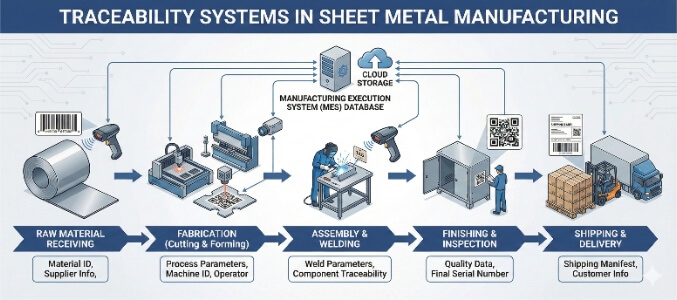
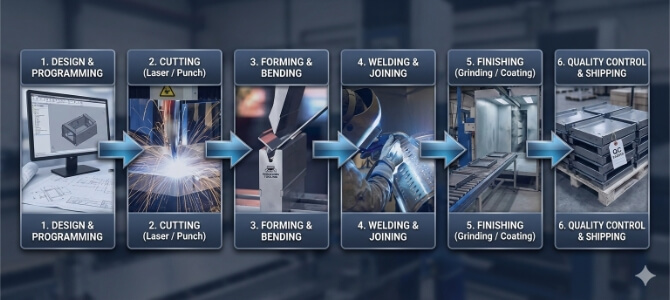
Tracking starts the moment a truck backs up to your loading dock. It follows a strict “Chain of Custody.” This means every person who touches the metal adds to the record.
Here is the typical journey:
- Arrival: The steel plates arrive. You verify the Mill Test Report (MTR) immediately. You assign an internal ID code to that batch. You label the raw plate before it goes into the rack.
- レーザー切断: This is the most critical step. The operator pulls the plate and scans the label. Your nesting software automatically links the Plate ID to every specific part cut from that sheet. The “Heat Number” transfers digitally from the raw material to the finished component.
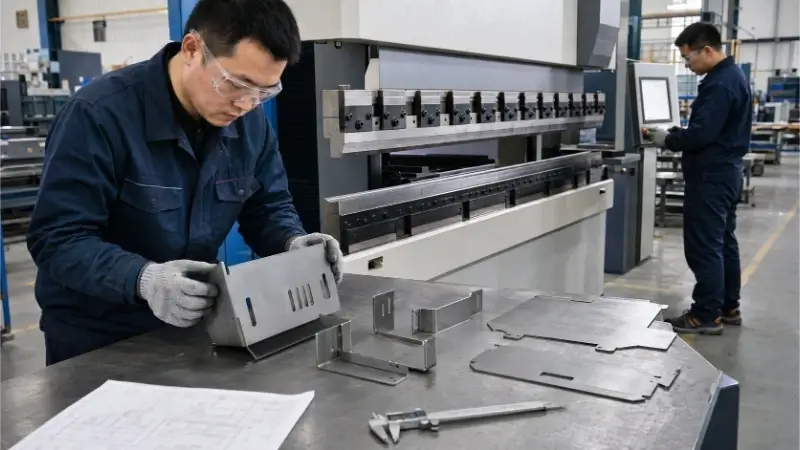
- 曲げ: The brake press operator picks up the part. They check the ID code. They perform the bend and log their name.
- Welding & Assembly: Welders verify the materials before striking an arc. They log the specific welding procedure (WPS) they used.
- Final QC: The inspector does a final check. They verify that the physical marks on the part match the digital records in your system.
The Technology Stack
You cannot rely on memory. You need the right tools to make this stick.
The “Sharpie Problem” Many shops still use permanent markers to write codes on parts. Stop doing this. Oil dissolves ink. Paint covers it up. Handling rubs it off. Once that ink is gone, that piece of metal is essentially scrap because you cannot prove what it is.
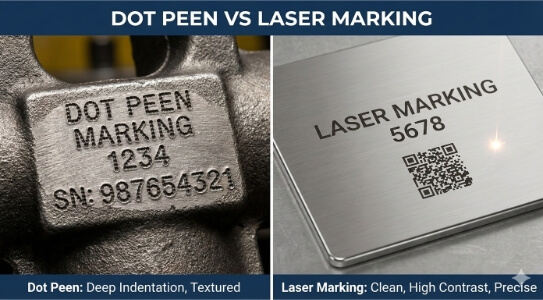
The Solution: Permanent Marking You need marks that survive the factory floor.
- レーザーマーキング: This uses a beam to etch a code onto the surface. It is fast, high-contrast, and readable by scanners. It is perfect for parts that need to look clean.
- Dot Peen: This uses a hard pin to mechanically stamp dots into the metal. It creates a deep mark. If you plan to paint or galvanize the part later, use this. The mark will still be visible under the coating.
Digital Automation In the old days, people typed numbers into Excel sheets. This is a recipe for disaster. One typo ruins the whole record.
Modern shops use integrated software. The software connects your inventory to your machines. When the laser cutter runs a job, it automatically records which plate it used. It updates your inventory in real-time. It removes the need for manual data entry. This reduces human error and keeps your data clean.
Tracking vs. Tracing: What is the Difference?
People often use these words interchangeably. But in a manufacturing context, they mean very different things. It helps to think of them as directions on a map.
Tracking (Forward: The Logistics Tool)
Tracking looks forward. It follows the product as it moves through your shop in real-time. Think of it like a UPS delivery map. You want to know where your job is right now.
- Is it at the laser cutter?
- Is it sitting in the queue for the press brake?
- Is it in the paint booth?
Tracking answers the question: “Where is it?” It is a logistics tool. It helps you manage schedules, predict bottlenecks, and tell your customer exactly when their order will ship.
Tracing (Backward: The Forensic Tool)
Tracing looks backward. It looks at the history of a product that is already finished. This happens after the part has left your building. Maybe a customer finds a crack six months later. You need to investigate. You look back at the digital thread.
- Who welded this specific unit?
- Which machine cut it?
- What was the exact chemical composition of the steel batch?
Tracing answers the question: “Where did it come from?” It is a forensic tool. It helps you solve quality claims and protect your business from liability.
The Human Element: Protecting Your “Tribal Knowledge”
Systems run on software, but they save your people. Manufacturing has a talent problem. Experienced engineers are retiring, and new hires are hard to find. A traceability system bridges this gap.
The “New Guy” Advantage
Every shop has that one veteran. He has been there for twenty years. He knows that the laser cutter acts up on humid days. He knows exactly which supplier sends the cleanest steel.
But what happens when he retires? Or what if he takes a job at another company? If that knowledge is only in his head, it walks out the door with him.
A digital system captures this “tribal knowledge.” It records the settings used. It records the material choices. It turns one person’s memory into company property.
- 結果 When you hire a new engineer, they don’t have to guess. The system tells them exactly how the job was done last time. You stop relying on memory and start building a scalable process.
Practical Advice: Don’t Overdo It
Traceability takes effort. It costs money to scan, tag, and log data. Here is a rule of thumb: Don’t spend ten dollars to track a one-dollar part.
You need to balance safety with speed.
- Full Traceability: This is mandatory for critical parts. If a beam holds up a roof or a bracket goes into an airplane, you need the full history (Heat Number, MTRs, Welder ID).
- Certificate of Compliance (CoC): This is enough for standard parts. Think about washers, simple clips, or cosmetic covers. You usually don’t need to know which specific mine the ore came from. You just need a document stating the parts meet the standard.
Be pragmatic. Save the deep tracking for the parts that really matter. “Gold-plating” your process for cheap parts will only slow you down.
結論
Traceability is your shield. It protects your past. If a lawsuit happens or a part fails, you are safe. You have the hard data to prove you did it right. You limit your liability to a few parts instead of your whole production run.
Traceability is also your sword. It secures your future. It lets you bid on high-value contracts that your competitors can’t touch. It tells Aerospace and Medical clients that you are ready for the big leagues. It helps you win business over shops that are still messy with their records.
Do you have a project that can’t afford mistakes? Don’t risk it with a shop that runs on sticky notes and guesswork. Send us your drawings today. Let us show you what a professional, transparent manufacturing process looks like.
ケビン・リー
レーザー切断、曲げ加工、溶接、表面処理技術を専門とし、板金加工において10年以上の実務経験があります。シェンゲンのテクニカルディレクターとして、複雑な製造上の課題を解決し、各プロジェクトにおける革新と品質の向上に尽力しています。