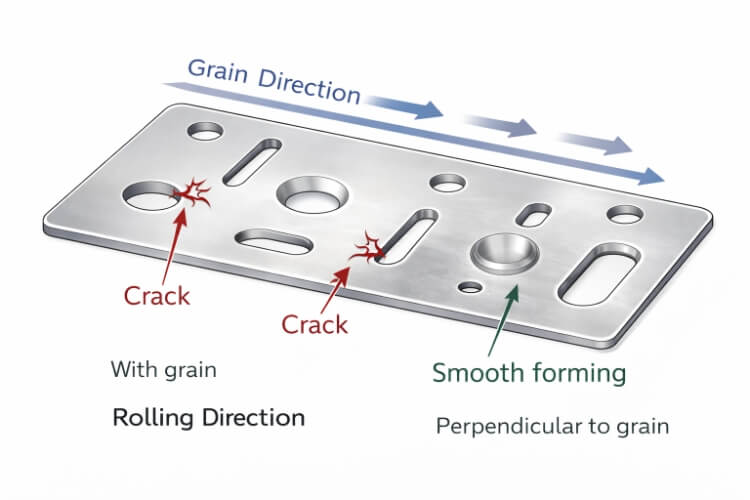
Selecting the correct sheet metal thickness can make or break a project. It defines how strong, light, and cost-efficient your product will be once it moves from CAD to production. A design that looks perfect on screen can quickly become costly or unreliable if the chosen thickness doesn’t match the part’s purpose or the equipment used to fabricate it.
Choosing thickness is not guesswork — it’s a balance between function, manufacturability, and cost. Too thin, and your part may bend, rattle, or crack under stress. Too thick, and you face higher costs, slower processing, and potential fitting issues during assembly. In many cases, a few tenths of a millimeter can decide whether a part performs flawlessly or fails under load.
Understanding how thickness interacts with materials, processes, and designs helps engineers make smarter decisions early. This guide explains the principles behind sheet metal thickness selection — with a practical focus on real manufacturing needs, not just theory.
What Is Sheet Metal Thickness?
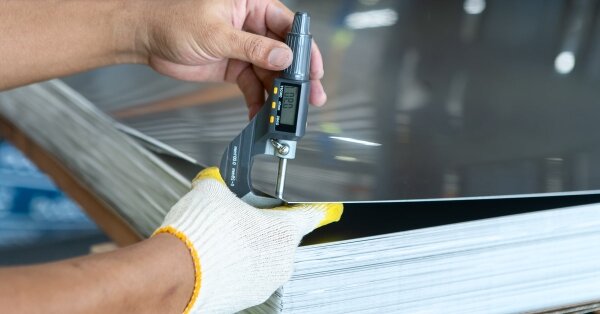
Sheet metal thickness refers to the distance between the two surfaces of a metal sheet. It’s typically measured in millimeters (mm) or inches (in). In some industries, especially steel and aluminum, the gauge system is still used, but it can be not very unclear. The lower the gauge, the thicker the sheet. For example, 12-gauge steel is about 2.78 mm thick, while 20-gauge steel is roughly 0.91 mm thick.
However, a gauge number does not represent the same thickness across materials. A 16-gauge aluminum sheet is thinner than a 16-gauge steel sheet because aluminum has a lower density. That’s why professional designers and global manufacturers prefer to specify thickness directly in millimeters — it avoids costly misunderstandings during international projects.
| 素材 | ゲージ | Approx. Thickness (mm) |
|---|---|---|
| 軟鋼 | 16 | 1.52 |
| ステンレス・スチール | 16 | 1.45 |
| アルミニウム | 16 | 1.29 |
When accuracy matters — such as in enclosure assembly or tight-tolerance parts — always communicate in metric units and confirm with your fabrication partner’s material chart.
How Thickness Affects Strength and Rigidity?
Thickness directly controls stiffness and load-bearing capacity. Mechanically, doubling the thickness increases bending stiffness roughly eightfold, according to standard beam theory. That means even minor thickness adjustments can have a dramatic impact on how much a part deflects or vibrates under force.
For instance:
- 0.8 mm aluminum works well for lightweight panels and decorative covers.
- 1.5–2.0 mm stainless steel provides good rigidity for control boxes or brackets.
- 3.0–5.0 mm mild steel is strong enough for frames, supports, or machine bases.
But stiffness doesn’t always have to come from thicker material. Innovative geometry — like bends, ribs, or folded edges — can significantly increase rigidity while keeping the sheet thin and light. In many designs, a 1.2 mm sheet with a well-placed flange performs as well as a 2.0 mm flat sheet.
プロのアドバイス When possible, strengthen by design instead of by thickness. It reduces cost, improves formability, and simplifies assembly.
Standard Thickness Ranges by Material and Application
| Application | Common Material | Typical Range (mm) | Design Focus |
|---|---|---|---|
| 装飾パネル | アルミニウム | 0.5 – 1.0 | Lightweight and flexible |
| Electronic Enclosures | ステンレス・スチール | 1.0 – 2.0 | Balance of strength and corrosion resistance |
| 取付ブラケット | 軟鋼 | 2.0 – 4.0 | High structural strength |
| マシンフレーム | 炭素鋼 | 3.0 – 6.0 | Maximum stiffness and weldability |
| HVAC Panels | 亜鉛メッキスチール | 0.8 – 1.5 | Corrosion protection and easy forming |
These ranges are general guidelines, not strict limits. The right choice always depends on how the part is used, how it’s manufactured, and what mechanical demands it must meet. A decorative cover and a machine bracket might both use steel, but their ideal thicknesses can differ by several millimeters.
Key Factors That Determine the Right Thickness
Selecting the ideal thickness requires more than checking a chart. It involves understanding how your part functions, which materials you’re using, and what your manufacturing process can handle — all while balancing cost and performance.
Functional and Structural Requirements
The most important question to start with is simple: What must this part do?
If the part’s purpose is mainly cosmetic or protective — such as covers, shields, or access panels — a 0.8–1.2 mm aluminum or stainless sheet is usually sufficient. These parts don’t bear heavy loads, so thin, formable materials keep the design lightweight and affordable.
For load-bearing parts like brackets, mounts, or machine frames, the demands change completely. Here, thickness directly impacts strength and stiffness. A 3–6 mm steel sheet may be necessary to prevent deformation or vibration during operation. Parts that handle repetitive motion or high stress must also consider fatigue resistance, not just static load.
Environmental exposure is another key factor. Components used in harsh or vibrating environments need a thicker gauge or reinforced design. For example, industrial enclosures exposed to continuous vibration typically use 1.5–2.5 mm stainless steel to prevent panel flexing and fatigue cracking over time.
Design Insight: Define the part’s purpose early — load-bearing, decorative, or protective — before finalizing the thickness. Redesigning after fabrication trials often costs far more than a pre-production adjustment.
Material Type and Mechanical Properties
Thickness choice is closely tied to material behavior. Each metal responds differently to stress, bending, and forming.
| 素材 | 密度 (g/cm³) | Strength Level | 成形性 | 一般的な用途 |
|---|---|---|---|---|
| アルミニウム | 2.7 | ミディアム | 素晴らしい | Enclosures, panels |
| 軟鋼 | 7.8 | 高い | グッド | Brackets, frames |
| ステンレス・スチール | 8 | 非常に高い | ミディアム | Outdoor or corrosion-prone assemblies |
| 銅/真鍮 | 8.4 | ミディアム | 素晴らしい | Decorative or conductive components |
Because aluminum is about one-third the density of steel, you can use a slightly thicker aluminum sheet to reach similar stiffness with less total weight. For instance, 2.0 mm aluminum offers comparable rigidity to 1.2 mm steel while cutting total weight nearly in half — a significant benefit for portable devices or transport systems.
Surface treatments also influence the final choice. Powder coating, galvanizing, or anodizing can add 0.05–0.10 mm per side, which slightly alters fit-up tolerance in assemblies. Accounting for these layers during design prevents tight parts from binding after coating.
ヒント Choose thickness and material together — not separately. A thin, high-strength alloy often outperforms a thick, low-grade sheet in both stiffness and corrosion resistance.
Manufacturing Process Limitations
Every fabrication method has its own working range. Selecting a thickness that exceeds process limits can increase cost, reduce accuracy, or even damage tooling.
- 曲げ: Thin sheets (<0.8 mm) risk wrinkling or tearing, while thick sheets (>4 mm) need greater press force and larger bend radii. As a rule of thumb, keep the bend radius at least equal to the material thickness to prevent cracking.
- レーザー切断: Most laser machines can handle steel up to 25 mm thick, but thinner sheets (0.8–3 mm) cut faster and cleaner. For tight-tolerance assemblies, thinner materials produce smoother edges and less heat distortion.
- Punching and Stamping: Excessive thickness accelerates tool wear and increases burr formation. Keeping within 1–3 mm maintains consistent edge quality.
- 溶接: Thin sheets demand precise heat control to prevent burn-through or warping. Thick plates, however, require more filler and higher amperage, which can slow production.
A part designed beyond a shop’s forming or welding capacity will not only increase cost but also reduce dimensional accuracy. Always confirm machine capabilities before locking in the final design.
注記: If your supplier uses CNC press brakes or fiber lasers, ask for their optimal thickness ranges — this often reveals cost-saving opportunities.
Cost, Weight, and Supply Chain Factors
Material thickness doesn’t just affect mechanical performance — it directly drives project cost and logistics.
Thicker sheets consume more raw material, need stronger fixtures, and take longer to cut or bend. As a result, the total fabrication cost can increase by 30–50% for every additional millimeter of thickness, especially when large panels or multiple bends are involved.
Standard sheet sizes are also important. Most stock materials come in 1.0 mm, 1.5 mm, 2.0 mm, 3.0 mm, and 5.0 mm gauges. Choosing non-standard thicknesses, like 2.8 mm or 3.3 mm, can lead to custom orders, higher minimum quantities, and extended lead times.
Weight reduction offers long-term savings. Replacing 3.0 mm steel with 2.0 mm aluminum can reduce total part weight by over 50%, which lowers transport costs and makes assembly easier.
Design-Stage Considerations
Thickness decisions aren’t finalized on the production floor—they’re made during the design stage. This is where engineers can improve stiffness, reduce cost, and ensure manufacturability long before fabrication begins.
Balancing Performance and Manufacturability
The most innovative way to strengthen a part isn’t always by adding thickness — it’s by enhancing geometry. Adding flanges, ribs, or bends can dramatically increase rigidity while keeping materials thin and easy to form.
For instance, a 1.5 mm aluminum panel with a folded 10 mm edge can match the stiffness of a 2.5 mm flat panel, cutting both material cost and bending force by more than 30%. Similarly, adding reinforcing ribs across long panels helps prevent oil canning or vibration.
Before locking in the final design, engineers should simulate bending and stress distribution using finite element analysis (FEA) or other digital tools. These simulations show where the sheet is too weak or overbuilt. By adjusting bends, folds, and mounting points, you can maintain structural integrity without unnecessary thickness.
Design Insight: It’s easier to add stiffness through geometry than to correct distortion caused by excessive thickness during production.
Tolerances and Fit-Up
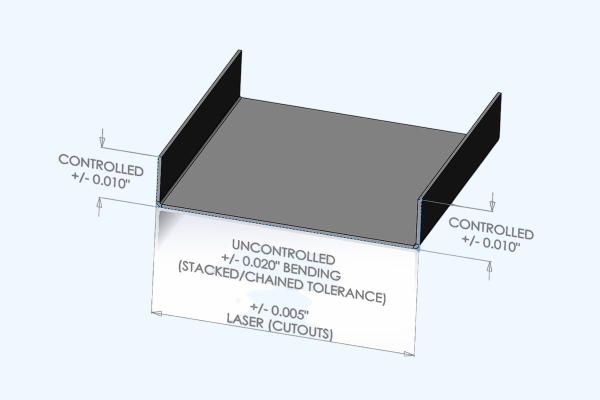
Precision assemblies depend on consistent sheet thickness. Even slight variations — say ±0.1 mm — can accumulate across multiple parts, leading to gaps, uneven joints, or poor weld fit-up.
To manage this, define tolerance zones early in the drawing phase. For general sheet fabrication, a ±0.05–0.10 mm tolerance works well. For critical assemblies like electronic housings, tighter control may be required. Discuss acceptable ranges with your fabricator before production.
Post-processing also affects dimensions. コーティングと仕上げ add measurable thickness — typically 0.05–0.10 mm per side for powder coating and 0.01–0.03 mm for anodizing. If these layers aren’t included in your design allowance, even a perfect part can become misaligned after finishing.
プロのアドバイス Align design tolerances with your manufacturer’s cutting, bending, and coating capabilities. Early communication saves time and rework later.
Environmental and Durability Factors
Where and how your parts are used can dictate the ideal thickness just as much as strength requirements. Corrosion, temperature changes, and vibration can all influence how thick your sheet needs to be.
Corrosion and Weather Resistance
For outdoor or humid environments, corrosion protection is critical. A thin sheet made from the wrong material can degrade quickly, no matter how well it’s designed. Using galvanized steel (0.8–1.5 mm) or stainless steel (1.0–2.0 mm) ensures long-term resistance against moisture and rust.
When exposure to salt, chemicals, or cleaning agents is expected — such as in marine, food processing, or medical applications — upgrading to 316 stainless steel or anodized aluminum extends product lifespan.
A practical example:
A 2.0 mm galvanized steel outdoor enclosure can last up to eight years without corrosion under moderate conditions, whereas a 1.0 mm untreated mild steel sheet may show rust within months. The correct combination of material, thickness, and finish is what ensures reliability — not just thickness alone.
ヒント Design for the harshest environment your part may face, not just the average one. This ensures performance consistency in real-world conditions.
Thermal and Vibration Effects
In high-temperature environments, metals expand and contract repeatedly. Thicker sheets absorb and distribute thermal stress better, but they also retain more heat — increasing the risk of post-weld distortion. For heat-sensitive assemblies, controlled cooling or intermittent welds can prevent warping.
Vibration presents a different challenge. Repeated stress cycles can cause thin sheets to fatigue, especially at corners or around welds. In such cases, designers can improve lifespan by adding fillets, rounded corners, or reinforcement plates instead of simply thickening the base material.
For components like hinges, brackets, or machine guards, fatigue resistance should guide the design. A 1.5 mm sheet may appear adequate, but after thousands of vibration cycles, it might crack near the joint. Reinforcing the stress zone or increasing local thickness is a better solution than overbuilding the entire part.
Design Insight: Fatigue failure often starts at predictable weak points. Strengthen these areas locally instead of increasing thickness everywhere — it saves material and improves product reliability.
How to Validate Your Thickness Selection?
Even the most experienced designers confirm their decisions with testing or simulation. Minor adjustments after testing can prevent major rework later.
1. Rapid Prototyping or Pilot Runs
Fabricate a few samples to assess how the chosen thickness performs during bending, welding, and assembly. Evaluate stiffness, surface finish, and fit before mass production.
2. Bending and Load Testing
Perform deflection or vibration tests under simulated loads. For example, if a 2.0 mm steel panel deflects by more than 1 mm under its working load, increasing the thickness or adding a rib may be required.
3. Design for Manufacturability (DFM) Review
Collaborate with your fabrication partner to check real-world feasibility. Engineers can recommend adjustments to bend radii, joint designs, or gauge choices that reduce cost and improve reliability.
4. Post-Processing Validation
After painting, coating, or welding, recheck dimensions and flatness. Finishing layers or thermal stress can slightly alter geometry. Inspecting early ensures consistency in final assemblies.
Common Mistakes to Avoid
- Assuming thicker is stronger: Excessive thickness can reduce formability, increase costs, and lead to unnecessary weight.
- Ignoring stock availability: Non-standard gauges lead to delays, custom rolling, or higher purchase costs.
- Forgetting about process limitations: A sheet too thin may warp under weld heat; too thick may exceed press brake tonnage.
- Overlooking coating and tolerance impacts: Finishing adds measurable thickness and can affect fit-up if not accounted for.
- Skipping simulation or prototype testing: Real behavior under stress often differs from design assumptions.
Avoiding these errors saves time, reduces waste, and helps ensure a smooth production process.
結論
Selecting the correct sheet metal thickness is not a single decision — it’s the result of engineering balance. Every project involves trade-offs between strength and flexibility, weight and cost, and function and manufacturability.
Good design uses thickness strategically, not excessively. With proper geometry, tolerance planning, and surface protection, even a thin sheet can perform as reliably as a thicker one. Collaboration between designers and fabricators ensures every choice — from material to finish — supports both performance and efficiency.
Are you unsure if your chosen thickness can handle your product’s demands? Our engineering team can help you verify your design before production.
We’ll analyze your drawings, run manufacturability checks, and suggest optimized thickness options — ensuring your parts stay strong, cost-effective, and easy to fabricate. Upload your CAD files or send your design today for a free DFM review.
ケビン・リー
レーザー切断、曲げ加工、溶接、表面処理技術を専門とし、板金加工において10年以上の実務経験があります。シェンゲンのテクニカルディレクターとして、複雑な製造上の課題を解決し、各プロジェクトにおける革新と品質の向上に尽力しています。