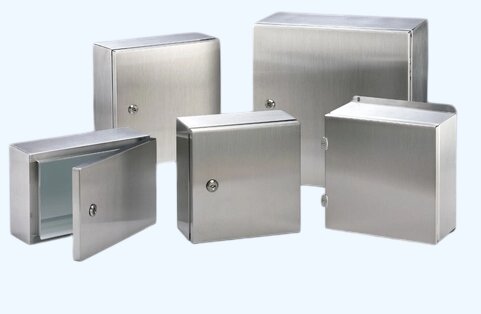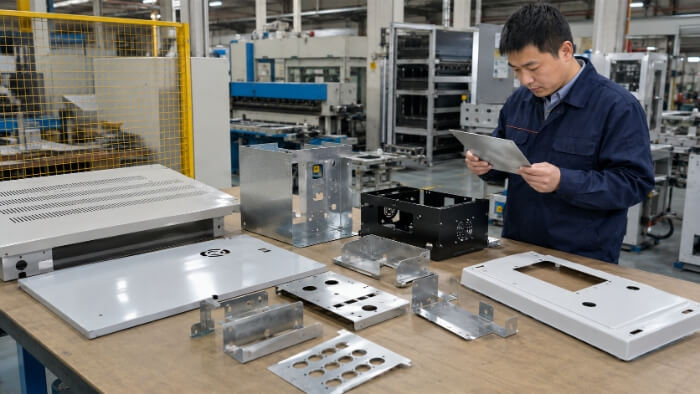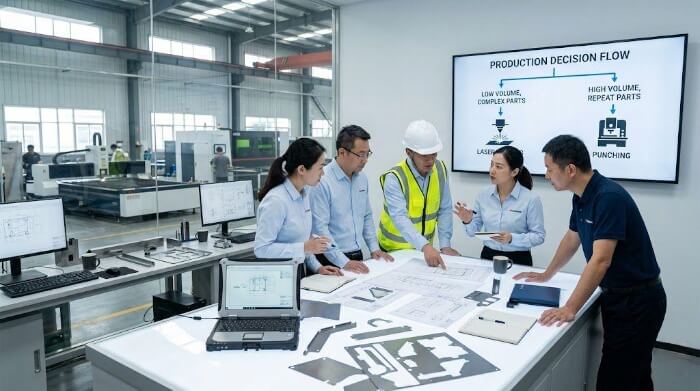
Choosing the right enclosure material isn’t just a preference — it determines durability, heat behavior, installation workload, corrosion life, and total operating cost over time. In real outdoor deployments, enclosure failures rarely come from poor cutting or welding. They happen when the material does not match the actual environment.

Aluminum and stainless steel are the two most commonly selected metals for industrial and electronic enclosures. Both can perform exceptionally well when used appropriately, but both can fail prematurely if placed in the wrong environment.

This article provides data-driven comparisons, mechanical behavior differences, corrosion performance, and practical use-case recommendations.

Stainless Steel vs Aluminum Enclosures

Stainless Steel vs Aluminum: Material Structure and Core Properties

Understanding the base characteristics of each metal makes the performance differences predictable — not surprising.

アルミニウム

  • Density ≈ 2.7 g/cm³ (about ⅓ the weight of stainless steel)
  • Forms a natural self-healing oxide barrier
  • High thermal conductivity ≈ 237 W/m·K
  • Easy to machine, form, and customize

ステンレス鋼(304/316)

  • Density ≈ 7.8 g/cm³ → heavier, more rigid
  • Corrosion resistance through passive chromium film
  • Lower thermal conductivity ≈ 15 W/m·K → heat retention is higher
  • High structural integrity under force or tampering

If weight and heat dissipation matter → aluminum leads. If impact resistance and structural stability matter → stainless becomes the safer choice.

Strength, Load Capacity & Structural Stability

Stainless steel offers higher tensile strength and holds its shape under heavy load or abuse. This makes it suitable for public-exposed machinery, heavy industrial floors, or environments where vandalism or tool impact is possible. It absorbs repeated load cycles well before failure.

Aluminum’s mechanical behavior is different. It has an excellent strength-to-weight ratio, but lower rigidity overall. Under severe impact, aluminum bends instead of cracking — a “fail-soft” behavior that keeps the enclosure intact but may distort doors or seals.

Strength Comparison at a Glance

プロパティ アルミニウム ステンレス・スチール
引張強さ より低い より高い
Failure mode under impact Bends first Cracks only at higher load
Strength-to-weight すごく高い Strong but heavy
Best purpose Lightweight equipment High-abuse environments

Corrosion Resistance in Long-Term Outdoor Use

Aluminum naturally forms a protective oxide surface — and importantly, this layer self-regenerates when scratched. With 粉体塗装 または 陽極酸化処理, aluminum can perform exceptionally well in humidity, rain, salt spray, and coastal wind.

Stainless steel resists corrosion differently. In clean industrial settings, its passive chromium film provides long service life. However, in chloride-heavy locations — near oceans, chemical vapor, wastewater plants — stainless steel can pit or crevice-corrode unless properly maintained or upgraded to 316.

Salt-Fog Reality

素材 Typical Salt-Spray Outcome
Carbon steel (no coating) < 200 hours before rusting
パウダーコート・アルミニウム Frequently 1,000+ hours stable
316ステンレス Excellent, but not invincible against stagnant chlorides

In coastal or high-salt environments → coated aluminum or 316 stainless is preferred. In factories or public-exposed mechanical areas → stainless steel maintains shape longer.

Thermal Performance & Heat Dissipation

Heat is one of the most common failure triggers inside metal enclosures — especially for electronics, batteries, inverters, and power distribution modules. Thermal conductivity determines how fast heat escapes rather than accumulates.

Aluminum transfers heat quickly at ≈237 W/m·K, making it great for cooling and heat spreading. Stainless steel is only ≈15 W/m·K, so it holds heat 10–15× longer and dissipates heat much more slowly.

Aluminum acts like a heat plane — it quickly distributes thermal load across its surface, reducing hotspots inside the enclosure. In many applications, this means fewer ventilation cutouts, smaller heat sinks, or no active cooling hardware required.

Stainless steel behaves differently. Because it releases heat slowly, the interior temperature tends to rise more, especially in high-sun outdoor environments. A 10–15°C temperature increase can shorten component lifespan by 30–50%, depending on the device.

When thermal stability is mission-critical → aluminum is the clear advantage. When insulation or heat retention is beneficial (cold regions, anti-frost structures) → stainless steel becomes useful.

Manufacturability & Fabrication Efficiency

Processing difficulty directly affects lead time, tooling cost, and customization flexibility.

Forming & Machining Performance

Metric アルミニウム ステンレス・スチール
加工性 Easy — low tool wear Harder — blunts tools faster
Welding difficulty 低~中程度 Higher — heat control required
Bending/formability Smooth, consistent High force required, spring-back risk
Prototype speed 速い Slower and costlier

Aluminum is easier to cut, パンチ, 工場, anodize, or powder coat. This makes it ideal for rapid prototyping, frequent design revisions, or low-volume custom enclosures. For teams still refining product geometry, aluminum reduces iteration time dramatically.

Stainless steel requires more energy to form and better welding discipline to avoid distortion or discoloration. This increases fabrication time — but rewards the user with higher long-term rigidity.

If you iterate designs often → aluminum lowers development cost.

If geometry is finalized and high rigidity is required → stainless steel scales better.

Surface Finishing & Weathering Longevity

Finishing quality determines how well both metals age outdoors.

Aluminum Finishing Options

  • 陽極酸化処理 — hard, UV-stable oxide layer
  • パウダーコーティング — excellent corrosion/impact resistance
  • Chemical conversion films — conductive RF-friendly surfaces

Anodized aluminum can achieve 3–5× surface hardness improvement, while powder coat adds a barrier layer capable of exceeding 1,000h salt-spray endurance.

ステンレス鋼仕上げオプション

  • ブラッシング — reduces visible scratching
  • Passivation/electropolishing — improves chromium film stability
  • Mirror polish — ideal for hygiene-critical environments

Polished stainless is chemically smooth and hard for contaminants to bond onto, which is why it dominates food processing, medical, and wash-down installations.

Neither finish is perfect alone — failure depends on exposure cycle, temperature swing, and maintenance frequency.

Hidden Failure Modes

Galvanic Corrosion (Aluminum vs Other Metals)

When aluminum contacts a dissimilar metal — stainless screws, brass terminals, copper lugs — and moisture is present, aluminum becomes the sacrificial anode and corrodes first.

Mitigation:

Insulating washers, nylon bushings, surface coating, or switching to aluminum-compatible fasteners.

Thermal Expansion Seal Fatigue

Aluminum expands nearly 2× more than stainless steel under temperature change.

In daily hot-cold cycling, gasket compression can loosen → reducing IP/NEMA rating over the years.

Mitigation:

Use elastomer gaskets with long-term compression memory or design with expansion clearance.

Long-Term Vibration Creep

Stainless holds geometry rigidly; aluminum may deform slowly under cyclic force or wind-load on large door panels.

Mitigation:

Use thicker-gauge aluminum or rib-reinforced panel structures.

These hidden risks don’t mean one material is “better” — only that each behaves predictably when engineered correctly.

Real-World Application Scenarios: Which Metal Performs Better?

Material selection becomes much easier when viewed through a use case rather than a theory. Below is a field-tested breakdown — based on weight constraints, exposure environment, heat conditions, and impact risk.

Environment / Use Case Recommended Material Why
Coastal telecom, offshore wind, marine sensor boxes Coated Aluminum or 316 Stainless Chlorides + moisture → aluminum resists better, 316 if tamper risk is high
Battery BMS, inverter housings, power electronics アルミニウム Best thermal conduction, better internal temperature regulation
Heavy-traffic industrial floors, public access zones ステンレス・スチール Impact resistance, vandal protection, better structural retention
Food & pharmaceutical processing areas ステンレス・スチール Hygienic surface, easy sanitation, resistant to chemical washdowns
Pole-mount smart city equipment, highways アルミニウム Lightweight → faster installation + lower mounting load
Harsh vibration sites (trains, turbines) Stainless or Reinforced Aluminum Stainless holds geometry longer. Aluminum possible if rib-stiffened
Remote solar/grid installations (no frequent maintenance) アルミニウム Low maintenance + lower corrosion risk over years

No universal winner — but there is always a correct match. Choosing based on workload, environment, and lifespan saves more money than choosing by habit.

Stainless Steel vs Aluminum Enclosures: Quick Material Selection Matrix

Use this matrix as a fast engineering decision tool:

Requirement Best Choice
Need lowest weight / easiest handling アルミニウム
Extreme heat or electronics inside アルミニウム
Long-term structural rigidity ステンレス・スチール
High vandal/impact risk ステンレス・スチール
Coastal or salt-fog exposure Aluminum (coated) / 316 Stainless
Frequent redesign & prototyping アルミニウム
Hygiene-critical, wash-down ステンレス・スチール

If 3 or more boxes land on one side → that material is the correct pick.

結論

Both materials are excellent — just excellent at different things. Aluminum wins where weight, corrosion resistance, thermal performance, and low-maintenance service life matter most. Stainless steel wins where mechanical abuse, public access protection, or rigid dimensional stability is required over the years.

The highest performing enclosures are not always the strongest or the most expensive — they are the ones engineered to match their environment, not fight against it. With data, corrosion cycles, heat load, and failure risks understood, reliability becomes predictable — and replacement frequency drops significantly.

If you’re selecting materials for an enclosure project and want fast guidance based on your environment, load requirements, and thermal profile, we can help. Please send us your enclosure drawings or specs. We will review suitability, compare expected lifetime performance, and recommend the most cost-effective material for your use case.

よくあるご質問

Which enclosure material lasts longer outdoors?

Both can last years, but conditions matter. Aluminum performs better in constant humidity or salt spray, while stainless steel lasts longest in clean industrial settings or where vandal resistance is required.

Does stainless steel resist corrosion better?

Not always. In chloride-heavy environments (coastal, chemical plants), stainless steel may pit or crevice-corrode unless the 316 grade is used or maintained. Coated/anodized aluminum often performs better outdoors long-term.

Can aluminum enclosures handle impact?

Yes, but it deforms instead of cracking. Stainless steel holds shape better under heavy abuse, so it’s preferred for public-exposed or industrial environments.

Which material is best for battery packs or inverter housings?

Aluminum — due to high heat dissipation, light weight, and lower maintenance.

Which material is best for hygienic or sanitary environments?

Stainless steel — electropolished or brushed finish resists contamination and is easy to clean.

Is aluminum or stainless steel cheaper long-term?

Often, aluminum, once installation + maintenance, + heat management costs are included. Stainless wins when durability and high-impact integrity save replacement cycles.

やあ、僕はケビン・リー

ケビン・リー


過去10年間、私はさまざまな形態の板金加工に没頭し、さまざまなワークショップでの経験から得たクールな洞察をここで共有してきた。

連絡先

ケビン・リー

ケビン・リー

レーザー切断、曲げ加工、溶接、表面処理技術を専門とし、板金加工において10年以上の実務経験があります。シェンゲンのテクニカルディレクターとして、複雑な製造上の課題を解決し、各プロジェクトにおける革新と品質の向上に尽力しています。
クイック見積もり

1営業日以内にご連絡いたします。接尾辞が"@goodsheetmetal.com "のメールにご注意ください。

ご希望のものが見つかりませんでしたか? 弊社のディレクターに直接ご相談ください!