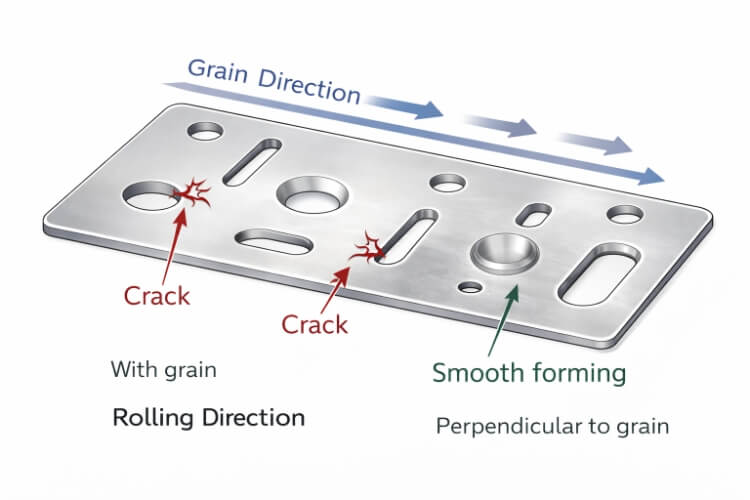
L'emboutissage profond et l'emboutissage de tôles comptent parmi les procédés de mise en forme des métaux les plus utilisés dans la fabrication moderne. Tous deux partent d'une tôle plate, mais la façon dont ils façonnent et sollicitent le matériau diffère considérablement. Pour les ingénieurs, les concepteurs et les équipes d'achat, il est essentiel de comprendre ces différences pour choisir la solution la plus efficace, la plus rentable et la plus durable pour chaque pièce.
Cet article compare leur mécanique, leur impact sur la conception, les exigences en matière de matériaux et l'efficacité de la production, offrant ainsi des conseils pratiques aux équipes chargées de trouver un équilibre entre la qualité, le coût et le délai de réalisation des projets de fabrication.
Emboutissage et emboutissage de la tôle : Principes fondamentaux de chaque processus
Les deux procédés partent d'une tôle plate mais diffèrent dans la façon dont ils la transforment. Comprendre leurs mécanismes de formage permet de savoir quand chaque méthode est la plus performante.
Qu'est-ce que l'emboutissage de la tôle? ?
Estampage de tôle utilise un poinçon et une matrice pour presser, plier ou découper des feuilles de métal dans des formes précises sous l'effet d'une force élevée. Le processus applique une contrainte de compression, ce qui permet au matériau de s'écouler dans le contour souhaité sans étirement important.
Les opérations d'estampage les plus courantes sont le découpage, le poinçonnage, le gaufrage, le pliage et le monnayage. Ces opérations peuvent être réalisées en une seule étape ou dans des matrices progressives qui combinent plusieurs actions par course. Les presses modernes peuvent atteindre 300 à 800 coups par minute, ce qui permet d'obtenir un rendement extrêmement élevé.
L'estampage est idéal pour les composants plats ou peu profonds tels que les supports, les panneaux et les couvercles électriques, pour lesquels la précision dimensionnelle et la répétabilité sont essentielles. Le processus étant axé sur la compression à grande vitesse, il permet d'obtenir une géométrie cohérente à un faible coût par pièce.
En bref : Dans les opérations de découpage fin, les tolérances des pièces peuvent atteindre ±0,05 mm, ce qui fait de l'emboutissage l'une des méthodes de production de masse les plus précises pour la tôle.

Qu'est-ce que le dessin profond? ?
Emboutissage profond L'emboutissage profond consiste à donner une forme profonde et creuse à une pièce de métal en la tirant dans une cavité de la matrice à l'aide d'un poinçon. Contrairement à l'estampage, qui comprime la tôle, l'emboutissage applique simultanément des forces de traction et de compression - le métal s'étire vers l'intérieur et s'écoule en douceur le long des parois de la matrice.
Ce procédé permet de produire des cylindres, des coupelles ou des boîtiers sans soudure, ce qui se traduit par une excellente solidité et une grande résistance aux fuites. Pour les pièces très profondes, plusieurs étapes d'emboutissage (appelées redécoupage) afin d'éviter les déchirures ou les amincissements.
L'emboutissage profond nécessite un contrôle précis des :
- Rayon du poinçon - généralement de 6 à 10 fois l'épaisseur de la feuille
- Pression de l'enveloppe - prévient les rides et l'irrégularité du débit
- Lubrification - réduit les frottements et les dommages de surface
Lorsqu'il est bien réglé, l'emboutissage permet d'obtenir des résultats lisses et stables sur le plan dimensionnel, même dans des matériaux minces comme l'acier inoxydable ou l'aluminium de 0,3 à 1,2 mm d'épaisseur. Il est largement utilisé pour les boîtiers automobiles, les conteneurs médicaux et les récipients sous pression, où la géométrie sans soudure et la résistance sont les plus importantes.
Aperçu de l'ingénierie : Le Rapport de tirage limite (LDR) - le rapport entre le diamètre de l'ébauche et le diamètre du poinçon - est généralement compris entre 1,8:1 et 2,2:1 pour l'acier inoxydable et jusqu'à 2,5:1 pour les alliages d'aluminium. Le dépassement de ce rapport augmente le risque de déchirure.
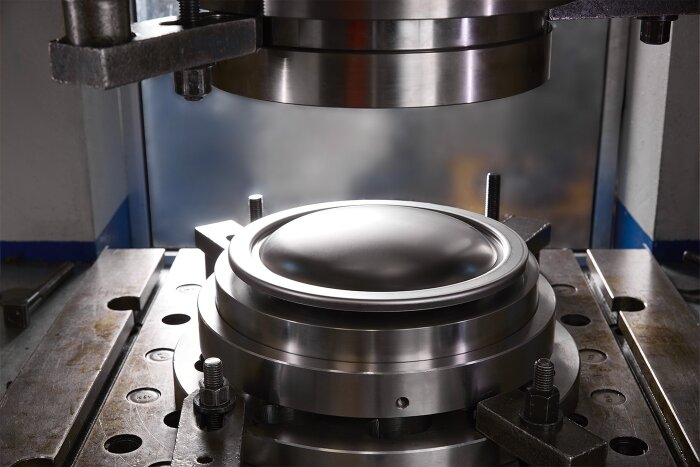
Principales différences de processus
Bien que les deux procédés façonnent efficacement le métal, les forces, l'outillage et les schémas de contrainte impliqués varient considérablement. L'étude de ces différences permet de comprendre pourquoi certaines pièces privilégient un procédé plutôt qu'un autre.
Direction et type de déformation
Dans l'emboutissage, la déformation est dominée par la compression et la flexion. Les contraintes se concentrent autour des coins, des arêtes et des trous, tandis que le reste de la tôle reste pratiquement plat. Ce procédé convient aux formes peu profondes où l'épaisseur reste constante et où la profondeur est limitée.
L'emboutissage profond, en revanche, repose sur l'étirement par traction. L'ébauche s'écoule continuellement dans la cavité de la matrice, redistribuant les contraintes sur toute la surface. Cela permet d'obtenir des formes profondes et sans soudure, sans joints ni soudures, ce qui est idéal pour les applications de support de pression ou de rétention de fluides.
| Aspect | Estampillage | Dessin en profondeur |
|---|---|---|
| Force principale | Compression et flexion | Traction et compression (simultanées) |
| Distribution des contraintes | Localisé dans les virages | Réparti uniformément le long des murs et du fond |
| Formulaire de résultat | Plat ou peu profond | Profonde, incurvée ou creuse |
| Rapport de profondeur typique | ≤ 0.5 : 1 | Jusqu'à 2 : 1 ou plus |
Conception d'outils et de matrices
Les matrices d'emboutissage sont relativement simples et rapides à fabriquer. Elles sont principalement conçues pour couper, plier ou frapper des pièces. Ils se concentrent sur le jeu entre le poinçon et la matrice (typiquement 5-10% de l'épaisseur de la tôle) afin de garantir un cisaillement propre.
Les matrices d'emboutissage sont plus complexes et plus sensibles à la précision. Elles nécessitent des surfaces polies comme des miroirs, des rayons généreux et un jeu contrôlé pour permettre un flux de matière régulier. Le porte-flanc applique une pression réglable pour éviter la formation de plis pendant l'emboutissage. En raison de ces contrôles supplémentaires, l'outillage d'emboutissage est plus coûteux au départ, mais il dure plus longtemps et produit des pièces d'une plus grande intégrité.
Exemple pratique : Pour une pièce en acier inoxydable de 1 mm, une matrice d'emboutissage peut coûter de 2 000 à 3 000 USD, tandis qu'une matrice d'emboutissage peut coûter de 5 000 à 8 000 USD en raison de l'état de surface et de la précision des contours requis.
Flux de matériaux et comportement sous contrainte
Lors de l'emboutissage, le métal se déplace très peu ; la déformation se produit principalement aux points de contact du poinçon et aux rayons de courbure. Cela permet d'obtenir une planéité prévisible et de faibles contraintes résiduelles.
Dans l'emboutissage, le flux de matière est dynamique - la zone de la bride se comprime, les parois latérales s'étirent et le fond reste sous compression. La gestion de cet équilibre des contraintes est essentielle. Une lubrification adéquate et une bonne géométrie de la filière permettent d'éviter l'amincissement ou la déchirure locale, qui se produit généralement lorsque l'épaisseur de la paroi tombe en dessous de 85-90% de l'épaisseur initiale de la tôle.
Cette différence explique également pourquoi l'emboutissage tend à augmenter la résistance de la pièce grâce à l'écrouissage, alors que l'estampage conserve les propriétés mécaniques d'origine.
Considérations relatives à la conception et à la géométrie
La forme, la profondeur et la tolérance d'une pièce dictent souvent la méthode de formage la mieux adaptée. Ces règles de conception déterminent dès le départ la fabricabilité et la rentabilité.
Complexité des formes
L'emboutissage convient mieux aux formes plates ou légèrement profilées. Sa compression à faible course limite le rapport hauteur/largeur réalisable à environ 0,3-0,5:1. Les pièces estampées les plus courantes sont les plaques de montage, les panneaux de recouvrement et les supports qui nécessitent des courbes ou des trous précis.
L'emboutissage profond, en revanche, permet d'obtenir des géométries à rapport d'aspect élevé, où la profondeur de la pièce peut dépasser le double de son diamètre. Ce procédé produit des coques cylindriques, coniques ou incurvées avec des surfaces lisses et des parois continues. Comme le métal s'écoule plutôt qu'il ne se plie, il peut former des cavités profondes sans qu'il soit nécessaire d'effectuer des soudures ou des raccords.
Exemple : Une coupelle en aluminium de 70 mm de diamètre et de 40 mm de profondeur (rapport d'aspect de 0,57:1) peut être emboutie en une seule étape, alors que l'emboutissage n'atteindrait que 20 mm avant de se fissurer ou de se plisser.
Lors du choix d'un procédé, les ingénieurs utilisent souvent la profondeur d'emboutissage, le diamètre de la bride et le rayon de l'angle comme indicateurs de faisabilité. Plus la conception est profonde ou sans soudure, plus elle penche en faveur de l'emboutissage.
Précision dimensionnelle et tolérance
L'emboutissage de la tôle permet d'obtenir une excellente planéité et une grande précision de positionnement, en particulier dans les trous ou les coudes. Les presses de découpage fin peuvent maintenir des tolérances aussi étroites que ±0,05 mm. Toutefois, les zones de pliage peuvent présenter un retour élastique, généralement de 1° à 3°, en fonction de la dureté du matériau et du rayon de pliage.
L'emboutissage profond, quant à lui, permet d'obtenir une géométrie et une profondeur de paroi constantes, mais peut nécessiter un ébarbage après le formage pour respecter les dimensions finales des bords. Pendant le formage, la redistribution de la matière entraîne des variations mineures (±0,2-0,3 mm) de l'épaisseur de la paroi ou du diamètre de la bride.
Les deux méthodes bénéficient d'une simulation basée sur l'analyse par éléments finis et d'une compensation de l'outil lors de la conception. Ces outils numériques prévoient la concentration des contraintes et les zones d'amincissement, ce qui permet d'ajuster les formes des outils pour garantir une répétabilité précise avant le début de la production.
Conseil de conception : Pour les pièces de précision telles que les boîtiers de capteurs, l'utilisation de la simulation au début de la phase de DFM peut réduire les itérations d'outillage de 30%-40%.
Épaisseur de la paroi et comportement du matériau
Les deux méthodes de formage diffèrent dans la manière dont elles affectent l'épaisseur de la tôle :
- Estampillage conserve une épaisseur presque uniforme car la déformation est localisée autour des coudes et des coupes.
- Emboutissage profond entraîne un amincissement des parois (jusqu'à 10-15%) sur les flancs et un épaississement près de la bride en raison de la compression.
Pour contrôler ces effets, les ingénieurs ajustent le rapport d'étirage, la pression du porte-flan et le rayon du poinçon. Par exemple, la réduction du rapport d'étirage de 2,0 à 1,8 augmente souvent le taux de réussite de manière significative pour l'acier inoxydable.
La distribution de l'épaisseur d'une pièce emboutie peut être analysée à l'aide d'une modélisation par éléments finis. Cela permet de confirmer qu'aucune section ne descend en dessous de la limite de déformation critique du matériau.
| Facteur | Estampillage | Dessin en profondeur |
|---|---|---|
| Modification de l'épaisseur de la paroi | <2% | 5-15% éclaircissement typique |
| Rapport de profondeur (H/D) | ≤0.5 | Jusqu'à 2.0 ou plus |
| Type de contrainte de formation | Cintrage local | Traction et compression réparties |
| Retour élastique typique | 1°-3° | Négligeable |
| Remaniement nécessaire | Minimal | Peut nécessiter un élagage |
Rayon d'angle et de transition
Les petits rayons d'emboutissage permettent de créer des arêtes vives et des courbes bien définies. Pour une tôle de 1 mm d'épaisseur, les rayons de courbure sont souvent de 1 à 1,5 fois l'épaisseur du matériau. L'emboutissage nécessite des rayons de transition plus importants (6 à 10 fois l'épaisseur) pour permettre un écoulement fluide du matériau. Un rayon trop petit concentre les contraintes et provoque des déchirures.
Une conception appropriée du rayon garantit un flux de matière laminaire et empêche la formation de plis - un défaut courant dans les flans mal contraints.
Note de l'ingénieur : Un rayon de poinçon poli réduit la friction et améliore la qualité de la surface. Cette caractéristique est particulièrement intéressante pour les boîtiers décoratifs en acier inoxydable ou en aluminium, pour lesquels la post-finition doit être réduite au minimum.
Matériaux et propriétés mécaniques
Le choix des matériaux détermine la facilité avec laquelle une pièce peut être formée et ses performances en service. L'emboutissage et l'estampage réagissent différemment à la limite d'élasticité, à l'allongement et à l'écrouissage.
Matériaux couramment utilisés
Les deux procédés utilisent généralement de l'acier inoxydable, de l'aluminium, de l'acier laminé à froid et des alliages de cuivre, mais les profils mécaniques requis diffèrent :
- Estampillage tolère une limite d'élasticité plus élevée et un allongement plus faible (≤15%). Les matériaux tels que le SPCC ou le SECC sont idéaux pour les composants structurels rigides.
- Emboutissage profond exige des matériaux ductiles avec un allongement ≥25% et un faible rapport rendement/traction (<0,6). Les qualités telles que SUS304 DDQ, C1008 et 3003-H14 offrent une bonne aptitude à l'emboutissage.
| Matériel | Adéquation du processus | Allongement typique (%) | Notes |
|---|---|---|---|
| SPCC / SECC | Estampillage | 12-18 | Commun pour les supports, les panneaux |
| SUS304 DDQ | Dessin en profondeur | 40-45 | Excellente capacité de tirage |
| Aluminium 3003-H14 | Dessin en profondeur | 25-30 | Léger et ductile |
| C110 Cuivre | Estampage / Emboutissage | 30-40 | Bonne conductivité, formabilité moyenne |
Vérification rapide : Un simple "test de la tasse" ou "test d'Erichsen" est souvent utilisé pour mesurer l'aptitude au tirage avant la production.
Résistance et état de surface obtenus
Estampillage:
Le processus ne modifie pas de manière significative la dureté du matériau. Les pièces conservent leur résistance mécanique d'origine, ce qui les rend aptes à des applications structurelles ou de montage. L'état de surface dépend de l'état de la matrice - un polissage secondaire ou un revêtement peut être nécessaire pour éliminer les bavures et les marques de presse.
Dessin en profondeur :
En raison de l'écrouissage, les parois étirées ont souvent une limite d'élasticité 10-25% supérieure à celle de la tôle de base. Cette propriété mécanique améliorée est précieuse pour les conteneurs ou les enceintes sous pression. Le procédé permet également d'obtenir des surfaces naturellement lisses, puisque le matériau glisse sur des matrices lubrifiées et polies.
| Caractéristique | Estampillage | Dessin en profondeur |
|---|---|---|
| Modification de la force | Aucun | Augmentations (10-25%) |
| Finition de la surface | Peut nécessiter un polissage | Lisse au contact de la matrice |
| Précision du formulaire | Haut sur les zones plates | Géométrie en profondeur |
| Post-traitements courants | Ébavurage, placage | Taille, nettoyage des surfaces |
Comportement du matériau pendant le formage
Lors de l'emboutissage, la plupart des déformations se produisent localement ; les grains restent pratiquement inchangés. En revanche, lors de l'emboutissage, l'allongement et l'orientation des grains se produisent le long de la direction de l'emboutissage, ce qui améliore la résistance directionnelle mais réduit la ductilité pour le formage ultérieur.
Pour les conceptions complexes, le recuit entre les tirages rétablit la ductilité et réduit le risque de fissuration - une étape courante pour les pièces en acier inoxydable ou en titane.
Conseil d'optimisation : Lors de l'emboutissage de matériaux à dureté élevée, un emboutissage en deux étapes avec recuit intermédiaire peut augmenter la profondeur d'emboutissage de 40% par rapport à un processus en une seule étape.
Comparaison de la vitesse de production et des coûts
Le temps de cycle, l'investissement en outillage et la taille des lots influencent directement le coût total. Comprendre ces compromis permet d'équilibrer les budgets à court terme et les objectifs de production à long terme.
Investissement dans l'outillage
L'emboutissage nécessite des matrices plus simples et plus rapides à produire. Ces outils se concentrent principalement sur la précision du jeu de coupe, des angles de pliage et de l'alignement de l'outil. Une matrice à opération unique typique peut coûter de 1 500 à 3 000 USD, tandis qu'une matrice progressive à plusieurs stations peut atteindre 5 000 à 10 000 USD en fonction de la complexité de la pièce.
L'emboutissage profond exige des surfaces de matrice de haute précision et une géométrie d'outil complexe pour contrôler le flux de métal et éviter les plis ou les déchirures. Ces matrices subissent souvent de multiples étapes de polissage et de traitement thermique. Par conséquent, les coûts d'outillage varient de 6 000 à 15 000 USD pour une production de qualité industrielle.
Cependant, les matrices d'emboutissage durent généralement plus longtemps - jusqu'à 500 000-1 000 000 de cycles - contre 200 000-400 000 cycles pour les outils d'emboutissage. Au fil du temps, le coût initial plus élevé est compensé par leur durabilité et la réduction de la fréquence d'entretien.
Conseil économique : Pour une production stable et à haut volume dépassant 50 000 pièces, l'emboutissage profond permet souvent de réduire le coût total par unité après amortissement de l'investissement dans l'outillage.
Temps de cycle et efficacité de l'automatisation
L'estampage est connu pour sa vitesse de production inégalée. Les lignes d'emboutissage progressif peuvent produire de 200 à 800 pièces par minute, avec des chargeurs de bobines automatiques et des capteurs de matrices assurant un fonctionnement continu.
L'emboutissage profond fonctionne généralement à une vitesse de 10 à 30 pièces par minute, en fonction de la profondeur d'emboutissage et du type de matériau. Les processus d'emboutissage en plusieurs étapes ou de réemboutissage ralentissent encore la production, mais ce compromis permet d'obtenir une meilleure intégrité structurelle et une plus grande uniformité dimensionnelle.
Des progrès tels que les presses hydrauliques servo-motorisées et les systèmes de transfert assistés par robot ont permis de réduire cet écart. Les servopresses modernes offrent des profils de course réglables, ce qui permet de réduire le temps d'emboutissage de 20 à 30% par rapport aux presses hydrauliques conventionnelles.
| Facteur | Estampillage | Dessin en profondeur |
|---|---|---|
| Vitesse typique | 200-800 pièces/min | 10-30 pièces/min |
| Niveau d'automatisation | Très élevé (lignes progressives) | Modéré à élevé (servo/hydraulique) |
| Taille de lot appropriée | Petit-grand | Moyen-très grand |
| Durée de vie de l'outil | 0,2-0,4 million de tirs | 0,5-1 million de tirs |
Aperçu pratique : Pour les boîtiers ou les couvercles légers, l'estampage est 5 à 10 fois plus rapide que l'emboutissage. Mais pour les boîtiers profonds ou les composants scellés, l'emboutissage permet d'éviter les étapes coûteuses d'assemblage secondaire ou de soudage.
Rentabilité par volume de production
La taille des lots a une incidence directe sur les performances en termes de coût par pièce.
- Volumes faibles à moyens (<10 000 pièces) :
- L'emboutissage offre un retour sur investissement plus rapide en raison de ses faibles coûts d'outillage et d'installation. Il est idéal pour les prototypes, les séries limitées ou les conceptions fréquemment modifiées.
- Volumes élevés (>20 000-50 000 pièces) :
- L'emboutissage profond devient plus rentable car les coûts d'outillage sont répartis sur un plus grand nombre de pièces et la nécessité d'opérations d'assemblage secondaires (comme le soudage ou le scellement) est éliminée.
Par exemple, un boîtier de capteur en acier inoxydable qui coûte 2 USD par pièce par emboutissage et soudage peut être embouti à 1,30 USD par pièce lorsque la production annuelle dépasse 100 000 unités - soit une réduction de 35%.
Référence dans l'industrie : Les fabricants d'automobiles et d'appareils électroménagers utilisent souvent l'emboutissage pour les panneaux extérieurs, mais ont recours à l'emboutissage pour les boîtiers de moteur, les filtres et les réservoirs afin de maintenir la stabilité des coûts pendant toute la durée de vie de l'appareil.
Comparaison des applications
Différentes industries dépendent de chaque processus pour des raisons spécifiques. Les applications de l'emboutissage et de l'emboutissage profond mettent en évidence leurs atouts complémentaires.
Produits typiques fabriqués par emboutissage
L'emboutissage est la méthode de prédilection pour les composants plats ou de forme modérée qui nécessitent de la précision et une production à grande échelle. En voici quelques exemples :
- Boîtiers électriques, couvercles et plaques de châssis
- Supports, panneaux de porte et éléments de garniture pour l'automobile
- Cadres structurels pour appareils et équipements d'automatisation
- Plaques de blindage, fixations et matériel de montage
L'emboutissage, qui allie précision et rapidité, domine les secteurs de production de masse tels que l'électronique, l'éclairage et l'assemblage automobile.
Note de conception : Pour les pièces qui nécessitent un soudage ou un pliage après le processus, l'estampage offre une flexibilité modulaire et une intégration plus facile dans les lignes d'assemblage en aval.
Produits typiques fabriqués par emboutissage profond
L'emboutissage profond est préféré pour les structures profondes, sans soudure ou sous pression qui nécessitent des parois solides et une intégrité sans fuite. Les produits les plus courants sont les suivants :
- Boîtiers, coupelles et réservoirs cylindriques
- Coquilles de filtres à carburant et à huile
- Conteneurs médicaux et corps de capteurs
- Eviers de cuisine, ustensiles de cuisine et canettes de boisson
- Boîtiers de batterie et enveloppes thermiques
Dans des secteurs tels que l'aérospatiale, les appareils médicaux et le stockage d'énergie pour véhicules électriques, l'emboutissage garantit une fiabilité à long terme lorsque les joints de soudure présentent un risque de fuite ou de déformation.
Exemple technique : Un boîtier de batterie en aluminium embouti pesant 15% de moins que son homologue soudé peut supporter des pressions internes allant jusqu'à 4 MPa sans fuite.
Choisir le bon processus pour votre projet
Le choix entre l'emboutissage de la tôle et l'emboutissage profond nécessite de trouver un équilibre entre la géométrie, le volume, le coût et les performances mécaniques. Le guide suivant permet d'aligner la sélection du processus sur les objectifs de conception réels.
Géométrie des pièces
- Conception plate ou à brides → Choisir estampillage
- Structure profonde ou sans soudure → Choisir dessin en profondeur
Propriétés des matériaux
- Aciers durs ou à haute résistance → Mieux pour estampillage
- Métaux ductiles (Al, SS304 DDQ, Cu) → Meilleur pour dessin en profondeur
Volume de production
- Prototypage ou courts tirages → Estampillage minimise les coûts
- Production stable à long terme → Emboutissage profond maximise le retour sur investissement
Exigences de performance
- Rigidité élevée et contrôle des dimensions → Estampillage
- Résistance à la pression et finition étanche → Emboutissage profond
Surface et objectifs esthétiques
- Finitions peintes ou enduites → Estampillage avec polissage post-traitement
- Finition métallique brossée ou miroir → Emboutissage profond offre une douceur naturelle
Conclusion
L'emboutissage et l'estampage de la tôle sont tous deux essentiels dans la fabrication des métaux, mais ils répondent à des objectifs techniques différents. Comprendre leurs principes et leurs avantages permet de s'assurer que la méthode choisie correspond à l'intention de la conception, aux objectifs de coût et à la capacité de production.
Si vous avez besoin de conseils pour choisir la meilleure méthode de formage pour vos pièces métalliques, notre équipe d'ingénieurs peut vous aider. Nous proposons des études de conception pour la fabrication et des solutions de formage personnalisées adaptées à votre projet. Téléchargez vos fichiers CAO ou contactez nos ingénieurs pour obtenir un examen gratuit de la fabricabilité.
Hey, je suis Kevin Lee

Au cours des dix dernières années, j'ai été immergé dans diverses formes de fabrication de tôles, partageant ici des idées intéressantes tirées de mes expériences dans divers ateliers.
Prendre contact
Kevin Lee
J'ai plus de dix ans d'expérience professionnelle dans la fabrication de tôles, avec une spécialisation dans la découpe au laser, le pliage, le soudage et les techniques de traitement de surface. En tant que directeur technique chez Shengen, je m'engage à résoudre des problèmes de fabrication complexes et à favoriser l'innovation et la qualité dans chaque projet.
Ressources connexes
Acier inoxydable résistant aux empreintes digitales : comment fonctionne-t-il et comment le choisir ?
OEM ou fabrication en sous-traitance : Comment choisir le bon modèle pour votre projet
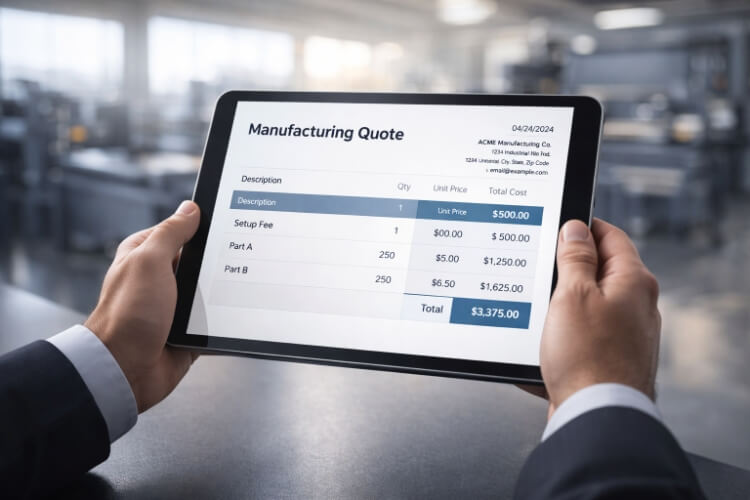
Coûts d'installation et coûts unitaires dans la fabrication de tôles