Titanium can look clean, sharp, and high-end after polishing. That is one reason it is used in medical parts, aerospace components, consumer products, and other applications where surface quality matters. But titanium is not a metal that polishes easily. If the process is not controlled well, the surface can end up uneven, discolored, or more expensive to finish than expected.
That is why titanium polishing should not be treated as a simple cosmetic step. The starting surface, part geometry, finish target, and polishing method all affect the result. In many cases, the real question is not how to make titanium shinier.
This article explains how titanium polishing works in real manufacturing. It covers why titanium is harder to polish than many other metals, when polishing is worth doing, what finish levels you can realistically expect, and how to avoid common problems before production starts.
Why Titanium Resists Traditional Polishing?
Standard abrasive protocols often fail on titanium due to two primary material characteristics: poor thermal management and rapid work-hardening.
Thermal Conductivity and Work-Hardening Risks
Titanium has exceptionally low thermal conductivity. During mechanical polishing, heat does not dissipate into the bulk of the part; it remains concentrated at the abrasive interface. This localized thermal buildup rapidly accelerates work-hardening.
If the abrasive pressure or RPM is incorrect, the top layer of the material glazes over and hardens. Once this occurs, subsequent material removal becomes highly unpredictable, heavily increasing the risk of altering the part’s critical dimensions or drawing out the brittle alpha-case layer.
Alloy Variations: Grade 2 vs. Ti-6Al-4V
Polishing strategies must be calibrated to the specific alloy being machined.
- Grade 2 (Commercially Pure): While softer, CP titanium is highly ductile and prone to galling. It drags against abrasives, quickly loading sandpaper and buffing wheels. Processing Grade 2 requires continuous lubrication and frequent abrasive cycling to prevent material smearing.
- Grade 5 (Ti-6Al-4V): This common aerospace and structural grade is significantly harder and highly abrasion-resistant. Standard aluminum oxide compounds are generally ineffective. Achieving a uniform polish on Ti-6Al-4V requires aggressive diamond suspensions or specific silicon carbide progressions, coupled with strict temperature control protocols.
When to Specify Polished Titanium?
Specifying a polished finish directly impacts manufacturing lead time and unit cost. The decision to polish should be driven by functional requirements or critical aesthetic value rather than default design habits.
Functional and Aesthetic Justifications
- Performance and Fatigue: Removing micro-scratches through polishing eliminates stress concentrators, which directly improves the fatigue life of dynamic aerospace or automotive components. In medical or fluid-handling applications, a highly polished surface (Ra < 4 µin / 0.1 µm) is required to eliminate microscopic crevices, mitigating localized pitting corrosion or bacterial colonization.
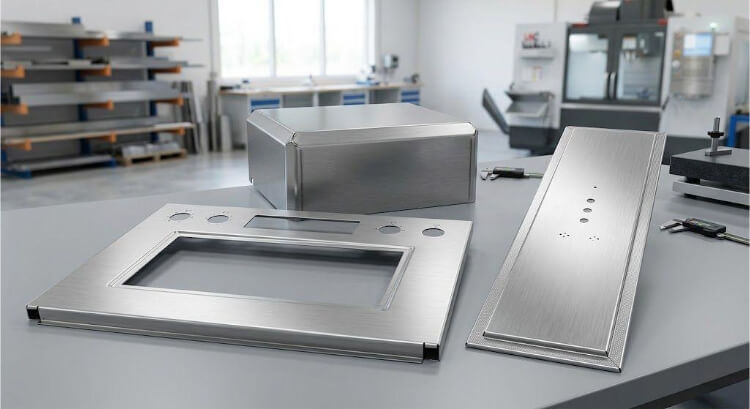
- High-Value Exteriors: For premium external components—such as the exposed faceplates and enclosures of a custom server chassis—a polished titanium finish provides superior tarnish resistance and an intended high-tech aesthetic that justifies the secondary operation costs.
Value Engineering: When to Skip the Polish
For internal structural brackets, mounting plates, or hidden enclosures, specifying a mechanical polish is an over-engineering mistake. A standard CNC “as-machined” finish (typically Ra 63 µin / 1.6 µm) is fully adequate for mechanical fit and function.
Shop Floor Note: In a recent aerospace bracket run, switching a print requirement from a “mechanical polish” to a “uniform bead-blast” reduced the unit cost by 35% without compromising the assembly’s structural integrity or dimensional accuracy.
The Step-by-Step Mechanical Polishing Protocol
When mechanical polishing is unavoidable, it must be executed as a strictly controlled progression. Skipping abrasive grits to save cycle time will inevitably leave deep sub-surface scratches that cannot be buffed out, ultimately leading to scrapped parts.
Step 1: Aggressive Degreasing
Before any abrasive touches the metal, the titanium must be meticulously degreased. If CNC cutting fluids, stamping lubricants, or handling oils remain on the surface, the high friction of the polishing wheel will bake these hydrocarbons directly into the titanium’s oxide layer, causing permanent discoloration.
Crucial: Ensure all degreasers are strictly chlorine-free. Exposing titanium to chlorides under heat can induce stress corrosion cracking (SCC), severely compromising the component’s structural integrity.
Step 2: Progressive Abrasive Machining
The goal here is gradual, uniform material removal. A standard shop progression looks like this:
- 400 Grit: Removes primary CNC tool marks and establishes a flat baseline.
- 800 to 1200 Grit: Refines the surface profile.
- 2000 Grit: Prepares the surface for final buffing.
- Process Control: Directional strokes must alternate by 90 degrees between grit changes. This visual check ensures the previous, deeper scratches are fully eradicated, rather than just smoothed over.
Step 3: Buffing and Heat Management
Final buffing requires stitched cotton wheels and high-performance polishing compounds—typically diamond paste when working with Grade 5 (Ti-6Al-4V). Because of titanium’s massive heat retention, operators must use intermittent contact (e.g., 5 seconds on the wheel, 10 seconds off) or active cooling mists.
Selecting the Right Process & Managing Shop Safety
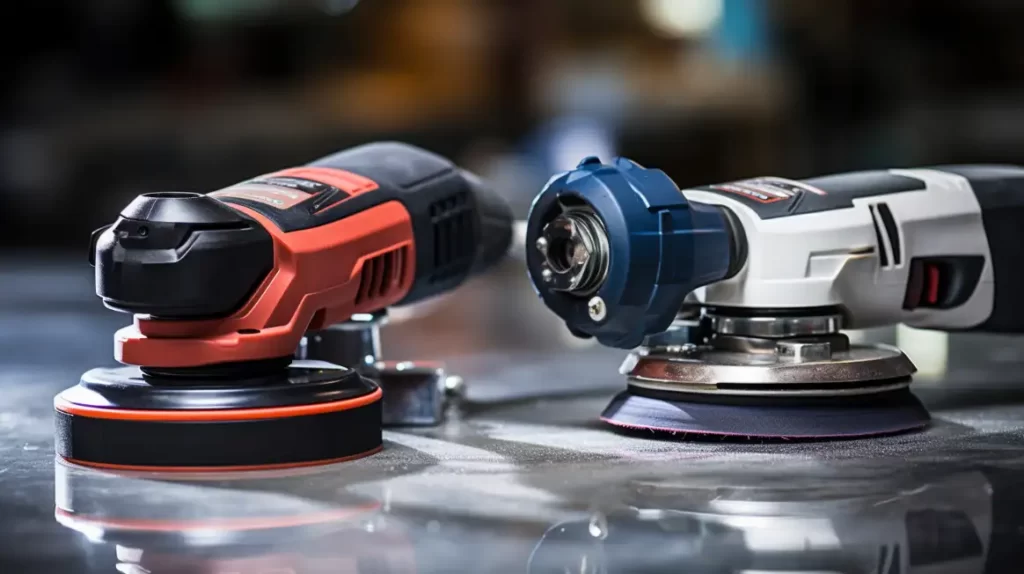
Mechanical polishing is not the only option. Depending on the part’s geometry, tolerance requirements, and end-use application, electrical alternatives often yield superior, more consistent results.
Mechanical Polishing vs. Electropolishing (EP)
Electropolishing is an electrochemical process that dissolves surface peaks uniformly. While mechanical polishing relies on physical abrasion, EP strips the material away at a microscopic level, leaving a passivated, ultra-clean surface.
| Feature | Mechanical Polishing | Electropolishing (EP) |
|---|---|---|
| Best For | Flat surfaces, simple convex exteriors, aesthetic faceplates | Complex internal cavities, threads, porous structures, medical implants |
| Tolerance Shift |
±0.015mm to ±0.030mm (highly variable based on operator) |
Highly uniform and predictable material removal |
| Surface Result | Directional, high-gloss mirror finish | Non-directional, passivated, smooth finish |
| Typical Cost | Medium (Labor-intensive) | High (Requires specialized tooling and chemical handling) |
Data Point: For a recent production run of Grade 5 titanium bone screws, electropolishing strictly per ASTM B600 achieved a uniform Ra of 0.04 µm while simultaneously passivating the surface—a level of consistency mechanical polishing simply cannot achieve on complex threads.
The Combustible Dust Hazard (Critical Safety Standard)
When evaluating a manufacturing partner for titanium polishing, their safety protocols are a leading indicator of engineering competence. Dry grinding or polishing titanium generates micro-dust that is highly pyrophoric (combustible). A single spark can trigger a catastrophic Class D metal fire or explosion.
A qualified facility will strictly adhere to NFPA 484 standards, utilizing dedicated wet downdraft tables and explosion-proof vacuum systems specifically rated for combustible metals. If a shop does not have documented, specialized titanium dust protocols, the risk to your supply chain—and their operators—is unacceptably high.

Avoiding Costly Mistakes on the Drawing Board (DFM)
The most expensive titanium polishing mistakes happen in CAD, long before the first chip is cut. Engineers must design with the finishing process—and the physics of material removal—in mind.
Pre-Polish Material Allowances
You cannot polish a surface without stripping away material. If a dimension is critical (such as a bearing press fit or a high-pressure sealing surface), the CNC program must leave material behind. For a standard mechanical polish on titanium, explicitly dictate a pre-polish allowance of +0.0006″ to +0.001″ (+0.015mm to +0.025mm) on the affected surfaces. Failing to do this guarantees an undersized part.
Mitigating Edge Rounding
Cotton buffing wheels naturally conform to shapes, which means they will aggressively attack and round over sharp edges and precision chamfers. If a sharp edge is critical for a mating component, it must be explicitly protected.
- Best Practice: Add a leader note stating, “Critical Edge: Mask prior to polishing.” A competent machine shop will then design custom 3D-printed or machined fixtures to shield that specific edge during the buffing cycle.
Writing Unambiguous Finish Callouts
Never put a simple “Polish” note on an engineering drawing. It is legally and technically ambiguous, leaving your supply chain vulnerable to inconsistent batches. A proper, bulletproof finish callout for titanium should look like this:
- “Mechanical polish surfaces marked [X] to Ra 0.1 µm / 4 µin maximum. Dimensional tolerances apply AFTER polishing.”
Conclusion
Titanium polishing isn’t just about making a part look good; it’s a critical manufacturing operation that alters the component’s surface chemistry, dimensions, and cost structure. By understanding the thermal limitations of the material, selecting the right process, and locking down your CAD callouts, you can leverage polished titanium where it counts while keeping project timelines firmly under control.
Need a DFM review on your next titanium project?
At Shengen, our engineering team brings over 10 years of experience in precision CNC machining and metal fabrication. We know exactly how to manage heat and hold micro-tolerances while delivering the exact surface finish your application demands. Upload your CAD files for a straightforward manufacturability assessment and a competitive quote.
Hey, I'm Kevin Lee

For the past 10 years, I’ve been immersed in various forms of sheet metal fabrication, sharing cool insights here from my experiences across diverse workshops.
Get in touch
Kevin Lee
I have over ten years of professional experience in sheet metal fabrication, specializing in laser cutting, bending, welding, and surface treatment techniques. As the Technical Director at Shengen, I am committed to solving complex manufacturing challenges and driving innovation and quality in each project.
Related Resource
Fingerprint Resistant Stainless Steel: How It Works,and How to Choose