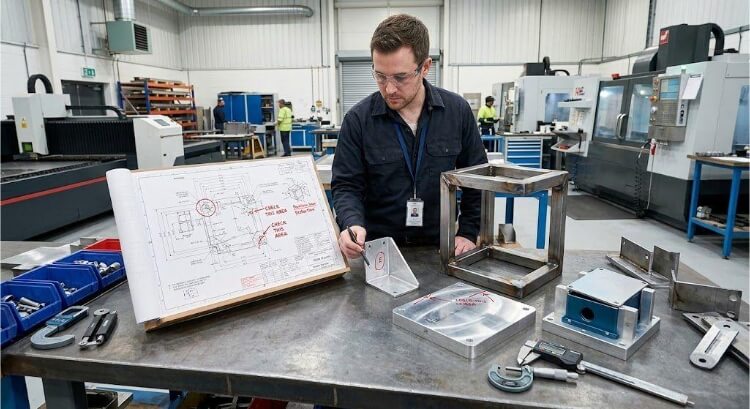
A fly cutter is a single-point rotary tool utilized in milling operations to produce flat, machined surfaces. On the shop floor, choosing between a fly cutter and a multi-insert face mill isn’t just about tool preference—it is a calculated gamble between machine time, tooling costs, and scrap rates.
While it can leave a cleaner surface than a face mill in specific scenarios, deploying it incorrectly destroys cycle times. The final outcome depends heavily on the cutting pattern, setup rigidity, and material properties. Understanding the exact physical mechanics of a single-edge cut is required to determine when this tool becomes a competitive advantage rather than a production bottleneck.
Why a Fly Cutter Can Leave a Better Surface?
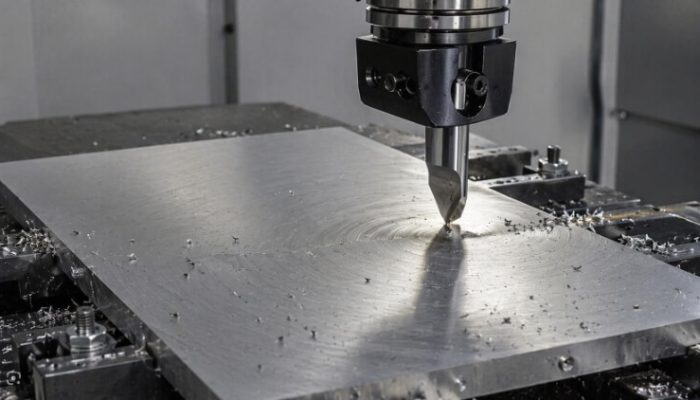
The ability of a fly cutter to produce an exceptional finish is a direct result of its mechanical simplicity. By stripping away the variables introduced by multiple cutting edges, the machining environment becomes highly predictable.
Single-edge cutting
The fundamental advantage of a fly cutter lies in its single point of contact. By relying on one tool bit—often a standard carbide insert or a hand-ground piece of high-speed steel (HSS)—the tool generates a uniform, continuous cutting action across the workpiece.
This prevents the uneven chip loads and variable cutting pressures inherently associated with multi-tooth cutters. A single edge guarantees that the cutting dynamics remain identical from the initial entry to the final exit.
Runout reduction
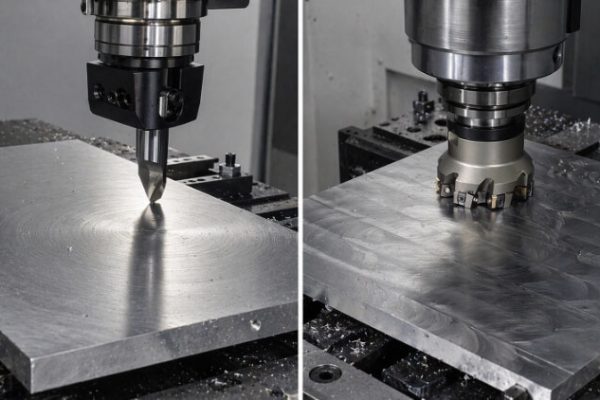
Axial runout is the primary cause of finish degradation in face milling. Even tightly toleranced, high-end face mills suffer from 0.0002 to 0.0005 inches of height variance between individual inserts, which inevitably transfers a wavy, scalloped pattern onto the machined surface.
A fly cutter physically engineers this variable out of the equation. With a single cutting edge, insert-to-insert height mismatch drops to absolute zero, guaranteeing a mechanically flat depth of cut across the entire tool path regardless of the tool holder’s runout.
Surface roughness
Due to the elimination of axial runout and the ability to customize the geometry of the single cutter, fly cutters excel at driving down surface roughness.
When paired with the correct feed per revolution and a broad nose radius, a fly cutter can reliably achieve surface finishes in the range of Ra 16 to 32 microinches (0.4 to 0.8 µm). This near-mirror finish often allows shops to entirely bypass secondary grinding or lapping operations.
Low spindle load
Cutting forces are directly proportional to the number of teeth simultaneously engaged in the material. Because a fly cutter engages only a minute fraction of the surface area at any given moment, it drastically reduces the horsepower required from the machine.
This reduction in cutting pressure minimizes tool deflection and makes it the ultimate tool for machining thin-walled parts or delicate extrusions. In these applications, the aggressive cutting force of a heavy face mill would cause catastrophic part distortion.
Where a Fly Cutter Works Best?
A fly cutter is a specialized tool that trades metal removal rates (MRR) for surface quality and operational flexibility. Its implementation should be strictly reserved for production situations where its unique geometry solves a specific engineering problem.
Wide flat surfaces
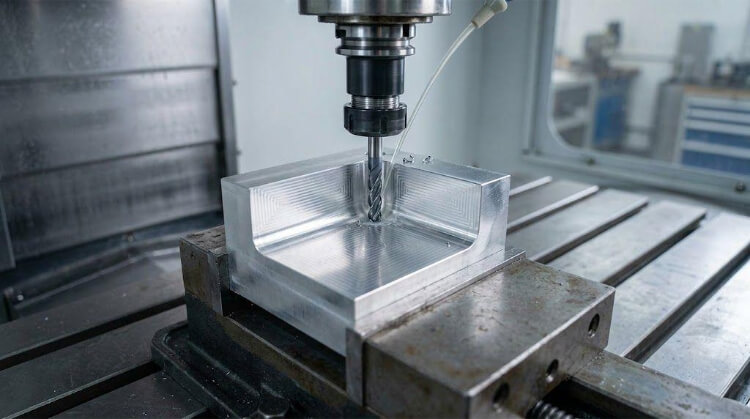
The ideal application for a fly cutter is surfacing wide plates where overlapping tool paths from a smaller end mill would leave visible blend lines. By adjusting the tool bit outward, a fly cutter can often cover the entire width of a workpiece in a single pass.
This single-pass strategy is critical for components like hydraulic manifolds or flange mating surfaces. In these specific applications, even a microscopic step-over mismatch can severely compromise the integrity of a high-pressure seal.
Light finishing cuts
Fly cutters are explicitly engineered for skim cuts. They operate optimally at a very low depth of cut—typically between 0.005 and 0.015 inches for final finishing passes.
Attempting heavy material removal with a single point generates excessive localized heat and cutting force. This rapidly results in severe tool deflection, accelerated insert wear, or catastrophic tool failure.
Small milling machines
Knee mills equipped with R8 spindles or light-duty Vertical Machining Centers (VMCs) with sub-5 HP motors often lack the structural rigidity and spindle torque required to push a 3-inch multi-insert face mill through solid metal.
Because of its exceptionally low spindle load, a fly cutter provides a reliable method to face large components on these lighter machines. It achieves the necessary surface finish without inducing severe machine chatter or stalling the spindle.
Low-volume work
In prototyping, first-article inspection (FAI), or the manufacturing of custom fixturing, setup flexibility outweighs cycle time optimization. A fly cutter allows an operator to quickly load and dial in a single, inexpensive insert.
In these low-volume scenarios, saving 20 minutes on finding, loading, and indicating a complex multi-insert face mill is far more profitable than saving 5 minutes of actual spindle run time.
What Changes the Cutting Result?
A fly cutter is highly sensitive to the exact geometry of its single cutting edge and the physical parameters of the machine. Because there are no other inserts to compensate for a poor setup, every geometric choice directly dictates the final surface roughness, heat generation, and mechanical stability.
Nose Radius and the Feed Rate Mathematical Lock
The nose radius of the tool bit establishes the baseline for your surface finish. The theoretical surface roughness relates directly to feed rate (f) and nose radius (R) through the fundamental machining formula: Ra=f²/8R
This creates a strict mathematical lock on the shop floor: if you want to double your feed rate to save cycle time without sacrificing surface finish, you must quadruple your nose radius. However, a massive wiper-style radius drastically increases tool contact area and cutting pressure. If your machine lacks absolute rigidity, that increased pressure will instantly transition the cut from a smooth shear into violent machine chatter.
Feed per Revolution and Frictional Heat
Because a fly cutter only has one tooth, your feed per tooth (IPT) and feed per revolution (IPR) are identical. Dropping the feed rate too low in an attempt to “sneak up” on a mirror finish is a guaranteed way to destroy the tool.
If the IPR falls below the cutting edge radius (typically below 0.001 inches), the insert stops shearing the metal and begins rubbing it. This burnishing effect generates massive frictional heat, rapidly dulling the tool and causing severe work hardening in materials like 304 stainless steel, effectively ruining the part for any subsequent operations.
Rake Angle Optimization for Chip Evacuation
The angle at which the tool meets the material dictates how the chip is formed and ejected. For gummy materials like 6061 aluminum or plastics, a steep positive rake (often hand-ground on an HSS blank) is mandatory to cleanly slice the material and prevent built-up edge (BUE) from welding to the tool.
Conversely, machining tougher alloys requires a neutral or slightly negative rake. A razor-sharp, high-positive edge will instantly micro-chip when it impacts a block of pre-hardened 4140 steel.
Tool Material Limitations and Edge Wear
The cutting material must be strictly matched to the workpiece. High-speed steel (HSS) blanks are unmatched for aluminum because they can be ground to a scalpel-like edge, but they will physically melt under the thermal load of steel alloys.
For ferrous metals, coated carbide inserts (like standard turning CCMT or TCMT inserts) are required to survive the heat. For the absolute ultimate finish in non-ferrous metals, aerospace shops utilize polycrystalline diamond (PCD) inserts, which resist edge wear and hold a perfect geometry across massive production plates.
Where Fly Cutting Starts to Cause Problems?
Despite its ability to achieve extreme surface finishes, a fly cutter is a mechanically imbalanced tool. It introduces unique shop-floor hazards and machining constraints that a balanced, multi-insert face mill completely avoids.
Cyclical Loading and Setup Chatter
A fly cutter does not maintain continuous contact with the material. It acts as an interrupted hammer blow, slamming into the workpiece exactly once per spindle revolution.
This cyclical loading introduces violent harmonic vibrations into the setup. If the workpiece is tall, thin-walled, or held in a vise without adequate jack-screw support, this hammering effect will trigger severe chatter, destroying both the part finish and the insert edge.
Spindle Tram Misalignment and Scalloping
A fly cutter acts as a massive magnifying glass for poor machine alignment. If a milling machine’s head is out of tram by even 0.001 inches, extending the cutter to a 6-inch swing diameter will create a massive geometric error.
Instead of cutting flat, the tool will sweep a concave or convex dish into the part. Furthermore, a tilted spindle will cause the tool to “back-drag”—meaning the heel of the cutter drags across the freshly machined surface on the back half of its rotation, leaving deep, permanent scratches that cannot be polished out.
Large Swing Diameters and Dynamic Imbalance
Shop-made fly cutters are often extended to massive diameters to clear large plates in a single pass. However, swinging a heavy, offset mass of steel at high RPM generates terrifying centrifugal forces.
As a strict shop-floor rule: any unweighted, custom fly cutter with a swing diameter exceeding 4 inches should never exceed 800 to 1,000 RPM. Pushing past this redline causes the tool to act like an unbalanced washing machine. This severe dynamic imbalance will not only ruin the surface finish but permanently brinell the high-precision bearings inside the machine’s spindle.
Interrupted Cuts and Catastrophic Carbide Failure
Fly cutters are designed for uninterrupted, continuous planes. They are uniquely vulnerable to workpieces that feature cross-drilled holes, deep slots, or uneven cast surfaces.
When the single cutting edge drops into a void and slams into the opposing steel wall, it experiences massive mechanical shock. If an operator combines this mechanical shock with flood coolant, the tool undergoes lethal thermal shock—rapidly cooling as it exits the cut and instantly heating as it impacts the next wall. This combination will cause a carbide insert to micro-crack and shatter mid-pass.
How Material Changes the Strategy?
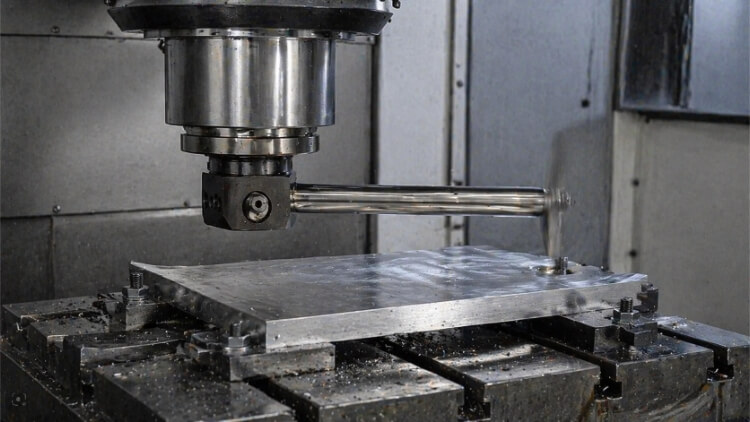
A fly cutter is a purely mechanical tool, meaning it cannot automatically adapt to different alloys. The behavior of the metal being cut dictates the exact insert geometry, coating, and speed you must deploy.
Aluminum and Extreme Positive Rake
Aluminum alloys like 6061 and 7075 are relatively soft but incredibly gummy. If the tool pushes rather than slices, the aluminum will instantly weld itself to the cutting edge—a catastrophic failure known as Built-Up Edge (BUE).
To combat this, the tool bit requires a scalpel-sharp, extreme positive rake (often 60 degrees). High-Speed Steel (HSS) blanks ground by hand are highly preferred here over standard carbide, as HSS can hold a sharper, keener edge to cleanly shear the material without tearing it.
Mild Steel and Coated Carbide
Low-carbon steels like 1018 or A36 are forgiving to machine, but they generate significantly more heat than aluminum. An HSS blank will quickly lose its temper and melt if pushed across a large steel plate at production speeds.
For mild steel, a standard turning insert (such as a C5 grade carbide or a modern TiAlN coated insert) mounted with a neutral to slightly positive rake is mandatory. Surface speeds (SFM) must be dialed back to 400-600 SFM to keep the localized heat at the single cutting edge from destroying the binder in the carbide.
Stainless Steel and the Work-Hardening Trap
Austenitic stainless steels, particularly 304 and 316, will rapidly work-harden if they are rubbed rather than cut. If your fly cutter is dull, or your feed rate drops below 0.002 inches per revolution (IPR), the single cutter will compress the steel into an impenetrable crust.
You must use a sharp, PVD-coated carbide insert and aggressively feed the tool to stay below the work-hardened layer. Furthermore, because stainless has low thermal conductivity, the cutting edge will superheat. Using flood coolant on an interrupted fly cutter pass in stainless will induce immediate thermal shock and micro-cracking in the carbide.
Titanium and Edge Thermal Overload
Machining Ti-6Al-4V with a fly cutter is exceptionally difficult and should only be done for final skim passes. Titanium transfers almost no heat into the chip; instead, 80% of the cutting heat is driven straight back into the single cutting edge of the fly cutter.
To prevent the insert from plastically deforming under the thermal load, surface speeds must be dropped to a crawl (150-200 SFM). You must use a highly positive, uncoated, or TiAlN-coated carbide insert to shear the metal cleanly, accompanied by high-pressure coolant to constantly evacuate the chips and prevent them from re-cutting.
When a Face Mill Is the Better Choice?
To run a profitable shop floor, you must respect the mechanical limits of your tooling. A fly cutter is a precision sniper rifle for surface finish; it is completely useless for trench warfare. When bulk material removal is the goal, the modern multi-insert face mill completely dominates.
Higher Metal Removal Rates (MRR)
If you need to tear off a quarter-inch of steel plate, a fly cutter will instantly stall your spindle or snap the tool. Fly cutters top out at a depth of cut (DOC) of around 0.020 inches before chatter destroys the setup.
A 45-degree lead angle face mill, however, translates cutting forces axially up into the spindle, allowing it to easily handle a 0.150 to 0.250-inch DOC in a single pass. For sheer volumetric metal removal (MRR), the face mill is the only viable engineering choice.
Better Batch Efficiency and Wear Distribution
In a production run of 500 parts, stopping the machine to manually regrind an HSS fly cutter bit destroys your profit margin. A single cutting edge takes 100% of the wear during every rotation.
A face mill distributes that exact same wear across 5, 6, or 10 separate inserts. This allows the machine to run continuously for hours unattended. When the inserts finally dull, an operator can index them to a fresh edge in seconds with predictable, repeatable results.
More Stable Roughing Dynamics
Swinging a single-point mass creates an asymmetric, hammering force on the workpiece and the machine spindle. During heavy cuts, this cyclical pounding will vibrate parts right out of the vise.
A face mill is a balanced, symmetrical tool. Because multiple teeth are engaged in the material simultaneously, the cutting forces stabilize and cancel each other out. This continuous engagement prevents chatter, protects the spindle bearings, and allows for aggressive roughing on less-than-ideal setups.
Shorter Cycle Times via Feed Rate Multiplication
Machine feed rates (Inches Per Minute, or IPM) are calculated by multiplying RPM, feed per tooth, and the number of cutting flutes. A fly cutter only has one flute.
If you run a 5-flute face mill and a fly cutter at the exact same RPM and chip load, the face mill will travel across the part exactly five times faster. In high-volume production, sacrificing that much cycle time to a single-point tool is economic suicide unless the blueprint specifically demands a fly-cut finish.
How to Judge the Real Cost?
Procurement managers and manufacturing engineers often clash over tooling budgets. The true cost is calculated by balancing the upfront capital, the hourly machine rate, and the risk of part failure.
Initial Tooling and Insert Cost
The barrier to entry for face milling is steep. A high-quality 3-inch face mill body costs upwards of $300, and loading it with six premium carbide inserts will cost another $90 to $120.
A fly cutter body costs less than $50, and a blank of high-speed steel costs $5. For a job shop taking on a one-off custom bracket, the fly cutter keeps the initial overhead near zero, making it highly attractive for low-budget, low-volume contracts.
Tool Life vs. Refresh Cost
Face mill inserts are expensive, but they offer multiple cutting edges per insert (often 4 to 8 corners on a modern octagonal insert). This drives the cost-per-edge down significantly over a long production run.
While a fly cutter’s tool life is much shorter, refreshing it is virtually free if the operator knows how to use a pedestal grinder. However, you are paying the operator their hourly wage to grind that tool, which must be factored into the hidden cost of the fly cutter.
Cycle Time Machine Rates
Machine time is the most expensive commodity in a factory, often billed internally at $100 to $150 per hour.
If a fly cutter adds 6 minutes of cycle time to face a large plate, and you are running a batch of 100 plates, you have just burned 10 hours of machine time. At $150 an hour, that “cheap” fly cutter just cost the company $1,500 in lost spindle time. In this scenario, buying the $400 face mill setup yields an immediate, massive ROI.
Rework Risk and First-Pass Yield
Sometimes, cycle time is irrelevant compared to the cost of the raw material. If you are machining a $3,000 billet of aerospace aluminum into a vacuum chamber door, the mating surface must be flawlessly flat to hold an O-ring seal.
If a face mill leaves a 0.0005-inch step-over line across that sealing face, the part is scrapped. Deploying a fly cutter for the final pass acts as an insurance policy. It guarantees a perfectly flat, zero-mismatch surface, ensuring a 100% first-pass yield on critical, high-liability components.
Conclusion
A fly cutter is not the fastest way to machine a flat surface, and it is not the right tool for every job. But when the setup is rigid, the cutter is balanced, and the cutting conditions are matched to the material, it can produce a very clean finish with low tool cost. That is why it still has a place in real milling work, especially for wide flat faces, light finishing passes, and lower-volume parts.
If you are deciding whether a fly cutter is the right choice for your part, send us your drawing or machining requirements. We can review the surface target, material, setup risk, and batch size, then suggest a practical process that fits your part, machine limits, and production cost.
Hey, I'm Kevin Lee

For the past 10 years, I’ve been immersed in various forms of sheet metal fabrication, sharing cool insights here from my experiences across diverse workshops.
Get in touch
Kevin Lee
I have over ten years of professional experience in sheet metal fabrication, specializing in laser cutting, bending, welding, and surface treatment techniques. As the Technical Director at Shengen, I am committed to solving complex manufacturing challenges and driving innovation and quality in each project.
Related Resource
Fingerprint Resistant Stainless Steel: How It Works,and How to Choose