In modern sheet metal manufacturing, choosing the right forming process directly affects production cost, precision, delivery speed, and scalability. Two of the most widely used methods are Press Brake Forming and Roll Forming.
Although both shape metal sheets through bending, they differ greatly in mechanics, speed, and production strategy. Press brake forming provides flexibility and is ideal for customized or small-batch fabrication. Roll forming, on the other hand, enables continuous production and uniform quality for long, high-volume parts.
For engineers and procurement teams, the decision isn’t about which process is better overall—it’s about which one aligns with your project’s requirements, materials, and expected production volume.
プレスブレーキ成形とは?
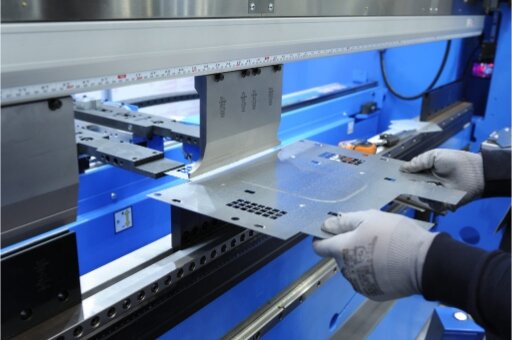
プレスブレーキ成形 is a precision bending process where a flat metal sheet is pressed between a punch and a die to achieve the desired angle. The punch moves downward with controlled force, shaping the metal along the bend line.
Each bend is performed individually, and complex parts are produced by repositioning and bending the sheet multiple times. Modern CNC press brakes use digital back gauges and angle sensors to control bend sequence, achieving repeatability within ±0.5° and dimensional accuracy around ±0.25 mm.
主な特徴
Press brake forming is a discrete, flexible operation. It allows quick setup changes, tool adjustments, and custom angles—all with minimal tooling cost. The same machine can process multiple designs within a single shift, making it ideal for low- to medium-volume production or projects with frequent design changes.
The method supports a wide range of materials, including stainless steel, mild steel, aluminum, and copper alloys. Typical bend radii range from 0.8× to 1.5× the sheet thickness, depending on the material’s ductility and grain direction.
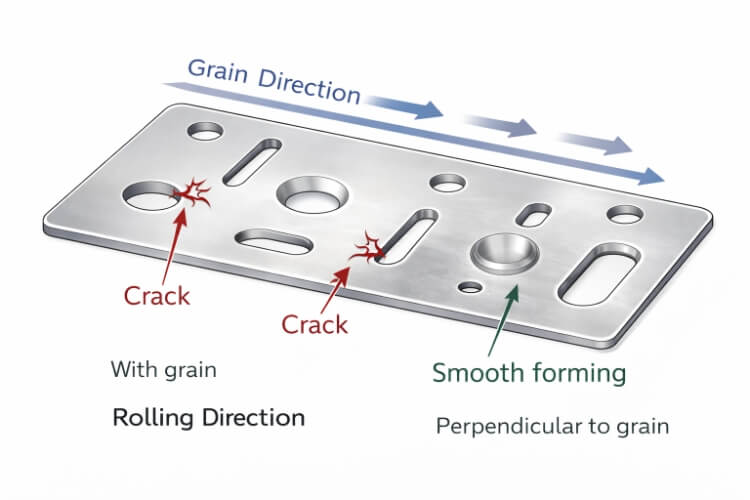
💡 エンジニアリングのヒント Always consider grain orientation when bending. Bending parallel to the grain increases the risk of cracking, especially in aluminum and stainless steel.
一般的な用途
Press brake forming is widely used for:
- Electrical and electronic enclosures
- Equipment frames and brackets
- Industrial panels and machine housings
- Custom trims or structural components
It is especially valuable for rapid prototyping, custom fabrication, and low-volume production, where flexibility and fast turnaround outweigh the cost of tooling.
What Is Roll Forming?
ロール成形 is a continuous metal forming process that gradually bends a long strip of sheet or coil through a series of precision rollers. Each roller pair applies a small amount of deformation until the final profile is achieved.
Unlike press brake forming, which bends one section at a time, roll forming creates the entire length and shape in one smooth, automated operation. The result is a part with consistent geometry, tight tolerances, and excellent surface finish.
Typical production speeds range from 60 to 120 ft/min, depending on material thickness, number of roller stations, and profile complexity.
主な特徴
Roll forming is best suited for high-volume production of long, uniform cross-sections. Once the tooling is installed, the process delivers outstanding repeatability and efficiency.
Because the bending is progressive, the strain is evenly distributed along the part. This minimizes springback, improves straightness, and maintains dimensional accuracy over several meters. Additionally, modern roll-forming lines can integrate punching, cutting, embossing, and coating on the same line—reducing handling time and improving throughput.
一般的な用途
Typical applications include:
- Structural channels, beams, and rails
- Battery trays and energy storage enclosures
- Roofing, wall, and ceiling panels
- Automotive reinforcement profiles
Roll forming is preferred in automotive, construction, and energy sectors, where consistent quality, long part length, and cost per piece are critical.
プロセスの比較
Workflow and Equipment Setup
| アスペクト | プレスブレーキ成形 | ロールフォーミング |
|---|---|---|
| Production Mode | Batch-based, manual or semi-automatic | Continuous, coil-fed automated |
| セットアップ時間 | Short (minutes to hours) | Long (initial tooling may take days) |
| Tooling Cost | Low (standard punches/dies) | High (custom roller sets) |
| Changeover Flexibility | すごく高い | 限定 |
| 典型的な使用例 | Short runs, variable designs | Long runs, standardized profiles |
In a press brake, each bend is made individually—requiring manual alignment and repositioning between bends. This gives engineers the flexibility to easily modify angles or sequences. Roll forming, however, uses a single setup for the entire profile, allowing continuous, uninterrupted production for tens of thousands of parts with minimal supervision.
Material Flow and Forming Mechanics
The two methods differ in how stress and strain are applied to the sheet metal:
- Press Brake Forming: Applies concentrated force along specific bend lines. The localized deformation zone can lead to slight thinning or surface marking if not properly controlled.
- ロール成形: Applies a distributed bending force across multiple rollers. The gradual deformation reduces internal stress, yielding smoother bends, less distortion, and higher straightness tolerance.
In practical terms, roll forming can maintain straightness deviation under 1 mm over 2 m length, while press brake bending may show slightly higher variation depending on material thickness and operator skill.
Production Efficiency and Cost Structure
Selecting the right forming process often comes down to how efficiently you can balance speed, tooling cost, and production scale. Press brake forming and roll forming serve different goals — one prioritizes flexibility, the other efficiency.
Setup and Tooling Costs
Press brake forming requires only standard punches and dies, which are widely available and easily interchangeable. This keeps tooling costs low, typically ranging from $300–$1,000 per setup. It’s perfect for projects where design changes are frequent, or production runs are limited to a few hundred parts.
Roll forming, however, involves custom roller dies engineered for a specific profile. A complete roller set may include 15–30 stages, with a total tooling cost of $5,000–$30,000 depending on profile complexity and material thickness. But this investment quickly pays off in high-volume production, where each part’s cost drops sharply once the setup is complete.
💡 エンジニアリングのヒント For projects with more than 10,000 parts annually, roll forming is often more cost-effective than press brake forming, despite the higher initial tooling cost.
Cycle Time and Throughput
Cycle time directly affects delivery speed. A press brake typically performs one bend every 10–30 seconds, depending on part size, bend count, and operator experience. Complex parts may require multiple repositions and setups, limiting throughput to 100–200 parts per shift.
Roll forming, in contrast, is a continuous process. Once the line is running, it can process material at 60–120 feet per minute, producing thousands of identical profiles per shift. The combination of coil feeding, automatic cutoff, and inline inspection ensures consistent flow without manual repositioning.
Labor and Automation
Press brake forming remains labor-intensive, requiring skilled operators to align, measure, and inspect parts at each stage. Even CNC press brakes depend on human setup and handling, leading to potential variations in productivity and accuracy.
Roll forming is fully automated. Once parameters are set, the line can run continuously with minimal operator involvement. Sensors monitor forming pressure, feed alignment, and output tolerance in real time. This automation not only reduces labor costs but also enhances repeatability and safety.
Lifecycle Economics
From a long-term perspective, press brake forming excels in low-volume, high-mix production, where quick setup and tool reuse are priorities. Roll forming wins in mass production scenarios, where consistent parts and low per-unit cost matter most.
In essence:
- Press Brake = Agility and Customization
- Roll Forming = Automation and Scalability
Precision, Consistency, and Quality Control
Precision in forming directly affects assembly, fit, and final product quality. Both processes can achieve tight tolerances, but their consistency mechanisms differ significantly.
Dimensional Accuracy and Repeatability
Modern CNC press brakes achieve ±0.25 mm dimensional tolerance and ±0.5° angular accuracy through programmable back gauges and hydraulic control systems. However, variations can occur due to fluctuations in material thickness, operator handling, or machine deflection during long bends.
Roll forming, by comparison, maintains ±0.15 mm repeatability over extended lengths. Because forming occurs progressively and automatically, dimensional consistency remains uniform across thousands of parts — ideal for structural rails, battery trays, or enclosure frames where precise alignment is essential.
📊 エンジニアリングの洞察
In side-by-side tests, roll-formed 2.5 m U-profiles showed 40% lower dimensional deviation compared to those made on a press brake.
表面仕上げと美観
Tool marks are a known issue in press brake bending, especially for brushed or mirror-finished stainless steel. Using soft pads, plastic dies, or protective films can minimize these marks, but it increases setup time.
Roll forming, on the other hand, produces smooth, continuous surfaces. The gradual forming and lower friction reduce scratches and preserve coatings such as galvanization, powder paint, or anodization. For visible components — such as decorative trims or exterior panels — roll forming typically requires less post-processing.
Residual Stress and Springback
Press brake forming creates localized stress concentration at the bend line, which may lead to slight スプリングバック or warping. CNC-controlled depth compensation can reduce this, but parts with multiple bends may still require manual adjustments.
Roll forming distributes deformation across multiple rollers, significantly reducing springback and maintaining straightness. This is particularly advantageous in high-strength steel or aluminum alloys, where residual stress control ensures long-term dimensional stability.
Design Flexibility and Part Complexity
While precision defines quality, flexibility defines capability. Here’s where press brake forming truly stands out.
Geometry and Profile Variety
Press brake forming supports multiple bend angles, radii, and complex geometries within a single part — all achievable through sequential bends. It allows the production of boxes, U-shapes, brackets, and enclosures with unique configurations.
Roll forming, however, is limited to constant cross-sectional profiles. Once the roller tooling is designed, every part produced will share the same shape. This limitation is offset by its high consistency and production speed, making it ideal for standardized parts like channels and rails.
Length and Structural Constraints
Press brake machines are restricted by their bed size — typically 1 to 4 meters. Longer parts must be segmented or welded, which can introduce alignment challenges.
Roll forming, on the other hand, has no length limitation beyond material coil size. It can produce continuous parts exceeding 10 meters while maintaining straightness within ±1 mm/m, making it the method of choice for large panels and framework structures.
Customization vs. Standardization
- Press Brake: Offers unmatched customization. Ideal for prototyping, R&D, and low-volume manufacturing where frequent design iterations are required.
- ロール成形: Excels in standardized, long-term production with strict dimensional control.
By combining both processes strategically — press brake for prototypes, roll forming for scale-up — manufacturers can optimize both development speed and cost efficiency.
Choosing the Right Process for Your Project
Deciding between Press Brake Forming and Roll Forming ultimately depends on how you balance production volume, precision requirements, part geometry, and lifecycle cost. Each process serves a different engineering purpose — and understanding their trade-offs helps ensure optimal performance and manufacturability.
Decision Criteria and Practical Guide
| Evaluation Factor | Best for Press Brake Forming | Best for Roll Forming |
|---|---|---|
| 生産量 | Low to medium; frequent design updates | Medium to high; steady production |
| 部品形状 | Multiple bends, non-linear shapes | Long, uniform cross-sections |
| Material & Thickness | Suitable for thin to medium gauge sheets | Works well with high-strength steels |
| 表面仕上げ | May need protective film or polishing | Preserves coatings and smooth finishes |
| Tolerance Control | ±0.25 mm typical, operator-dependent | ±0.15 mm consistent across long lengths |
| セットアップ費用 | Low ($300–$1,000) | High ($5,000–$30,000) |
| Per-Part Cost (Large Runs) | より高い | より低い |
| Automation Level | Moderate (CNC-based) | Fully automated line |
| 柔軟性 | High (easy reprogramming) | Limited (fixed profile tooling) |
| 理想的なアプリケーション | Cabinets, brackets, prototypes | Rails, channels, enclosure frames |
結論
Both forming methods are essential in modern sheet metal manufacturing — Press Brake Forming for versatility, and Roll Forming for scalability.
Press brake forming shines in custom fabrication, short runs, and projects requiring multiple bend geometries or quick design iterations. It’s the ideal solution when flexibility, precision, and design variation matter most.
Roll forming dominates when speed, consistency, and volume efficiency are key. It delivers excellent dimensional control, minimal waste, and cost efficiency over long production cycles.
Looking for the right forming solution for your sheet metal project? At Shengen, our engineering team provides expert DFM analysis, feasibility studies for forming, and cost-optimization guidance. CADファイルをアップロードするか、今すぐお問い合わせください。 for a free technical review and quotation within 24 hours.
よくあるご質問
Which process offers better cost efficiency for low-volume runs?
Press brake forming is more cost-effective for low-volume or prototype production. It requires minimal tooling investment and supports fast design modifications.
Can roll forming handle stainless steel and coated materials?
Yes. Modern roll forming lines can process stainless steel, aluminum, and pre-painted or galvanized coils with precise control, ensuring no damage to coatings.
Which process achieves tighter tolerances for long parts?
Roll forming provides superior dimensional consistency (±0.15 mm) and minimal straightness deviation, ideal for rails or structural components exceeding 2 meters.
Does press brake forming affect material strength?
Yes, localized bending causes work hardening near the bend line. It increases hardness and rigidity but slightly reduces ductility. Proper radius selection minimizes this effect.
Is roll forming suitable for custom or variable designs?
Not typically. Roll forming is designed for fixed cross-sections. Each profile requires new tooling, making it best for standardized designs or long-term production.
ケビン・リー
レーザー切断、曲げ加工、溶接、表面処理技術を専門とし、板金加工において10年以上の実務経験があります。シェンゲンのテクニカルディレクターとして、複雑な製造上の課題を解決し、各プロジェクトにおける革新と品質の向上に尽力しています。