Modern manufacturing is entering an era where near-zero defect rates and micron-level accuracy are no longer optional — they’re essential. Whether it’s assembling EV motors, fitting medical device components, or pressing microconnectors onto PCBs, precision now defines competitiveness.
Servo presses have become a cornerstone of this transformation. By combining programmable motion control, digital feedback, and clean, efficient operation, they deliver accuracy and repeatability that traditional mechanical or hydraulic systems cannot match.
This article explains why servo presses outperform older systems — not only in precision but also in flexibility, process control, and long-term manufacturing value.

The Shift Toward Precision in Modern Assembly
Precision manufacturing is evolving fast, driven by smaller tolerances and higher expectations. Servo presses are redefining what accuracy means on today’s production floors.
Growing demand for tighter tolerances
Across global industries, tolerance windows are becoming increasingly narrow. Automotive powertrain assemblies require press-fit accuracy within ±0.01 mm, while electronic connectors often need force consistency within ±5 N. Traditional mechanical presses, driven by fixed-speed flywheels, struggle to maintain that level of precision over thousands of cycles.
Servo presses solve this through digital control of force, position, and velocity. A servo motor and encoder work together to monitor every micron of motion, ensuring consistent results even when material hardness or part geometry changes. This stability translates directly into fewer rejects, higher yield, and better downstream assembly accuracy.
Example: In an EV stator assembly line, switching from a mechanical to a servo press reduced force variation by 42% and cut rework rates by nearly one-third — proof that precision directly improves cost efficiency.
From mechanical to intelligent forming
Conventional mechanical presses apply maximum force at the bottom of every stroke, regardless of material behavior. This “one-speed-fits-all” approach often leads to overloading, part deformation, and premature tool wear — especially when forming thin or delicate components.
A servo press, on the other hand, enables engineers to program motion profiles digitally. The press can accelerate quickly at the start, slow near contact, dwell briefly at bottom dead center to relieve stress, and then return at high speed. This intelligent control transforms forming from a purely mechanical action into a data-driven precision process.
For instance, in a precision metal gear assembly application, optimizing the dwell phase of a servo press extended die life by 40% and improved dimensional consistency by 0.02 mm. Where traditional systems rely on brute force, servo presses rely on intelligence and adaptability, converting digital inputs into precise physical accuracy.
Why are manufacturers making the switch now?
The shift to servo technology is not just about better machines — it’s about more innovative production. Manufacturers today face rising quality demands, stricter traceability requirements, and sustainability goals. Servo presses align perfectly with all three.
They enable process traceability, energy-efficient operation, and flexible reprogramming without requiring hardware changes. In short, servo technology gives factories the control they need to meet modern production targets while keeping costs under control.
As industries transition to “smart factories,” servo presses are becoming the standard equipment for any production line where precision, adaptability, and cleanliness are key to success.
Core Advantages of Servo Press Technology
Servo presses bring multiple benefits that directly impact product quality, efficiency, and process control. Below are the key advantages that explain their growing adoption in advanced manufacturing.
Accurate and Repeatable Force Control
Precision assembly depends on the ability to apply precisely the right amount of force — not more, not less. Servo presses achieve this through digital torque and displacement control driven by high-resolution encoders. Every micron of movement is tracked and adjusted in real time, ensuring consistent forming results even when part dimensions or material hardness vary slightly.
Unlike mechanical systems that depend on inertia or clutch timing, servo presses generate controlled force only when needed. This makes them ideal for delicate operations such as bearing insertion, PCB connector pressing, or precision sensor assembly.
In production benchmarking, servo presses maintained force accuracy within ±1% after tens of thousands of cycles. That level of repeatability means fewer dimensional deviations, lower scrap rates, and higher downstream assembly accuracy — key factors for industries chasing “zero defect” production.
Closed-Loop Feedback for Adaptive Performance
Servo presses operate within a closed feedback loop — continuously measuring position, speed, and force, then comparing them to the programmed target profile. If the system detects an unexpected resistance spike or misalignment, it automatically adjusts output in milliseconds to maintain accuracy.
This feedback-driven intelligence helps identify potential defects before they cause damage to the part. For example, in precision gear assembly, the system can sense abnormal insertion resistance, pause the cycle, and alert the operator — preventing tool damage and avoiding production stoppages.
Field data show that closed-loop control can reduce defective assemblies by 25–30% while improving first-pass yield. It also supports predictive maintenance, since the same sensors monitor load trends and component wear over time.
Programmable Motion for Flexible Production
Traditional presses are limited by fixed crank or cam profiles. Servo presses remove that restriction entirely. Engineers can design and save custom motion profiles for different parts — for example, a fast approach with a slow final press, a dwell at bottom dead center for stress relaxation, or a multi-stage compression cycle for adhesives and laminates.
These stored programs can be switched in seconds, enabling high-mix, low-volume production without mechanical adjustments. For contract manufacturers handling multiple part numbers or prototypes, this flexibility directly improves machine utilization and reduces setup time.
Moreover, programmable dwell times minimize residual stress in parts. In forming operations using aluminum or stainless steel, this control can reduce springback by up to 35%, improving flatness and fit accuracy.
Lower Noise and Cleaner Operation
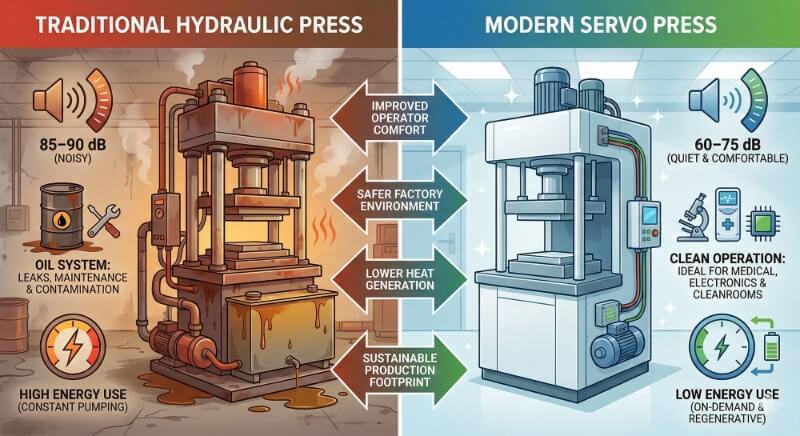
Because servo presses are fully electric, they eliminate the pumps, valves, and oil systems that are typically found in hydraulic machines. This not only reduces noise and maintenance but also removes the risk of oil leaks or contamination, making them ideal for medical, electronic, and cleanroom environments.
Typical noise levels drop from 85–90 dB for a mechanical press to 60–75 dB for an equivalent servo model — a meaningful improvement for both operator comfort and factory compliance with safety standards.
Energy use is also cleaner: power is drawn only during forming, not while idling, and regenerative systems can store or return energy during deceleration. The result is lower heat generation, more stable operating conditions, and a more sustainable production footprint.
Efficiency and Cost Considerations
Precision isn’t the only advantage of servo systems. Their smart power use and simplified maintenance deliver measurable savings and reliability across long-term production cycles.
Energy Efficiency Through Smart Power Use
Energy consumption has a direct impact on production costs and sustainability, unlike hydraulic presses, which require constant pump pressure — even when idle — servo presses consume power only when performing work. During approach, hold, or return strokes, the motor speed automatically adjusts to minimize waste.
A typical 30-ton hydraulic press consumes around 6–8 kWh per hour under load. An equivalent servo press often uses less than half the energy, especially in intermittent or mixed-cycle production. Some advanced systems also include regenerative braking, where energy from deceleration is recovered and reused, improving total energy efficiency by 30–50%.
This innovative power use does more than reduce utility bills. It reduces overall heat generation, thereby lowering the need for cooling systems and extending the lifespan of nearby equipment. For companies pursuing ISO 14001 certification or carbon reduction targets, servo presses are a direct step toward more sustainable manufacturing.
Reduced Maintenance and Downtime
Traditional hydraulic systems require frequent oil changes, seal replacements, and valve maintenance. In contrast, servo presses use direct-drive electric motion with minimal mechanical contact. This design eliminates pumps, filters, and oil circuits — dramatically reducing maintenance frequency and failure points.
Real-world case studies demonstrate that switching from hydraulic to servo systems can reduce unplanned downtime by 20–35%, resulting in hundreds of additional production hours each year. Additionally, servo control software continuously monitors motor torque, stroke position, and temperature.
Total Cost of Ownership Advantage
While servo presses typically cost more upfront than mechanical or hydraulic models, they deliver strong ROI within two to three years. The combination of energy savings, fewer consumables, and higher yield quickly outweighs the initial investment.
Consider a high-volume assembly line operating 20 hours per day:
- Energy savings: USD 8,000–12,000 per year per machine
- Reduced maintenance and consumables: USD 2,000–3,000 per year
- Quality and scrap reduction: up to 25% fewer rejects, translating to additional profit protection
Over five years, the total savings can exceed USD 50,000–70,000 per press, excluding the productivity gains from increased uptime.
More importantly, servo systems support stable, repeatable performance, which protects both product consistency and brand reputation. In a precision-driven market, that reliability is often worth more than the immediate cost savings.
Applications in Precision Assembly
Servo presses prove their value across demanding industries. The next examples show how they enhance accuracy, cleanliness, and traceability from automotive lines to medical and aerospace assembly.
Automotive and EV Components
Automotive and EV assembly demands consistency across thousands of repetitive operations — from bearing insertion and motor core stacking to battery module compression. Each of these processes requires precise control of force and position to ensure a proper fit, optimal function, and long-term durability.
Servo presses excel here. Their ability to maintain force accuracy within ±1% ensures that every press-fit component seats correctly without damaging parts. In EV battery assembly, controlled compression is crucial for balancing cell pressure and preventing electrolyte leakage. Production data show that servo-controlled compression reduces variation by over 40%, directly improving both yield and pack reliability.
Electronics and Micro Devices
In electronics manufacturing, even minor force deviations can cause cracked solder joints or misaligned connectors. Servo presses deliver the low-force precision (often below 1 kN) necessary for these delicate operations. The system can detect resistance changes in milliseconds and stop automatically to prevent damage.
This capability makes servo presses indispensable for assembling connectors, sensors, camera modules, and optical components, where process accuracy is crucial for optimal performance. Manufacturers report 20–25% lower defect rates after switching from pneumatic or mechanical presses to servo systems.
The technology’s quiet operation and oil-free design also support cleanroom production for semiconductor and microelectronic parts — a requirement many traditional systems cannot meet.
Medical and Aerospace Assemblies
For medical and aerospace components, cleanliness, documentation, and reliability are just as important as precision. Servo presses eliminate the need for hydraulic oil, minimizing contamination risk during implant, surgical tool, or valve assembly. They also allow programmable slow forming, protecting materials such as titanium, cobalt-chrome, or composites from deformation.
Most importantly, servo presses record detailed process data for every cycle. Manufacturers can trace every part back to its force–displacement profile — crucial for meeting ISO 13485 and AS9100 traceability requirements. This digital documentation shortens audit times and ensures full compliance in regulated industries.
Conclusion
Servo presses have redefined what precision assembly means in the modern factory. They combine digital motion control, adaptive feedback, and clean operation to deliver consistency that mechanical or hydraulic presses cannot match.
Beyond technical precision, servo technology offers measurable business value: lower energy use, minimal maintenance, faster changeovers, and complete data traceability. For manufacturers in automotive, electronics, and medical sectors, servo systems aren’t just an upgrade — they’re the foundation for innovative, sustainable, and high-value production.
Ready to take your precision assembly to the next level? Our engineering team can help you evaluate tonnage requirements, design the proper motion and force profiles, and implement data-integrated servo systems tailored to your product line. Contact us today to request a complimentary manufacturability consultation or a review of your servo press capabilities.
Hey, I'm Kevin Lee

For the past 10 years, I’ve been immersed in various forms of sheet metal fabrication, sharing cool insights here from my experiences across diverse workshops.
Get in touch
Kevin Lee
I have over ten years of professional experience in sheet metal fabrication, specializing in laser cutting, bending, welding, and surface treatment techniques. As the Technical Director at Shengen, I am committed to solving complex manufacturing challenges and driving innovation and quality in each project.
Related Resource
Fingerprint Resistant Stainless Steel: How It Works,and How to Choose