Why the OEM vs Contract Manufacturing Debate Often Creates Confusion?
OEM and contract manufacturing often sound clear, but in real projects, the confusion usually starts when the supplier label is clear, and the responsibility split is not.
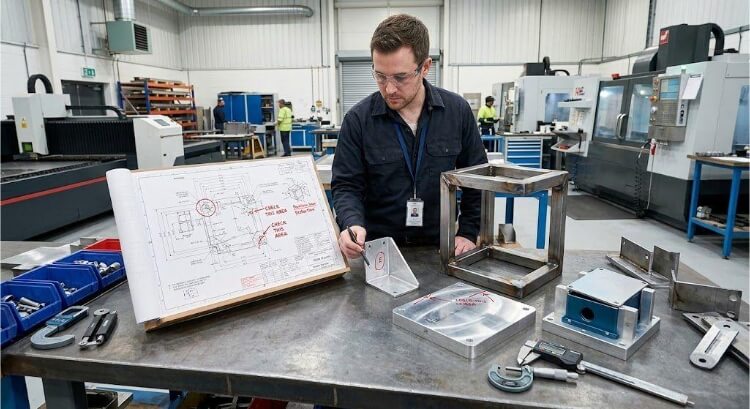
A drawing may be complete on paper and still be weak for production. The bend sequence may mark a visible surface. Welding may cause the frame to shift out of position. Coating may reduce assembly clearance. A machined wall may hold size during setup and move after unclamping. These are normal production realities, not unusual failures.
That is why the real issue is not what the supplier calls itself. The real issue is who is expected to catch these risks and who is allowed to act when the process starts drifting.
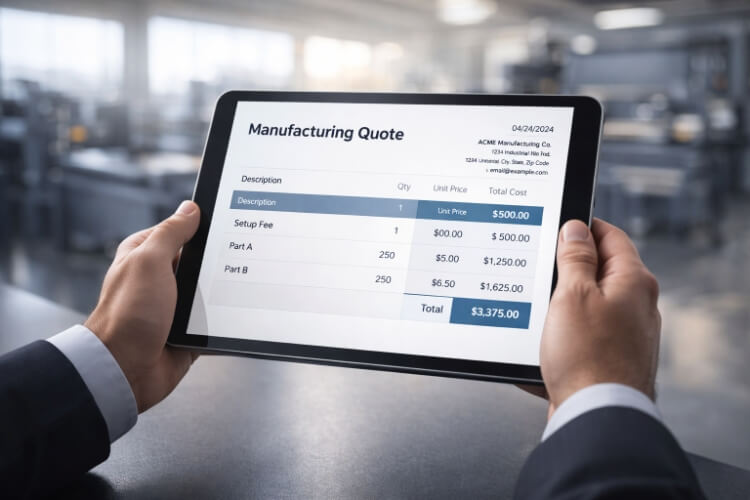
Many sourcing problems begin at the RFQ stage. The quote may look fine, the sample may look acceptable, and the price may be competitive. But none of that proves the factory and the customer agree on who owns DFM review, tooling correction, supplier control, inspection updates, or process changes.
This is where many teams make the wrong assumption. They compare labels, but real production is shaped by decision ownership.
A supplier, or OEM, may still expect the customer to make most engineering decisions. A supplier called a contract manufacturer may still provide strong DFM feedback and practical process support. The label does not tell you how the factory will behave once repeat production starts, exposing variation.
A better way to judge the model is to ask a few direct questions:
- Who owns manufacturability review?
- Who owns tooling and fixture correction?
- Who controls approved materials and outside processes?
- Who reacts when batch behavior changes?
- Who updates inspection logic when the method changes?
If these answers are vague, the project is still high-risk, no matter how clear the supplier label sounds.

What does OEM Usually Mean?
In practical manufacturing, OEM usually means the factory operates under a more stable production structure. The product may still be custom, but the process is usually built on known routing, repeatable inspection, established suppliers, and a clearer method for holding output once volume increases.
This model works best when the product is already fairly stable. The drawing rarely changes, the BOM is mostly fixed, the assembly logic has been proven, and the team cares more about repeatability than flexibility.
The main value is not just capacity. It is process stability.
A stronger OEM-style setup usually reduces:
- Set up changes between batches
- routing drift on repeat jobs
- variation between operators or shifts
- uncontrolled supplier substitution
- Repeated correction of the same production problem
This matters because many parts look simple until real production starts, when small variations multiply. Hole position may shift after forming. Weld pull may affect fit. Coating thickness may tighten the assembly. A good OEM-style setup is valuable when the factory already knows these sensitivity points and has a stable way to control them.
This model becomes weaker when the product is still changing fast. Frequent revisions, unstable tolerances, moving assembly interfaces, and changing cosmetic targets can turn a repeat-production structure into a slow correction loop.
What does Contract Manufacturing Usually Mean?
In practical manufacturing, contract manufacturing usually means the customer keeps tighter control over the product. At the same time, the factory builds inside that structure and feeds back what the process is doing in real production.
This model works best when the product is still changing, the process window is not fully proven, or the customer needs close control over materials, approved vendors, revisions, or inspection logic.
The main value is not “flexibility” by itself. It is control during production learning.
This matters because many parts look finished before they are ready for repeat production. A housing may need bend relief changes after the first build. A machined part may move after unclamping. A welded frame may distort across repeat batches. A coated enclosure may lose fit after the finish thickness is added. In these cases, the factory can raise the issue, but the customer still wants tighter control over what changes next.
This model is useful when the project needs:
- stronger revision control
- tighter material or supplier control
- closer review of DFM feedback
- faster engineering decisions during early builds
- more customer authority over change approval
Its weakness appears after the product becomes stable. Too much customer-side control can slow small corrections, delay routing improvements, and add approval friction to normal production work.

OEM vs Contract Manufacturing: The Real Difference Is Who Owns the Decisions
The clearest difference between OEM-style production and contract manufacturing is not the factory name. It is who owns the key decisions once the project moves from drawing release into real production.
In an OEM-style model, more of the production method is usually controlled by the factory. The supplier often operates within a more established manufacturing system and assumes greater responsibility for how the product is produced, how the process is stabilized, and how repeatable output is maintained. The customer still owns the product requirements, but the factory usually has greater control over the manufacturing path.
In a contract manufacturing model, the customer usually keeps tighter control over the product and the production boundaries. The factory may still provide DFM feedback and process advice. Still, the customer more often controls what can change, which suppliers are approved, how revisions are released, and how production decisions are escalated.
That is the practical difference:
OEM-style production usually gives the factory greater control. Contract manufacturing usually gives the customer greater control over decision-making.
How does this difference show up in real projects?
The difference becomes clear in a few key areas.
Design-to-production decisions
In OEM-style production, the factory is more likely to take the lead in turning the drawing into a repeatable process. In contract manufacturing, the customer usually stays closer to that decision and may want tighter approval over changes.
Tooling and fixture correction
In OEM-style production, the factory often has more authority to adjust tooling, fixture logic, or process details to protect repeatability. In contract manufacturing, those corrections are more likely to need customer review or approval.
Supply chain control
In OEM-style production, the supplier often has greater freedom to manage material sources, hardware, and external processes within the agreed requirements. In contract manufacturing, customers are more likely to lock in approved materials, vendors, and sourcing rules.
Quality and change decisions
In OEM-style production, the factory usually takes on more responsibility for keeping the process stable as small drift begins to appear. In contract manufacturing, the customer usually stays more involved in deciding how deviations, process changes, or revisions are handled.
A simple way to judge the difference
A useful way to think about it is this:
- If the factory is expected to run the manufacturing method and stabilize production, the model is closer to an OEM-style production model.
- If the customer wants to control more of the product, suppliers, revisions, and change decisions, the model is closer to contract manufacturing.
How Does the Right Choice Change Across the Project?
The best model often depends on the project’s stage, not just the type of supplier.
In early development, contract manufacturing is often the better fit because the product is still learning. Drawings may still change, tolerances may not be fully proven, and the factory may need to raise DFM issues quickly. At this stage, tighter customer control usually helps the team correct problems before the process is locked in.
In pilot builds, the main question is no longer whether the part can be made once. The real question is whether it can be repeated with stable results. This is where teams begin to see bend variation, weld movement, machining distortion, finish-related fit issues, or batch-to-batch drift. If those problems still need frequent engineering decisions, the project is still closer to a contract manufacturing model.
Once the design becomes stable and the main process risks are understood, the project usually shifts. At that point, the goal is less about learning and more about protecting repeatability, yield, lead time, and daily production control. This is where OEM-style production often becomes the better fit, because the factory needs more authority to run and stabilize the method without constant approval delays.
Questions Buyers Should Ask Before Choosing
The fastest way to judge the difference is to ask a few practical questions before the RFQ moves too far.
First, ask whether the design is truly stable. If drawings, tolerances, materials, or assembly details are still changing frequently, the project is usually not ready for a model in which the factory is expected to lock the process and run it with minimal intervention. That situation is usually closer to contract manufacturing.
Second, ask whether the process window is already known. A part may be manufacturable once, but still not stable in repeat production. If the team is still learning how bending, welding, machining, stress, coating thickness, or assembly fit behave in real builds, the project usually still needs tighter engineering control and faster decision loops.
Third, ask how much control the customer really needs. If key materials, approved vendors, revision changes, or inspection logic must stay tightly managed by the customer, the project is usually closer to contract manufacturing. If the main goal is stable repeat output and the factory can be trusted to control the method, the project is usually closer to OEM-style production.
Fourth, ask who will make decisions when problems appear. If the factory is expected to adjust tooling, optimize routing, and stabilize output with less customer approval, that points more toward OEM-style production. If the customer wants to stay close to those decisions, that points more toward contract manufacturing.

Why Unit Price Can Mislead You?
A lower quote does not always mean a better manufacturing choice, because OEM-style production and contract manufacturing hide different kinds of costs.
In a contract manufacturing model, the unit price may be higher because the project still needs more engineering support, more revision handling, tighter customer control, and more decision time during early builds. That does not always mean the model is expensive. In many unstable projects, it is safer to avoid larger losses from incorrect tooling, repeated rework, or process corrections made too early.
In an OEM-style model, the unit price may look more attractive once the product is already stable, because the factory can operate under a more controlled, repeatable structure. But that cost advantage only works when the design, process window, and sourcing rules are already mature enough to support repeat output.
This is why buyers should not compare piece price alone. They should compare the project’s stage and the support the job still needs.
Conclusion
In real projects, OEM-style production and contract manufacturing are not separated by a simple label. The real difference is who keeps control when the product starts showing normal manufacturing behavior.
If the design is still changing, the process window is not fully proven, or the team still needs frequent engineering decisions, keeping tighter control on the customer side is usually the safer path.
If the product is already stable and the main challenge is repeatable output, the better path is usually to give the factory greater control over the production method so that the job can run with less delay and fewer daily corrections.
Need a Practical Review Before You Decide?
If you are comparing suppliers for a real project, it is often worth reviewing the job from a production perspective before choosing a model.
Our team works with custom sheet metal parts, machined components, welded assemblies, enclosures, and production builds. We review drawings, tolerances, forming and machining risks, assembly fit, finish impact, and the issues that often cause trouble when a job moves from sample approval to repeat manufacturing.
If you already have drawings, samples, or an RFQ package, send them to us for review. We can help you check whether your project is better suited to a more controlled contract manufacturing approach or a more repeatable OEM-style production setup.
Hey, I'm Kevin Lee

For the past 10 years, I’ve been immersed in various forms of sheet metal fabrication, sharing cool insights here from my experiences across diverse workshops.
Get in touch
Kevin Lee
I have over ten years of professional experience in sheet metal fabrication, specializing in laser cutting, bending, welding, and surface treatment techniques. As the Technical Director at Shengen, I am committed to solving complex manufacturing challenges and driving innovation and quality in each project.
Related Resource
Fingerprint Resistant Stainless Steel: How It Works,and How to Choose