When two suppliers give you quotes for the same sheet metal part, it’s easy to assume they’re based on the same conditions. But in most cases, they aren’t. Different assumptions about material grade, tolerances, tooling, or finishing can create significant gaps in cost and lead time. These hidden variables often explain why one quote looks cheaper but comes with a higher risk later.
A fair comparison requires uncovering what’s behind each quote. You need to check whether vendors use the same assumptions for material type, process selection, and inspection scope. Without that, comparing prices alone can be misleading and may affect your project’s budget or delivery schedule.
Many buyers stop at the total price. Yet, the story behind each quote holds the real value difference. Here’s what to check before you decide.

Understanding the Foundation of Vendor Quotes
When two sheet metal quotes look very different, the reason is usually the assumptions behind them. Each vendor builds pricing based on how they interpret your drawings, materials, and production intent.
The Role of Technical Drawings and RFQ Clarity
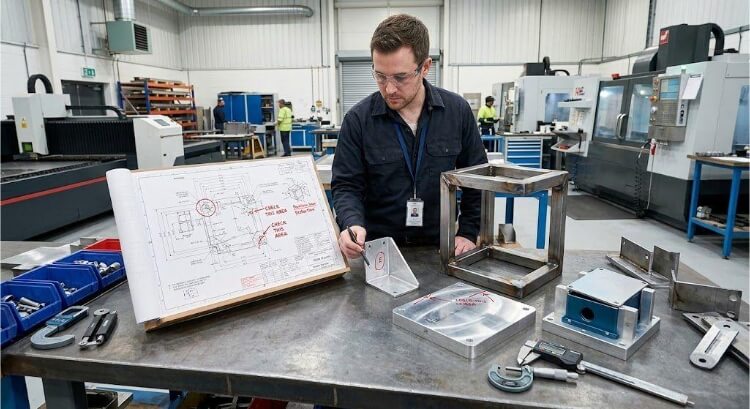
Every accurate quote begins with a precise drawing. When drawings lack details — such as tolerances, bend radii, or surface finish — vendors fill in the blanks in different ways. One may assume ±0.5 mm tolerance, another ±0.1 mm. That small change can double the machining or inspection time.
Adding 3D models, finish standards, and tolerance notes in your RFQ (Request for Quotation) eliminates guesswork. It also shows vendors you’re organized, which often leads to faster responses and fewer clarification emails.
Pro Insight: Typical sheet metal fabrication tolerances range from ±0.1 to ±0.5 mm, depending on process and part size. Defining this early saves time and prevents costly over-precision.
Action Tip: Before sending your RFQ, do a quick drawing audit — check that every part has defined tolerances, material type, and surface callout. Precise data produces fair comparisons.
Influence of Material Selection and Availability
Material choice shapes both cost and manufacturability. If you write “stainless steel,” vendors will make their own choice — 201, 304, or 316. These grades differ in strength, corrosion resistance, and price by up to 30%.
Availability also matters. A vendor with 304 stainless steel in stock may quote a two-day turnaround. Another may need to order it, which would add a week to the schedule.
Action Tip: Always specify exact material grade, thickness, and finish in your RFQ. When comparing quotes, confirm that every vendor is pricing based on the same material source and batch size.
Impact of Production Volume and Repeatability
Production volume defines how vendors approach your job. A single prototype may be laser cut and manually bent, while a batch of 1,000 might justify custom tooling or stamping. Without volume clarity, vendors will assume differently — and their pricing will reflect it.
If one expects repeat orders, they may amortize setup costs and offer a lower unit price. Another may quote everything as a one-time run. Both are logical — just based on different expectations.
Action Tip: In your RFQ, include both the current quantity and your estimated annual demand. This lets vendors optimize between manual and automated setups for the best overall cost.
Differences in Cost Structure Between Vendors
Two vendors can quote completely different prices for the same sheet metal part — and both can be right. The difference lies in how each builds cost from labor, machines, and sourcing strategy.
Labor Rates and Automation Levels
Labor cost varies widely between factories. A vendor relying on skilled manual operators spends more hours per part. A modern facility with automated laser cutters and press brakes finishes faster and with less human error.
Automation improves consistency but adds depreciation and programming cost. Manual work remains cheaper for one-off prototypes or small batches. For medium- or large-scale runs, automation usually lowers total fabrication costs.
Typical Ranges:
| Production Type | Labor Share in Total Cost | Common Scenario |
|---|---|---|
| Manual fabrication | 40–60% | Prototype or low volume |
| Semi-automated | 25–40% | Small-to-medium batch |
| Fully automated | 10–25% | Large-volume or repeat production |
Action Tip: When reviewing a sheet metal quote, ask what percentage of the process is automated. This reveals not only cost efficiency but also repeatability and future scalability.
Machine Setup, Tooling, and Programming Charges
Every production run begins with setup. Vendors calculate these costs differently. Some spread them across the entire batch; others list them separately.
Setup includes fixture alignment, CNC programming, die preparation, and inspection calibration. For instance, a complex part may need 2–3 hours of setup time before cutting even starts. If one vendor quotes setup as a one-time charge and another builds it into the unit price, comparisons can be misleading.
Action Tip: Request a line-item breakdown for setup, tooling, and programming. If you plan future repeat orders, a one-time tooling fee is usually more cost-effective.
Material Markups and Sourcing Strategy
Material cost is another key variable in vendor comparison. Some suppliers maintain bulk inventory and benefit from stable pricing under long-term contracts. Others buy per project, so they pass on market fluctuations directly.
Most add a handling markup for cutting loss and storage — usually 10–25%. A vendor with steady volume may offer lower markups, while smaller shops might charge higher to cover procurement effort.
Action Tip: Ask vendors about their material sourcing policy — do they stock regularly or buy-to-order? This provides insight into both price stability and lead-time reliability.
Process and Equipment Assumptions
Two vendors may quote for the same part but plan to make it using very different machines and methods. These differences — in cutting, bending, or welding — explain why sheet metal quotes vary so widely.
Laser Cutting vs. Turret Punching vs. Stamping
Each cutting process has a unique balance of setup cost and production speed.
- Laser Cutting: Best for prototypes or complex geometries. Minimal setup and high precision (±0.1–0.25 mm), but slower per piece.
- Turret Punching: Faster for repetitive holes or slots. Ideal for medium batches. Accuracy around ±0.2–0.3 mm, but tool changes add time.
- Stamping: Highest efficiency for mass production. After tooling, cycle time can drop below 2 seconds per part, but dies are expensive upfront.
When one vendor assumes stamping, and another assumes laser cutting, a 50% price gap is normal — they’re planning completely different workflows.
Action Tip: Confirm the process listed in every sheet metal quote. Match the chosen method to your batch size and tolerance needs before comparing prices.

Bending Methods
Bending is another primary cost driver. Manual press brakes rely on operator skill and experience with setup. They work well for small batches or unique shapes but have a slower throughput.
Robotic or CNC press brakes use programmed angles and back gauges for speed and consistency. They achieve high repeatability (±0.3° typical) and are suitable for large runs or tight tolerances. However, initial setup takes longer and requires specialized tooling.
Action Tip: Add expected volume and precision level in your RFQ. Vendors will then choose the proper bending setup — saving time, scrap, and unnecessary cost.
Welding and Assembly Techniques and Their Cost Implications
Welding methods vary widely in cost, appearance, and strength:
- TIG Welding: High precision and clean finish, perfect for stainless steel or thin aluminum parts. Slower but cosmetic.
- MIG Welding: Faster and cost-efficient for thicker materials, but usually needs post-weld grinding.
- Spot or Laser Welding: Excellent for sheet-to-sheet joints, ideal for enclosures and brackets.
Assembly adds another layer of complexity. One vendor may use custom fixtures for alignment, while another may weld manually. Fixtures improve consistency but add setup time and cost.
Action Tip: Ask vendors which welding method and fixture setup they plan to use. It helps you compare not just cost but also visual finish, strength, and repeatability.
Quality and Inspection Expectations
Two vendors can quote the same drawing and still plan completely different inspection and quality steps. One might measure every part with advanced tools, while another checks only samples by hand.
Dimensional Tolerance Standards and Measurement Tools
Precision always comes at a cost. For most sheet metal parts, the general tolerance range is ±0.2 mm to ±0.5 mm. When tighter control is required, vendors must slow production, use better jigs, and verify every part.
Measurement tools also change the game. Calipers or height gauges are fine for non-critical parts. But when a vendor uses a CMM (Coordinate Measuring Machine) or laser scanner, inspection time and cost increase.
Example:
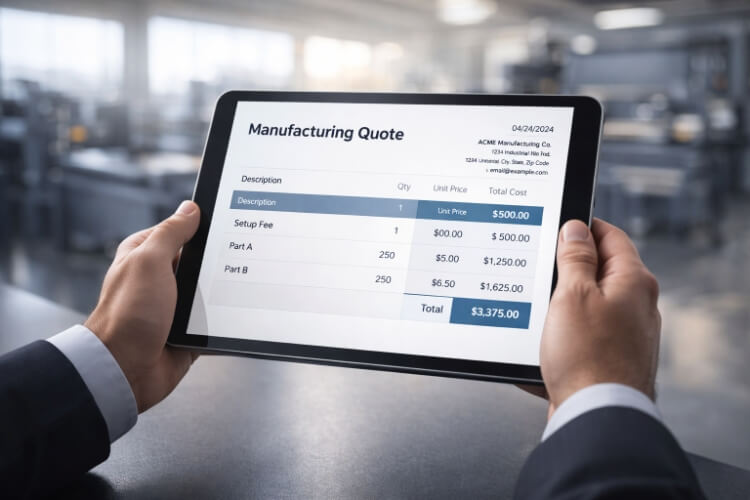
One supplier quotes $50 per part, with a ±0.5 mm tolerance and manual checks. Another quote is $68 per part, with ±0.1 mm tolerance and CMM validation. Both are correct — just built on different inspection assumptions.
Action Tip: Always confirm what tolerance and inspection tools are included in the quote. Align them with your part’s function, not just its drawing.

Surface Finish Requirements and Rework Risks
Surface finishes affect both appearance and corrosion performance. Vendors may assume different finish levels if your RFQ is vague. One may quote for basic deburring; another for complete polishing or powder coating.
High cosmetic standards demand extra labor and higher scrap risk. If rework is needed, costs rise quickly. That’s why finish clarity is critical — define the Ra value, coating type, or color code right on your drawing.
Typical Finish Guidelines:
| Finish Type | Roughness (Ra µm) | Common Use |
|---|---|---|
| Basic deburr | 3.2–6.3 | Internal brackets or hidden parts |
| Brushed finish | 0.8–1.6 | Visible panels and covers |
| Polished or coated | <0.4 | Decorative or medical parts |
Action Tip: Ask vendors if their quote includes rework or cosmetic inspection. Some charge separately, while others include it in base pricing.
Certification, Traceability, and Documentation Costs
If your product requires compliance — ISO, RoHS, or full material traceability — documentation becomes part of the cost. Vendors who maintain certified systems invest in recordkeeping, testing, and audit readiness.
Traceability adds paperwork: batch numbers, inspection reports, and certificates of compliance. These steps don’t affect part geometry but add labor hours that cheaper quotes often exclude.
Action Tip: State your documentation level in the RFQ — “ISO 9001 inspection reports required” or “material certification only.” This ensures quotes reflect the proper scope and avoid unexpected admin fees later.
The Role of Communication and Transparency
A sheet metal quote is only as good as the communication behind it. Most pricing gaps come not from dishonesty but from misunderstanding.
How Misaligned Expectations Lead to Quote Variations?
Many cost discrepancies start with small assumptions. If a drawing lacks finish notes or tolerance ranges, vendors will fill in the blanks on their own. One may design for high-precision cutting; another may plan for quick turnaround. Both are reasonable — just different.
Even simple omissions such as packaging, labeling, or inspection reports can shift costs by 5–10%. Buyers often assume these are standard, but many shops treat them as optional. Clear early discussion removes this uncertainty.
Example: A buyer expected polished stainless enclosures, but the vendor quoted for mill finish. The parts arrived dull — the quote wasn’t wrong; it was just incomplete.
Action Tip: When reviewing quotes, ask vendors to describe their processes in plain language—from material prep to packaging. You’ll quickly see whether their plan matches your expectations.
Importance of Clear Notes, Revisions, and Update Protocols
Designs evolve — and quotes must evolve with them. If one vendor receives the latest revision but another quotes an older version, you’re no longer comparing the same job.
Every drawing should include a revision number, date, and a brief change description. When updates occur, distribute them to all vendors simultaneously and confirm receipt from each vendor. A shared file link or version-controlled folder prevents confusion.
Action Tip: Create an “RFQ version log” listing all revisions and the date each vendor confirmed them. This small habit saves days of back-and-forth later.
Negotiating Assumptions Without Sacrificing Quality
Negotiation should clarify assumptions, not compromise quality. When you see a significant price gap, resist the urge to force a match. Instead, ask how each vendor built their number — what material, tolerance, or inspection scope they used.
Sometimes, reducing cosmetic standards or using stocked materials lowers cost without hurting performance. Other times, the higher quote may reflect better fixture design or consistent CMM inspection. The key is transparency on both sides.
Pro Insight: Vendors respect buyers who discuss trade-offs openly. They’re more likely to offer process improvements or volume discounts when they feel collaboration, not pressure.
Action Tip: Ask vendors, “What changes could reduce cost without affecting function?” You’ll often uncover more innovative fabrication solutions instead of risky shortcuts.
Evaluating and Normalizing Multiple Quotes
When all the sheet metal quotes arrive, it’s tempting to pick the lowest price. But that number alone rarely tells the whole story.
Creating an Apples-to-Apples Comparison Framework
Start with structure. Build a simple table listing the major cost factors—material, process, tooling, inspection, and lead time. Then record what each vendor included. Seeing it side by side immediately highlights hidden gaps.
| Cost Factor | Vendor A | Vendor B | Vendor C |
|---|---|---|---|
| Material | 304 SS | 304 SS | 201 SS |
| Cutting | Laser | Stamping | Laser |
| Finish | Brushed | Mill finish | Brushed |
| Inspection | Sample check | 100% CMM | Sample check |
| Lead time | 7 days | 14 days | 5 days |
In this case, Vendor C’s “cheaper” quote may reflect thinner material and fewer inspection steps—not greater efficiency.
Action Tip: Use a comparison table for every multi-vendor RFQ. Highlight mismatches in red and verify them before you decide.

Identifying Outliers and Hidden Costs
Quotes that sit far above or below the average deserve special attention. An unusually low price often skips steps such as polishing, inspection, or packaging. A higher one might include extra documentation or tighter tolerances.
Shipping, minimum order fees, and special packaging are common hidden costs. If they’re not clearly listed, they can appear later as “extras.”
Pro Insight: True fabrication cost includes more than cutting and bending — logistics, rework risk, and inspection time often add 10–20% beyond the unit price.
Action Tip: When a quote looks off, ask for a detailed cost breakdown. Transparency now saves you the stress of later negotiations.
Using Checklists and RFQ Templates to Align Assumptions
A structured RFQ template turns messy email threads into organized data. Include clear checkboxes for:
- Material grade and thickness
- Finish or coating type
- Quantity and repeat potential
- Tolerance and inspection level
- Documentation and shipping terms
When every vendor answers the same questions, your comparison becomes objective. Over time, you’ll also see patterns — which vendors are consistent, and which tend to underquote or overpromise.
Action Tip: Standardize your RFQ template and keep it under version control. It speeds up vendor onboarding and produces faster, cleaner quotes.
Common Red Flags When Comparing Quotes
Not every low price is a win. Some sheet metal quotes look attractive on paper but hide risks that surface later — from poor material selection to missing finish details. Spotting these red flags early keeps your project on schedule and your budget under control.
Unusually Low Prices With Vague Assumptions
When a quote seems “too good,” pause before celebrating, a vendor may assume cheaper materials, skip inspection steps, or quote looser tolerances to cut costs.
Example: A supplier offered a quote 25% below average — later it turned out they used 201 stainless instead of 304. The parts corroded during field testing, costing more than the price saved.
Low prices aren’t always bad, but they should be backed by clear technical logic. Ask vendors what’s included and how they achieved that number.
Action Tip: Always request a cost breakdown and confirmation of material grade and finish type. Transparency is worth more than a “good deal.”
Missing Details in Material, Process, or Finish
A strong quote lists specifics. A risky one hides behind general terms like “stainless steel,” “standard finish,” or “per customer drawing.” These vague lines often mean the vendor hasn’t thoroughly reviewed your design.
When details are missing, you lose control over what’s actually being made. One supplier’s “standard finish” may be brushed to 1.5 µm, while another’s may be barely deburred.
Action Tip: Treat missing information as a red flag. Return the quote and ask the vendor to fill in every blank — it’s faster to clarify now than to fix parts later.
Lack of Reference Samples or Proven Experience
Reliable vendors show proof of capability — photos, previous projects, or reference samples. Inexperienced ones may avoid sharing because they lack similar work.
Without real examples, you can’t verify their process control or finish quality. This risk increases for cosmetic parts, tight-tolerance enclosures, or assemblies that require alignment.
Pro Insight: Vendors who share case studies or previous production data signal confidence in their quality system. That’s a good sign of reliability.
Action Tip: Before awarding a new supplier, ask for at least one reference sample or photo of a comparable part. Experience is the best quality assurance.
Conclusion
Comparing sheet metal quotes isn’t just about chasing the lowest number — it’s about understanding what’s behind it. Each vendor builds their quotation around unique assumptions on materials, tolerances, and inspection scope. When those details aren’t aligned, prices can differ dramatically.
The smartest buyers treat quoting as part of engineering — not paperwork. Clear RFQs, consistent communication, and structured comparison methods eliminate confusion and reveal actual value. A fair, transparent quoting process not only improves cost control but also strengthens long-term supplier relationships.
Ready to get a quote that actually reflects your design and production goals? Send us your drawings or RFQ today. Our engineers respond within 24 hours with a fully detailed sheet metal quotation that includes process plan, material options, and cost breakdown.
FAQs
Why do two vendors quote drastically different prices for the same part?
Each vendor interprets your RFQ differently. One might include tooling, inspection, or documentation costs; another might skip them. Small changes in tolerance or material grade can create significant price gaps.
How can I ensure all vendors quote under the same conditions?
Use a standardized RFQ format. Include drawings, 3D models, finish requirements, and quantity expectations. When vendors receive identical data, their assumptions — and quotes — stay aligned.
What details should always be included in an RFQ to avoid misunderstandings?
Define the following clearly:
- Material grade and thickness
- Surface finish or coating
- Dimensional tolerances
- Inspection type (sample or 100%)
- Expected volume and repeat frequency
- Packaging, labeling, and delivery terms
Is a lower quote always a better deal in sheet metal fabrication?
Not always. Lower prices can result from weaker materials, loose tolerances, or skipped inspections. The best deal balances cost, quality, and process reliability — not just price.
How often should I verify or update quotation assumptions with vendors?
Every time a drawing, material, or finish changes. For recurring parts, review assumptions every few months to stay aligned with market material costs and supplier capacity.
Hey, I'm Kevin Lee

For the past 10 years, I’ve been immersed in various forms of sheet metal fabrication, sharing cool insights here from my experiences across diverse workshops.
Get in touch
Kevin Lee
I have over ten years of professional experience in sheet metal fabrication, specializing in laser cutting, bending, welding, and surface treatment techniques. As the Technical Director at Shengen, I am committed to solving complex manufacturing challenges and driving innovation and quality in each project.
Related Resource
Fingerprint Resistant Stainless Steel: How It Works,and How to Choose