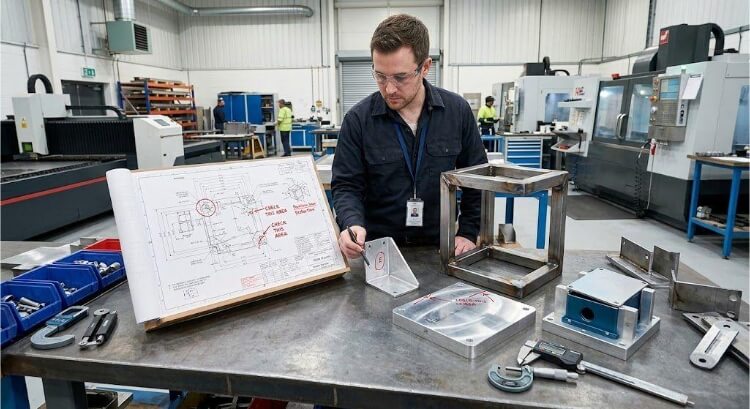
Every engineer knows that no design stays perfect after the prototype. Adjustments are part of the process. However, what many teams overlook is how small design changes can silently inflate project costs and extend delivery times.
A single drawing update can ripple across CAD models, tooling, materials, and schedules, affecting all related components. A change in hole diameter, a repositioning of the flange, or a tweak in thickness—each can halt production lines and restart the entire workflow. In the world of sheet metal fabrication and precision manufacturing, these changes are not just technical—they’re financial.
This article has a clear goal. It explains how design revisions affect both cost and lead time. It also shows practical ways to reduce these effects. The focus is on smart engineering, close teamwork, and clear change control.

The Real Cost of Design Revisions
Behind every drawing update lies a chain of hidden expenses. Understanding these costs helps teams avoid financial waste before a single part is made.
Why Late Changes Cost More?
Timing is everything in manufacturing. A design revision made early costs almost nothing; made late, it can cost everything. This is often described by the 1–10–100 rule:
- Fixing an issue in design costs 1 unit.
- Fixing it in production costs 10 units.
- Fixing it after shipment costs 100 units.
As a project moves forward, each design becomes tied to tooling, material orders, and production schedules. A seemingly small update—say, driving a mounting hole by 3 mm—can invalidate entire toolpaths, inspection programs, or fixtures. If discovered during fabrication, it triggers rework, scrap, and schedule resets.
In real-world sheet metal operations, an unplanned revision can delay a batch of control boxes or machine frames by two to five days, resulting in hundreds of dollars in material and labor waste. Industry studies estimate that over 70% of a product’s total cost is locked in during the design phase, yet most revisions occur after the design freeze—when changes are most expensive.
While revisions are inevitable, late revisions are particularly dangerous. They turn an engineering decision into a production problem.
Hidden and Indirect Costs
Most teams calculate only the direct cost of design changes—such as new tooling, remachining, or scrap. But the indirect costs are where the real damage happens:
- Rework Labor: Operators must halt production, adjust setups, and re-run batches under new parameters.
- Material Waste: Updated drawings often make existing parts obsolete. Even small dimensional updates can render finished parts unusable.
- Inspection & Validation: Each revision requires new measurement programs, updated inspection sheets, and sometimes third-party validation.
- Scheduling Disruption: Revisions often bump other jobs off machines, creating cascading delays across multiple projects.
- Communication Time: Engineers, buyers, and production staff spend hours verifying “which version is correct.”
These soft costs often do not appear in reports, but they silently erode margins. Studies show that unmanaged revisions can consume 20–30% of total engineering hours, thereby reducing the time available for innovation and new product development.
A typical example:
A metal enclosure project needed a 2 mm shift in the connector cutout. The change required regenerating the flat pattern, updating the punching program, and redoing surface finishing. The factory lost one full day of production on that order—and three more days realigning other jobs.
This is how “a simple change” turns into an expensive delay.
How Design Revisions Extend Lead Time?
Every revision delays more than just production—it slows the entire workflow. Learn how a minor design tweak can result in weeks of lost productivity.
Chain Reaction Across the Workflow
In manufacturing, a design revision is rarely isolated—it triggers a domino effect. When a CAD model is updated, it doesn’t just affect the engineer’s screen; it also impacts the entire design process. Procurement, fabrication, assembly, and quality inspection all depend on that same data.
A single change—say, increasing a sheet’s thickness from 1.2 mm to 1.5 mm—means:
- Procurement must requote the new material stock.
- Programming must regenerate cutting and bending parameters.
- Production must adjust press brake setups or tooling clearance to ensure optimal performance.
- Quality control must revise inspection drawings and tolerance checks.
These tasks can’t run in parallel because each depends on the previous step being updated. That sequential lag often adds one to three extra working days per change.
In one case study, a precision fabrication shop found that a single drawing revision required an average of 12 internal communication exchanges before reaching full alignment. Each small delay stacked up to a 30% longer lead time across the project.
Supply Chain Delays and Vendor Dependencies
The ripple continues beyond the factory walls. When the updated drawing reaches suppliers, they must pause and revalidate before proceeding.
For example, changing a surface finish from brushed to powder-coated affects not only the coating vendor’s schedule but also material preparation, masking requirements, and curing time. Likewise, switching from aluminum 5052 to stainless steel 304 may require new tooling and longer lead times from the metal supplier.
Even a minor specification tweak can reset supplier timelines:
- New material quotes (1–2 days)
- Lead time confirmation (1–3 days)
- Sample approval or FAI recheck (1–5 days)
If your product involves multiple outsourced parts—such as sheet metal panels, machined brackets, and fasteners—the compounding effect can easily extend overall delivery by one to two weeks.
Research indicates that 60% of manufacturing delivery delays can be attributed to late-stage design modifications, particularly those affecting purchased components or materials.

Key Factors That Amplify Revision Impact
Some design changes cause minimal disruption, others spiral out of control. These key factors explain why certain revisions become costly bottlenecks.
Lack of Version Control and Communication
When different teams use different file versions, disaster follows. Engineering may be on Revision C, but production might still be building Revision B. The result: rework, wasted parts, and time lost confirming which version is correct.
In smaller operations, file names such as “final_final_v3” or “REV-new” are still commonly used. Without structured version control, such as a Product Data Management (PDM) or cloud-based design system, mistakes are inevitable.
One mid-size metal shop reported losing two full production days when a laser operator cut panels based on an outdated DXF file. That single miscommunication erased the profit margin for the entire job.
Complex Designs and Tight Tolerances
The more complex the part, the harder it is to revise. Tight tolerances and interdependent features magnify every adjustment.
Take a stainless steel chassis with multiple bent flanges and welded inserts. If the bend angle changes by even 0.5°, the flat pattern must be recalculated, press brake programs must be regenerated, and assembly alignment needs to be revalidated.
In high-precision fabrication, adjusting a tolerance by 0.1 mm may trigger an entirely new CMM inspection program. Each of these steps adds hours or days to the process.
Complex designs also create dependency loops; changing one component often forces related assemblies to be updated as well. Without a modular structure or parametric modeling, the revision effort grows exponentially.
Unstandardized Revision Processes
When change management lacks structure, confusion spreads. Some departments may apply revisions immediately; others wait for confirmation. As a result, production proceeds unevenly, and parts produced under mixed revisions often can’t be assembled.
Without a clear Engineering Change Order (ECO) process, revisions often become a matter of guesswork. Teams spend time asking, “Has this been approved?” or “Which version should we use?” This lack of synchronization can quietly waste 5–10% of total lead time per project.
A well-defined ECO system sets a clear sequence:
- Change request submission
- Impact analysis (cost, tooling, schedule)
- Approval and release
- Controlled implementation
Strategies to Reduce the Cost and Time Impact
Design revisions will always exist—but how your team manages them determines whether they cause chaos or improvement. With the right tools, workflows, and mindset, revisions can become faster, cheaper, and even a source of product optimization rather than disruption.
Below are four proven strategies that help engineering and manufacturing teams cut revision costs and maintain delivery schedules.
1. Adopt Parametric and Modular Design
The fastest way to simplify revisions is through parametric design. Instead of redrawing each feature manually, engineers define relationships—so when one parameter changes, the rest update automatically.
For example, increasing a sheet metal enclosure’s width from 200 mm to 220 mm would automatically adjust hole spacing, flange lengths, and mounting tabs. There’s no need to rebuild the model from scratch.
Paired with modular design, this approach gives even greater flexibility. If a product consists of standardized modules—such as panels, doors, or brackets—engineers can modify or replace a single section without disrupting the entire assembly.
Result: Reduces engineering rework time by 40–60% and ensures consistent geometry across revisions.
In practical terms, parametric and modular methods also improve data integrity—every downstream process (laser cutting, bending, assembly) receives an automatically updated drawing, reducing manual errors and maintaining alignment across teams.
2. Implement Controlled Change Management (ECN / ECO)
Many factories treat design changes informally, often relying on a few emails, verbal approvals, or shared files. This works until one mistake costs an entire production lot. A formal Engineering Change Notification (ECN) or Engineering Change Order (ECO) system prevents this by enforcing a clear, trackable workflow.
A robust ECO system should include:
- Request: An engineer or client identifies the need for a change.
- Assessment: Teams evaluate the impact of their cost, tooling, and materials.
- Approval: Quality and management confirm the revision.
- Implementation: The production floor receives only the approved version.
Such systems don’t just improve traceability—they prevent chaos. Every department sees the same data, in the same order, with the same revision code.
Impact: Structured ECO workflows reduce communication errors by up to 75%, according to PLM software case studies.
Even a spreadsheet-based ECO log or shared folder with naming rules (“Part123_RevC_Approved”) is better than no structure at all. What matters is discipline—consistent documentation and version accountability.
3. Improve Cross-Team Collaboration
Most revision delays are caused not by design complexity, but by information lag between departments. Engineering finalizes a file, but procurement or production doesn’t see the update until days later.
To address this, consider shifting to real-time collaboration platforms. Cloud-based CAD or Product Lifecycle Management (PLM) systems allow every team to access synchronized data instantly. When an engineer updates a model, the change propagates across purchasing, fabrication, and inspection teams in minutes—not days.
This approach is especially valuable for multi-site operations or suppliers abroad. Instead of emailing static PDFs, everyone references a single “source of truth.”
🔧 Example: A fabrication team using real-time CAD collaboration reduced revision miscommunication incidents by 60% in six months.
Regular design review meetings further accelerate decisions. Weekly 15-minute “change syncs” between engineering, QA, and purchasing teams prevent misunderstandings and eliminate redundant approval cycles.
4. Use Design Automation and DFM Tools
Automation streamlines repetitive engineering tasks, enhancing consistency. Design automation tools can automatically generate variations of a design—such as enclosures with different sizes or mounting hole layouts—based on preset rules.
Equally important are Design for Manufacturability (DFM) checks. Automated DFM software scans models for issues like bend relief violations, hole-to-edge distance errors, or impossible tolerances. Detecting these problems before production prevents costly revisions later.
Result: Manufacturers using design automation report 25–50% faster design cycles and a major drop in late-stage revisions.
By combining automation and DFM, teams transition from a reactive to a preventive approach. Instead of discovering problems during fabrication, they fix them while still in the CAD environment.

Engineering and Procurement Synergy
When engineers and buyers collaborate early, revisions drop dramatically. Discover how supplier involvement turns potential setbacks into smoother, faster production.
Early Supplier Involvement (ESI)
Suppliers often see production challenges that engineers overlook. By inviting them into design discussions early, you gain practical insights that reduce the need for revisions later.
For instance, a supplier might recommend:
- Using standard hole diameters to fit existing punch tooling.
- Selecting a bend radius compatible with available press brake dies.
- Replacing a custom fastener with a standard off-the-shelf type.
These small adjustments can eliminate downstream changes.
Data insight: Manufacturers who involve suppliers early report 15–25% shorter lead times and 30% fewer mid-production revisions.
Early supplier input also clarifies tolerance expectations and achievable finishes, ensuring that drawings reflect real production capability—not idealized designs that cause frustration later.
Material Availability and Procurement Integration
Many design revisions are driven not by geometry, but by the availability of materials. A design might specify aluminum 6061-T6, but if the supplier only has 5052-H32 available, the project stalls.
Integrating procurement during design reviews avoids this problem. Procurement teams can flag long-lead or single-source materials early and suggest alternatives that strike a balance between performance and delivery reliability.
Tip: Always verify raw material stock levels before finalizing design revisions. A one-day design decision can save a week of supply delay.
By aligning material planning with design decisions, teams build resilience into production schedules—ensuring revisions don’t turn into bottlenecks.
Conclusion
Design revisions are inevitable, but inefficiency is not. Without structure, every modification becomes a source of cost overruns and delivery delays. But with parametric modeling, ECO workflows, and collaborative design platforms, revisions can be managed swiftly and accurately.
Design changes are inevitable—but costly delays aren’t. Our engineering team helps manufacturers simplify revision workflows, reduce rework, and speed up production with practical DFM insights and digital solutions. Upload your drawings or share your design challenges, and we’ll provide a free manufacturability review within 24 hours.
FAQs
When is the best time to make design changes?
During the early design and prototyping phase, before any tooling or material orders are finalized. Early revisions are faster, cheaper, and less disruptive.
How can manufacturers prevent rework caused by revisions?
By implementing formal ECO systems, using parametric CAD models, and enforcing a single digital “source of truth” across engineering and production teams.
Do automated tools truly save costs in small shops?
Yes. Even small-scale manufacturers can benefit from automation and DFM tools that detect design errors early. The reduction in rework and wasted material quickly offsets software costs.
What role do suppliers play in revision control?
Suppliers often identify manufacturability issues before they become production problems. Early Supplier Involvement (ESI) ensures that materials, tooling, and tolerances align with real-world capability.
Hey, I'm Kevin Lee

For the past 10 years, I’ve been immersed in various forms of sheet metal fabrication, sharing cool insights here from my experiences across diverse workshops.
Get in touch
Kevin Lee
I have over ten years of professional experience in sheet metal fabrication, specializing in laser cutting, bending, welding, and surface treatment techniques. As the Technical Director at Shengen, I am committed to solving complex manufacturing challenges and driving innovation and quality in each project.
Related Resource
Fingerprint Resistant Stainless Steel: How It Works,and How to Choose