Wanneer plaatmetalen onderdelen worden gevormd, zoals buigen, stampen of trekken, blijven ze zelden perfect vlak. Inwendige spanningen bouwen zich op en het metaal kan kromtrekken, verdraaien of iets uit het vlak buigen. Deze vervormingen lijken misschien klein, maar kunnen later ernstige uitlijnings- en assemblageproblemen veroorzaken.
Afvlakken en richten zijn de corrigerende stappen die de maatnauwkeurigheid herstellen. Ze zorgen ervoor dat het onderdeel voldoet aan de ontwerptoleranties en naar verwachting presteert bij het lassen, passen of monteren. In moderne productieprocessen zijn deze processen net zo belangrijk als het vormen zelf, omdat zelfs het beste ontwerp mislukt als het onderdeel niet past zoals bedoeld.

Waarom vlakheid belangrijk is bij nabewerkingen?
Vlakheid is niet alleen een kwestie van uiterlijk, het is een functionele vereiste die invloed heeft op hoe goed onderdelen passen, afdichten en belasting dragen. Een kromme afdekplaat kan leiden tot ongelijkmatige schroefspanning, waterlekkage of verkeerd uitgelijnde elektrische connectoren.
Typische tolerantieverwachtingen laten zien hoe kritisch deze controle is:
| Toepassing | Typische vlakheidstolerantie |
|---|---|
| Algemene plaatwerksamenstellingen | ± 0,3 - 0,5 mm per 1000 mm |
| Precisiemachinepanelen | ± 0,1 - 0,2 mm per 1000 mm |
| Zeer nauwkeurige componenten (optisch, medisch) | ≤ ± 0,05 mm |
Als je deze grenzen aanhoudt, voorkom je stroomafwaartse problemen - minder handmatig opnieuw uitlijnen, minder lekken en snellere montage. Vlakheid verbetert ook de hechting van coatings en vermindert stress tijdens het lassen. Kortom, consistente vlakheid staat gelijk aan voorspelbare prestaties.
Bronnen van vervorming in plaatmetaal
Vervorming ontstaat niet zomaar; het is een fysiek gevolg van ongelijke spanning over het oppervlak of de dikte van het metaal. Twee belangrijke categorieën veroorzaken de meeste vlakheidsproblemen na het vormen: procesgestuurde spanning en materiaalgestuurde factoren.
Procesgestuurde stress
Elke productiestap verandert de interne balans van het materiaal.
- Thermische processen zoals laser- of plasmasnijden plaatselijke verhittingszones introduceren. Wanneer deze ongelijkmatig afkoelen, vormt zich restspanning langs de snijranden.
- Mechanisch vormen-buigen, stempelen, diepe tekening-rekt de ene kant van de plaat uit en drukt de andere kant samen. Wanneer deze onbalans wordt losgelaten, ontstaat terugvering of omkrullen.
- Inrichting Als een plaat niet gelijkmatig wordt ondersteund, kan de zwaartekracht of klemkracht een permanente vervorming achterlaten.
Een roestvast stalen paneel van 1,5 mm dat in de walsrichting is gebogen, kan bijvoorbeeld tot 0,2 mm vertonen. springrug tenzij gecompenseerd door gereedschapontwerp of nivellering achteraf. Het beheersen van de procesvolgorde en de vervormingsenergie helpt deze spanningsverschillen te verminderen.
Materiaal-gedreven factoren
De geschiedenis van een plaat - hoe hij werd gewalst, opgerold en opgeslagen - heeft een directe invloed op hoe hij zich gedraagt tijdens het vervormen.
- Restspanning door rollen rollen: Wanneer een rol wordt afgerold, zetten de buitenste lagen meer uit dan de binnenste lagen, waardoor de spanning ongelijkmatig wordt afgevoerd.
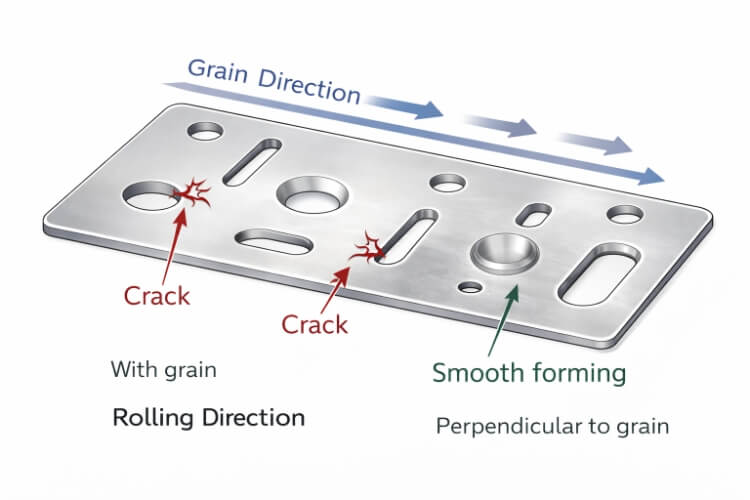
- Korrelrichting: Metalen hebben richtingsgevoeligheid; vervormen dwars op de korrel leidt vaak tot een minder voorspelbare terugvering.
- Dikte- en hardheidsvariaties: Zelfs kleine veranderingen kunnen de elastische herstelsnelheden veranderen, waardoor een ongelijkmatige spanning over het oppervlak ontstaat.
Hoge-sterktestalen hebben de neiging om vervorming tegen te gaan maar slaan meer energie op, waardoor ze later moeilijker te nivelleren zijn. Zachtere materialen zoals aluminium vervormen daarentegen gemakkelijk maar kunnen doorbuigen of golven door hun lagere stijfheid. Door dit gedrag vroegtijdig te herkennen, kunnen ingenieurs de juiste nivellerings- of spanningsverlichtingsstappen plannen voor het uiteindelijke vervormen.
Gebruikelijke methoden voor afvlakken en rechttrekken
Als een metalen onderdeel eenmaal gevormd is, wordt het herstellen van de vlakheid een balans tussen spanningsherverdeling en procesefficiëntie. Verschillende technieken bieden verschillende niveaus van precisie, snelheid en kosteneffectiviteit.
Handmatige en mechanische technieken
Handmatig richten blijft een praktische keuze voor prototypes, reparatiewerk en kleine series. Het is gebaseerd op het uitoefenen van plaatselijke kracht om kromtrekken of verdraaiing tegen te gaan.
- Hamer of moker correctie: Bekwame operators identificeren hoge plekken met behulp van rechte tanden of lichtreflectie en passen dan zachte, gecontroleerde slagen toe om specifieke gebieden te rekken of te comprimeren.
- Druk op rechtzetten: Een mechanische of hydraulische pers oefent een gelijkmatige kracht uit met behulp van vlakke matrijzen of platen, waardoor een betere consistentie wordt bereikt voor middelgrote onderdelen.
- Flame straightening: Er wordt selectief warmte toegepast op convexe gebieden, waardoor ze bij afkoeling samentrekken en de plaat platter wordt. Deze methode is geschikt voor dikkere secties, maar moet zorgvuldig worden uitgevoerd om overharding of verkleuring te voorkomen.
Hoewel deze handmatige benaderingen effectief zijn voor unieke of onregelmatige onderdelen, zijn ze sterk afhankelijk van de ervaring van de technicus. Ze bieden flexibiliteit, maar zijn tijdrovend en moeilijk precies te herhalen in omgevingen met hoge volumes.
Rolnivellering
Nivelleren met rollen is de meest gebruikte industriële methode om vervorming na het vervormen te corrigeren. Het proces voert de plaat door een reeks offsetrollen die afwisselend boven en onder het metaaloppervlak zijn geplaatst.
Elke rol buigt de plaat lichtjes in de tegenovergestelde richting, waardoor een opeenvolging van kleine, gecontroleerde doorbuigingen ontstaat. Deze afwisselende spanning en compressie herverdeelt de interne spanning gelijkmatig over de dikte van het materiaal.
De belangrijkste variabelen zijn:
- Aantal rollen en afstand tussen de rollen: Meer rollen (meestal 17-21) zorgen voor een gelijkmatigere spanningsverdeling.
- Penetratiediepte: Bepaalt de mate van plastische vervorming voor afvlakken.
- Lijnspanning: Houdt het vel stabiel en voorkomt terugslag tijdens de verwerking.
Een goed afgestelde waterpasrol kan de afwijking in vlakheid verminderen tot ±0,1 mm op materialen van 0,5-3 mm dik. Voor grotere platen kan voor het vormen een nivelleerstap worden toegepast om het spoelgeheugen te elimineren.
Nivelleren met rollen herstelt niet alleen de vlakheid, maar verbetert ook de balans tussen restspanning en vermindert toekomstige vervorming tijdens het lassen of poedercoaten. Het is zeer herhaalbaar en geschikt voor geautomatiseerde productielijnen waar consistentie het belangrijkst is.
Precisie nivelleermachines
Precisie nivellering gaat nog een stap verder in nauwkeurigheid. Deze systemen combineren servogestuurde rollen, lastsensoren en feedback met gesloten lus om nauwkeurige, herhaalbare resultaten te leveren.
In tegenstelling tot standaard rolnivelleermachines controleren precisiemodellen continu de druk en doorbuiging van de rollen tijdens de verwerking. Ze passen de instelling automatisch aan om materiaalvariaties te compenseren, zodat elk vel de lijn binnen de tolerantie verlaat.
Deze methode is ideaal voor:
- Hoogwaardige componenten zoals medische behuizingen, beugels voor de ruimtevaart of optische frames.
- Dunne of kwetsbare materialen waar kleine rolsporen of overbuiging moeten worden vermeden.
- Productie waarvoor gedocumenteerde vlakheidsgegevens nodig zijnVaak onder ISO 9001- of PPAP-controle.
Overzicht vergelijking
| Methode | Precisieniveau | Typische toepassing | Voordelen | Beperkingen |
|---|---|---|---|---|
| Handmatig rechttrekken | ±0,3-0,5 mm | Prototypes, reparaties | Flexibel, lage installatiekosten | Traag, afhankelijk van operator |
| Rechtdrukken | ±0,2-0,3 mm | Medium onderdelen | Eenvoudig gereedschap, uniforme druk | Beperkt voor dunne platen |
| Nivelleren met rollen | ±0,1 mm | Massaproductie | Snel, consistent, goede stressverlichting | Investering in apparatuur |
| Nivellering met precisie | ≤ ±0,05 mm | Hoogwaardige assemblages | Hoogste herhaalbaarheid, gedocumenteerde resultaten | Geavanceerd besturingssysteem vereist |
De juiste methode kiezen
Bij het selecteren van het juiste vlakdrukproces gaat het niet alleen om de mogelijkheden van de machine, maar ook om het afstemmen van technische vereisten, materiaalgedrag en kostendoelstellingen.
Op materiaalsoort
Verschillende metalen reageren uniek op mechanische spanning:
- Aluminium: Door de lage stijfheid en hoge vervormbaarheid is het gemakkelijk te nivelleren, maar is het gevoelig voor deuken in het oppervlak. Gebruik een minimale walsdruk en meerdere lagen.
- Roestvrij staal: Taai en elastisch; vereist diepere rollerpenetratie en hogere spanning.
- Hoogwaardig staal: Slaat een hoge interne energie op; heeft precisieregeling nodig om terugvering na het nivelleren te voorkomen.
Als de vloeigrens en vervormbaarheid bekend zijn, kunnen de nivelleringsparameters geoptimaliseerd worden om consistente resultaten te bereiken zonder het materiaal te overbewerken.
Op deelgeometrie
Vlakke panelen zijn eenvoudig, maar gevormde schalen, flenzen of beugels moeten vaak plaatselijk worden gecorrigeerd. Het te hoog nivelleren van dergelijke onderdelen kan buighoeken of maatintenties vervormen.
Voor complexe onderdelen kunnen technici een hybride aanpak gebruiken: handmatig richten voor kritieke zones en nivelleren met lichte rollen voor globale vlakheid. Deze gerichte methode zorgt voor nauwkeurige montagevlakken zonder de rest van de vorm aan te tasten.
Door Productievolume en Kosten
Proceskeuze komt vaak neer op doorvoer versus precisie.
| Productieschaal | Aanbevolen proces | Belangrijkste voordeel |
|---|---|---|
| Prototype / herbewerking | Handmatig of met een pers rechtmaken | Snelle installatie, geen gereedschapskosten |
| Kleine partij | Hybride handmatig + nivelleren met rollen | Uitgebalanceerde kosten en consistentie |
| Massaproductie | Geautomatiseerde rol of precisienivelleermachine | Hoge snelheid, herhaalbare vlakheid |
Door bijvoorbeeld over te schakelen van handmatige correctie op automatisch nivelleren van rollen kan de nabewerkingstijd met wel 30% worden teruggebracht bij de productie van middelgrote volumes plaatmetaal.
Bij Shengen evalueren we de geometrie, het materiaal en de assemblagetolerantie van elk onderdeel voordat we een vlakdrukstrategie aanbevelen, zodat het eindproduct zowel aan technische als economische doelstellingen voldoet.
Meten en controleren van vlakheid
Zelfs het beste nivelleringsproces betekent weinig zonder nauwkeurige verificatie. Het meten van de vlakheid zorgt ervoor dat elke plaat voldoet aan de tolerantiedoelen en dat het proces in de loop der tijd stabiel blijft.
Definities en normen voor vlakheid
Vlakheid beschrijft hoeveel een oppervlak afwijkt van een perfect geometrisch vlak. In productietermen is het de maximale verticale afstand tussen de hoogste en laagste oppervlaktepunten.
Internationale normen geven duidelijke criteria voor hoe vlakheid gemeten moet worden:
| Standaard | Toepassingsgebied | Definitie vlakheid |
|---|---|---|
| ISO 1101 | Geometrische productspecificaties | Definieert tolerantiezones voor vlakheid met behulp van parallelle vlakken |
| DIN ISO 2768 | Algemene toleranties voor gefabriceerde onderdelen | Specificeert vlakheid op basis van materiaaldikte en onderdeelgrootte |
| ASTM A480 | Gewalst plat roestvrij staal | Geeft vlakheidslimieten voor coil- en plaatproducten |
Tolerantie op vlakheid varieert sterk per industrie en dikte. Een stalen paneel van 2 mm dik voor algemene fabricage kan bijvoorbeeld ±0,3 mm per 1000 mm toelaten, terwijl een elektronisch precisiechassis ≤±0,05 mm kan vereisen.
Testen worden meestal uitgevoerd onder neutrale steun en stabiele temperatuuromstandigheden (20 °C ± 2 °C) om invloeden van buitenaf, zoals zwaartekracht of warmte-uitzetting, te elimineren.
Technieken voor vlakheidsmeting
Verschillende inspectietools zijn geschikt voor verschillende nauwkeurigheidsniveaus en productiescenario's. Hieronder volgt een overzicht van de meest gebruikte technieken.
| Methode | Nauwkeurigheid | Typisch gebruik | Voordelen | Beperkingen |
|---|---|---|---|---|
| Oppervlakteplaat + voelermaat | ±0,2-0,5 mm | Snel prototype of reparatie controleren | Eenvoudig, lage kosten | Handmatig, lage herhaalbaarheid |
| Meetklok of hoogtemeter | ±0,1-0,2 mm | Steekproefsgewijze controle van kleine of middelgrote onderdelen | Gebruiksvriendelijk | Stabiele bevestiging vereist |
| Laserscanner / gestructureerd-lichtsysteem | ±0,02-0,05 mm | Middelgrote tot grote panelen | Snel, visueel in kaart brengen | Gevoelig voor oppervlakreflectie |
| CMM (coördinatenmeetmachine) | ±0,01 mm | Zeer nauwkeurige assemblages | Hoogste nauwkeurigheid, volledige 3D-gegevens | Langzaam, duur |
| In-line sensoren (geïntegreerd in leveler) | ±0,05-0,1 mm | Continue productie | Real-time bewaking | Automatisering instellen vereist |
Laserscannen en CMM-systemen worden steeds populairder omdat ze visuele afwijkingskaarten leveren, waardoor het eenvoudig is om in één oogopslag hoge en lage zones te zien. Veel werkplaatsen exporteren deze gegevens direct naar CAD vergelijkingsrapporten voor traceerbaarheid.
Metingen integreren met procesbesturing
Verificatie moet niet stoppen bij inspectie, maar moet verbetering stimuleren. Toonaangevende fabrikanten gebruiken Statistical Process Control (SPC) om de variatie in vlakheid in realtime te controleren.
Bijvoorbeeld:
- Trendbewaking: Als de afwijking in vlakheid geleidelijk toeneemt na elke 200 vellen, kan dit duiden op rollenslijtage of vervuiling.
- Capaciteitsindices: Een proces met Cp ≥ 1,33 of Cpk ≥ 1,0 wordt beschouwd als in staat om de vlakheid binnen de tolerantie te houden.
- Traceerbaarheid van gegevens: Automatisch gelogde gegevens ondersteunen de documentatievereisten van ISO 9001 en PPAP.
Bij Shengen zijn real-time SPC en geautomatiseerde meetfeedback geïntegreerd in onze productielijnen. Dit zorgt ervoor dat elk lot voldoet aan de gedefinieerde Cp/Cpk-doelstellingen en minimaliseert het risico op ongeplande herbewerking.
Praktische tips voor betere vlakheidscontrole
Afvlakken is van vitaal belang om de nauwkeurigheid te herstellen, maar de beste fabrikanten denken één stap vooruit - ze voorkomen vervorming voordat die optreedt. Door de spanning tijdens het ontwerpen, vormen en verwerken onder controle te houden, vermindert u nabewerkingen, verbetert u de processtabiliteit en zorgt u voor een consistente kwaliteit.
Minimaliseer vervorming tijdens het vormen
Vormmethodes zoals buigen, stampen en lasersnijden zijn de belangrijkste bronnen van restspanning. Om vervorming vanaf het begin te verminderen:
- Snijparameters optimaliseren: Stel het juiste laservermogen en de juiste voedingssnelheid in om oververhitting of ongelijkmatige inkrimping van de randen te voorkomen.
- Zorg voor uniforme ondersteuning: Gebruik gelijkmatig verdeelde klemming en fixatie om plaatselijke vervorming te voorkomen.
- Balansvormende reeks: Voer bewerkingen indien mogelijk symmetrisch uit om de spanning gelijkmatig te verdelen.
- Vermijd overmatige buigbelasting: Vergroot waar mogelijk de buigradius iets; scherpe bochten houden spanning vast die moeilijk te verlichten is.
Een goed geplande bekistingsopstelling kan de behoefte aan nivellering tot 25% verminderen, wat zowel tijd als kosten bespaart tijdens de assemblage.
Stress-Relief ontharden combineren met mechanisch nivelleren
Bij materialen als roestvast staal, titanium en legeringen met hoge sterkte kan er zelfs na het nivelleren nog interne spanning aanwezig zijn. De combinatie van spanningsarm gloeien bij lage temperatuur (meestal 150-250 °C) en nivelleren levert stabielere resultaten op lange termijn op.
Dit proces ontspant de opgesloten dislocaties in de microstructuur van het metaal en vermindert de opgeslagen elastische energie. Na de warmtebehandeling herverdeelt het nivelleren met precisierollen de resterende onbalans, waardoor de plaat zowel vlak als spanningsvrij blijft.
Bij Shengen wordt deze dubbele benadering vaak toegepast vóór het lassen of coaten om nieuwe kromtrekking tijdens thermische cycli te voorkomen.
Apparatuur en kalibratie onderhouden
Zelfs de beste nivelleermachine kan geen precisie leveren zonder goed onderhoud. Rollenslijtage, vuil en uitlijnfouten kunnen de prestaties geleidelijk verminderen.
- Inspecteer de rollen regelmatig: Krassen op het oppervlak, residu of ongelijke druklijnen kunnen sporen of ongelijkmatige spanning achterlaten.
- Hercalibreer de penetratie-instellingen: Controleer elke dienst voor werk met hoge toleranties; zelfs een afwijking van 0,05 mm kan de vlakheid beïnvloeden.
- Houd rollen en geleiders schoon: Stof of metaalschilfers tussen de rollen veroorzaken microdeukjes en een verkeerde uitlijning.
Consequent onderhoud verbetert de herhaalbaarheid van processen en vermindert stilstand. Een schone, gekalibreerde machine verlengt ook de levensduur van de rollen en minimaliseert materiaalverspilling.
Veelvoorkomende oorzaken en preventieve acties
| Vervorming Oorzaak | Wanneer het gebeurt | Aanbevolen preventie |
|---|---|---|
| Ongelijkmatige warmte-invoer | Laser- of plasmasnijden | Optimaliseer vermogen, zorg voor gelijkmatige koeling |
| Ongelijkmatig klemmen | Buigen of drukken | Balanceer armaturen, gebruik de juiste uitlijning |
| Rolspanning | Vel van rol | Voornivelleren voor het snijden |
| Overvormen of opnieuw buigen | Tijdens het vormen | Gebruik grotere buigradii, beperk de rek |
| Vuile of versleten rollers | Tijdens het nivelleren | Apparatuur regelmatig reinigen en kalibreren |
Tip: Behandel elke plaat als onderdeel van een gecontroleerd systeem - de vlakheid ervan hangt af van hoe elk upstreamproces bijdraagt aan de spanningsbalans.
Conclusie
Controle op vlakheid is meer dan een nabewerking - het is de basis van precisie plaatbewerking. Vervorming is onvermijdelijk na het vervormen, maar goed vlak en recht maken herstelt de maatnauwkeurigheid, verbetert de laskwaliteit en zorgt ervoor dat onderdelen perfect passen tijdens assemblage.
Van handmatige correctie voor prototypes tot nauwkeurig nivelleren voor massaproductie, de sleutel is het begrijpen van materiaalgedrag, het controleren van spanning en het verifiëren van resultaten. Bij Shengen integreren we vlakmaken, inspectie en procesbewaking in één gesloten lus, waardoor onze wereldwijde klanten elke keer weer betrouwbare vlakheid en herhaalbare kwaliteit krijgen.
Wilt u de vlakheid van uw op maat gemaakte plaatwerkonderdelen verbeteren? Het ingenieursteam van Shengen biedt DFM-reviews, nivellering van monsters en geavanceerde kwaliteitscontrole om u te helpen nauwere toleranties en soepelere assemblage te bereiken. Neem vandaag nog contact met ons op om je volgende project te bespreken.
Hey, ik ben Kevin Lee

De afgelopen 10 jaar heb ik me verdiept in verschillende vormen van plaatbewerking en ik deel hier de coole inzichten die ik heb opgedaan in verschillende werkplaatsen.
Neem contact op
Kevin Lee
Ik heb meer dan tien jaar professionele ervaring in plaatbewerking, gespecialiseerd in lasersnijden, buigen, lassen en oppervlaktebehandelingstechnieken. Als technisch directeur bij Shengen zet ik me in om complexe productie-uitdagingen op te lossen en innovatie en kwaliteit in elk project te stimuleren.
Verwante bron
Vingerafdrukbestendig roestvrij staal: hoe het werkt en hoe te kiezen
OEM vs Loonproductie: Hoe het juiste model voor uw project te kiezen
Setupkosten vs eenheidskosten bij de productie van plaatmetaal